
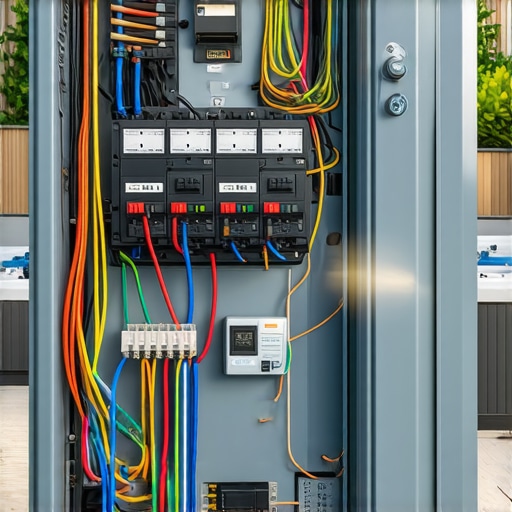
The Silent Screams of a 100-Amp Service
You see a $7,000 fiberglass oasis with pulsating jets and LED waterfalls. I see a 50-amp continuous load that’s about to turn your 1974 Zinsco panel into a space heater. In thirty-five years of residential forensics, I’ve seen more ‘dream backyards’ turned into charred skeletons because a homeowner—or worse, a cut-rate ‘handyman’—thought they could just double-tap a breaker and call it a day. Electricity isn’t a hobby, and water-filled vessels are the last place you want to play ‘guess the wire gauge.’ When you click that pump on, you aren’t just moving water; you’re demanding a massive, sustained migration of electrons that will find every weak point in your home’s infrastructure.
My old mentor, a man who smelled exclusively of pipe tobacco and 10-gauge insulation, used to grab my wrist if he saw me tightening a lug without a torque wrench. ‘If that screw doesn’t fight you back, kid, the house is going to fight the fire department later,’ he’d growl. He was obsessed with the physics of the connection. He taught me that a ‘soft’ lug is actually an oxidation layer acting like a sponge for heat. That lesson saved lives. When we talk about swimming pool bonding or hot tub circuits, we aren’t talking about convenience; we’re talking about preventing your body from becoming the shortest path to ground.
The Math of Misery: Why Your Breaker Trips
Most mid-century homes were built for a 100-amp or 125-amp total service. In the 70s, your biggest draws were a fridge and maybe a window A/C unit. Today, you’re trying to run a data center power setup, a 50-amp EV charger, and now a 12,000-watt heater for your soak. Something has to give. This is where we look at Ohm’s Law and the 80% rule. Under the National Electrical Code (NEC), a hot tub is considered a continuous load because it runs for more than three hours.
“Continuous load: A load where the maximum current is expected to continue for 3 hours or more.” – NEC Article 100
If your hot tub pulls 40 amps, you can’t just put it on a 40-amp breaker. You need to size the circuit at 125% of the load. That’s 50 amps. Now, look at your main breaker. If you have 100-amp service and you’re already pulling 60 amps for your stove, dryer, and lights, you’ve hit the ceiling. This is why an electrical panel upgrade isn’t an ‘upsell’; it’s the physical requirement of modern life. Without it, you’re inviting Cold Creep—the process where aluminum or even poorly torqued copper expands and contracts until the connection loosens, creates resistance, and eventually glows cherry red. I’ve pulled my Wiggy out of my bag at enough storm damage electrical repair calls to know that heat is the enemy that never sleeps.
Component Zooming: The Equipotential Bonding Grid
One area where ‘weekend warriors’ fail is swimming pool bonding and hot tub grounding. They aren’t the same thing. Grounding is for the equipment; bonding is for the people. We’re creating an equipotential plane so that the metal ladder, the water, and the pump motor casing are all at the exact same electrical potential. If they aren’t, and there’s a voltage differential, you become the bridge. You don’t want to be the bridge.
When we do a rough-in for a hot tub, we’re looking at the home run—the direct line from the panel to the disconnect. We use Romex inside, but once we head outside, we’re switching to THWN-2 in conduit. I’ve seen guys use Monkey Shit (duct seal) to try and waterproof a ‘Widow Maker’ connection that shouldn’t have been there in the first place. If I catch a tick tracer lighting up near the water’s edge because someone didn’t use a proper GFCI-protected disconnect within sight of the tub, I’m shutting the whole job down. Safety is non-negotiable.
The Infrastructure Reality: FPE and Zinsco Hazards
If your home was built between 1960 and 1980, you might be sitting on a time bomb: Federal Pacific Electric (FPE) or Zinsco panels. These are the pariahs of the electrical world. The FPE Stab-Lok breakers are notorious for ‘jamming.’ They won’t trip even when the wire is melting the bus bar. If you’re adding a high-amperage load like a hot tub or an RV hookup installation, and you see that red stripe on an FPE breaker, stop. Do not pass go.
“The failure of a circuit breaker to trip under overload conditions can lead to catastrophic insulation failure and fire.” – NFPA 70E
We often see these issues when homeowners try to DIY their recessed lighting installation or pathway lighting install and realize they have no more ‘spaces’ in the panel. They start using ‘cheater’ or ‘tandem’ breakers, which increases the heat density on the bus bar. Before you even think about Christmas light services or up lighting services, you need to know if your main lugs can handle the heat. Transitioning to a modern 200-amp square-D or Eaton panel isn’t just about the hot tub; it’s about ensuring safe and efficient EV charging station setup at home and future-proofing your property.
Step-by-Step: How We Calculate Your Load
1. **Inventory the Existing Load:** We use the ‘Standard Calculation’ from NEC Article 220. We take the square footage of the home (3 volt-amperes per sq. ft.), add the small appliance circuits (1,500 VA each), and the laundry circuit.
2. **Add Fixed Appliances:** The nameplate rating of your dishwasher, disposal, and water heater.
3. **Apply Demand Factors:** We don’t assume everything is on at once, but we have to be realistic.
4. **The Big Hitters:** We add the smart thermostat wiring controlled HVAC systems and the hot tub at 125%.
5. **Total and Divide:** We divide the total VA by 240 volts to get the total amperage requirement. If that number is over 80% of your main breaker’s rating, it’s time for a ‘Heavy-Up.’
If you’re unsure, it’s better to ask an expert than to smell the ozone of a failing main. You can contact us for a full load calculation. Whether you’re doing a data center power setup in your garage or just want lighting installations made easy, the math never lies. For more on high-draw maintenance, check out our top EV charger maintenance tips to see how sustained loads affect your equipment over time. Don’t let your relaxation be interrupted by a storm damage electrical repair caused by your own panel’s inability to breathe. Torque it down, bond it right, and sleep at night.