
The Invisible Hum and the Ghost in the Transformer
The first thing you notice when you step inside the perimeter fence of a high-voltage substation isn’t the sight of the massive transformers or the intricate lattice of bus bars—it’s the vibration in your chest. That low-frequency hum is the sound of thousands of amps of three phase power services working under immense pressure. It’s a sound that commands respect. For thirty-five years, I’ve walked these yards with a Wiggy in one hand and a healthy dose of paranoia in the other. I’ve seen what happens when a single insulator fails under the weight of a 138kV load, and it isn’t pretty. It’s violent, it’s expensive, and it’s entirely preventable.
The Old Timer’s Lesson: The Cost of a Nick
My journeyman, a man who smelled exclusively of stale coffee and electrical tape, used to smack my hand if I ever stripped a wire with a pocketknife instead of a dedicated pair of dikes. ‘You nick that copper, kid, and you’ve just created a hot spot,’ he’d scream over the roar of the job site. ‘That microscopic notch increases resistance, resistance creates heat, and heat is the silent killer of everything we build.’ He was right. Whether you are dealing with home rewiring services or a massive utility substation, the physics of electricity don’t change. A hot spot is a ticking time bomb, and in a substation, those bombs are the size of a small car.
The Forensic Breakdown: Why High-Voltage Infrastructure Fails
Substations are the heart of the grid, but they are also exposed to the most brutal conditions imaginable. We aren’t just talking about rain and wind; we’re talking about thermal cycling and the relentless physics of Ohmic heating. When electricity flows through a conductor, it encounters resistance. This resistance generates heat (I²R losses). In a perfect world, this heat dissipates. But in the real world, connections loosen due to vibration, oxidation layers form on aluminum bus bars, and dielectric strength in transformer oil degrades.
“Aluminum wire connections can overheat and cause a fire without tripping the circuit breaker.” – CPSC Safety Alert 516
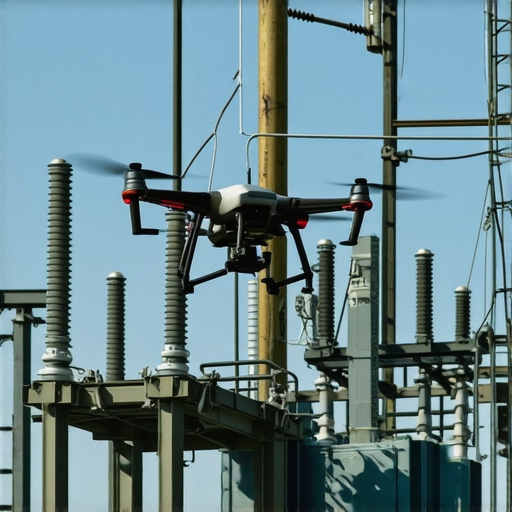
In a substation environment, we see a phenomenon called Cold Creep. Because aluminum expands and contracts at a different rate than the steel or copper it’s often bolted to, the physical connection literally breathes. Over time, that breathing loosens the bolt. Once the connection is loose, air enters the gap, oxidation occurs, and suddenly you have a high-resistance junction. This is where drones equipped for thermal imaging inspections become the ultimate forensic tool. They can see the infrared signature of a failing lug before it reaches the point of catastrophic ionization.
Drones: The New Eyes of the Master Inspector
Traditionally, inspecting a substation meant sending a guy up in a bucket truck or, god forbid, doing a visual check with binoculars from the ground. It was slow, dangerous, and incomplete. Now, we use heavy-lift drones outfitted with radiometric thermal sensors. This isn’t just about taking a pretty picture; it’s about ‘Component Zooming.’ We can hover ten feet away from a grounding electrode install or a high-side bushing and see the exact temperature differential across the surface. If one phase of a three phase power services array is running 15 degrees Celsius hotter than the others, we know we have an unbalanced load or an internal winding failure.
From Substations to Residential Safety
While the scale is different, the technology we use at the utility level is trickling down to the average homeowner. When we perform thermal imaging inspections on a residential load center upgrade, we are looking for the same thermal signatures. A loose breaker in your panel smells like ozone and fish—that’s the plastic housing off-gassing as it melts. By the time you smell it, the damage is done. A drone at a substation or a handheld thermal camera in a kitchen can catch that heat signature weeks before the smoke appears. This is why we push for free electrical estimates that include more than just a visual glance; we want to see the heat.
The Physics of the Arc: Why Grounding is Non-Negotiable
In both substations and homes, grounding is the only thing standing between a minor equipment failure and a lethal event. In the substation, the ‘ground grid’ is a massive buried mesh of copper. In your backyard, it might be spa grounding services or fence line lighting that needs protection. If you don’t have a solid path to earth, that electricity will find its own path—often through you. When we perform grounding electrode install work, we aren’t just driving a rod into the dirt; we are managing the potential difference of the entire site.
“All electrical equipment shall be installed in a neat and workmanlike manner.” – National Electrical Code (NEC) Article 110.12
That ‘workmanlike manner’ isn’t just about making the wires look straight. It’s about ensuring that every home rewiring services project follows the strict pathing required to prevent inductive heating. If you run a high-amperage home run through a tight hole in a steel stud without a bushing, you’ve just built an induction heater. It’s the same reason we use Monkey Shit (duct seal) to plug conduits—we have to stop the migration of moist air that causes corrosion in the first place.
The Integrated Future: CAT6, Smart Homes, and High Voltage
Modern preventative maintenance isn’t just about the heavy stuff. We are increasingly seeing the convergence of high-voltage power and low-voltage data. Whether it’s CAT6 cabling services for a substation’s SCADA system or smart thermostat wiring in a suburban ranch, the integrity of the signal depends on the isolation from the power. If you don’t understand the EMI (electromagnetic interference) generated by a three phase power services feed, you’ll never get your data speeds where they need to be. We treat every wire with the same forensic scrutiny, whether it’s carrying 5 volts or 500,000 volts.
The Takeaway: Don’t Wait for the ‘Pop’
If you’re hearing a ‘tick-tick-tick’ from your panel or seeing your lights flicker when the AC kicks on, you have a resistance problem. It might be a loose neutral or a failing bus bar. This is where troubleshooting for lighting installations becomes a critical part of home health. Don’t let a handyman ‘rough-in’ your new addition without a permit. Electricity is a relentless force that is always looking for a way out. At the end of the day, whether we are flying drones over a utility yard or performing spa grounding services in your backyard, our goal is the same: to make sure you can sleep at night knowing every connection is torqued to spec and every ground is solid. If you have concerns about your system, it is always better to get free electrical estimates now than to call a forensic investigator after the fire trucks leave. Contact us today to secure your infrastructure.