
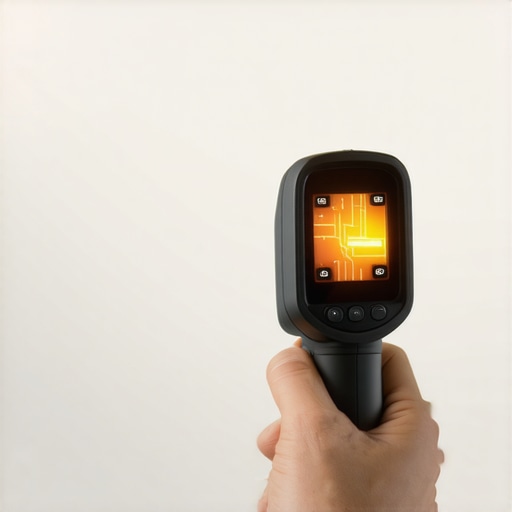
The Sensory Warning: When the Walls Start Talking
You’re sitting in your living room when you catch a whiff of it—that metallic, ozone-heavy stench that reminds you of a lightning strike. Or maybe it’s the faint, rhythmic clicking coming from behind the drywall, like a ghost tapping on the studs. Most homeowners’ first instinct is to grab a hammer and start swinging, looking for the culprit. That’s a rookie mistake. In my 35 years as an electrician, I’ve seen more damage done by frantic ‘exploratory’ demolition than by the actual electrical faults. Electricity is lazy; it always takes the path of least resistance, but when it finds a roadblock, it turns into a heat-generating monster. We don’t need to tear your house apart to find it anymore. Modern electrical inspections have evolved into forensic science, using drone thermography scans and remote diagnostics to see through the gypsum and lath. If you think you have a problem, stop reaching for the sledgehammer and start thinking about the physics of the failure.
The Old Timer’s Lesson: The Sin of the Nicked Copper
My journeyman used to smack my hand if I stripped a wire with a knife. ‘You nick the copper, you create a hot spot,’ he’d scream. He was right. Every time you score a conductor with a pair of dikes, you’re reducing the cross-sectional area of that wire. In the world of high-load data center power setup or even basic home theater wiring, that tiny nick is a bottleneck. It creates resistance, and resistance creates heat. Over decades, that heat causes the metal to expand and contract—a process known as thermal cycling. Eventually, the wire becomes brittle and snaps, or worse, it starts arcing. I’ve seen rough-in jobs from the 1940s where every single outlet was a ticking time bomb because some guy with a pocketknife was in a hurry. Today, we use precision tools, but the scars of those old-timers remain hidden in your walls, waiting for a high-load appliance to wake them up.
“Aluminum wire connections can overheat and cause a fire without tripping the circuit breaker.” – CPSC Safety Alert 516
The Physics of the ‘Hidden’ Fault: Ohmic Heating
To understand remote diagnostics, you have to understand Ohm’s Law. When we conduct electrical safety audits, we aren’t just looking for broken wires; we’re looking for heat signatures. Any point of resistance—a loose wire nut, a corroded bus bar, or a ‘bootleg ground’—generates heat according to the formula P=I²R. If you have 20 amps flowing through a loose lug with just 1 ohm of resistance, that’s 400 watts of heat concentrated in a space smaller than a dime. That’s a soldering iron buried in your wall. This is where drone thermography scans become a lifesaver. By flying a thermal-equipped drone over a property, we can identify heat plumes on fiber optic cabling runs or service masts before they melt the weather head. We can see the heat radiating through the siding, identifying a failing home run before the insulation ever ignites.
Remote Diagnostics in the Modern Era
We don’t just rely on our eyes anymore. When a client calls about track lighting services that are flickering, we don’t start by pulling down the cans. We use a Wiggy (a solenoid voltmeter) and high-frequency tracers to map the circuit. For complex issues, especially in commercial data center power setup, we use power quality analyzers that log voltage sags and swells over 24 hours. This remote monitoring tells us if the fault is internal or coming from the utility side. We’ve integrated these technologies into our electrical inspections to provide free electrical estimates that are actually accurate, not just guesses. For those who have served, we also offer military discount wiring services, ensuring that the men and women who protected us have homes that won’t burn down because of a 50-year-old Zinsco panel.
The Autopsy of a Failed Circuit
I recently performed a forensic scan on a house where the owner complained of a ‘fishy’ smell. Using a thermal imager, I didn’t see a fire; I saw a ‘ghost’—a signature of heat behind a built-in bookshelf. We found a junction box that had been buried by a previous ‘handyman.’ The wire nuts had melted into a blob of monkey shit (duct seal) and charred plastic. The tick tracer (non-contact voltage tester) wouldn’t even pick it up because of the shielding, but the thermal signature was unmistakable. This is why how electricians tackle troubleshooting for lighting installations is so critical; it’s about using the right tool for the specific resistance profile. Whether it’s home theater wiring or a complex fiber optic cabling grid, the diagnostic phase is where the battle is won or lost. If you skip the diagnostics, you’re just guessing with someone’s life.
Why Modern Loads Demand Better Audits
Our homes aren’t what they were in 1970. We are plugging in EVs, high-end gaming rigs, and massive HVAC systems. These constant, high-draw loads expose every weakness in your rough-in. A connection that was ‘fine’ for a 60-watt lightbulb will fail under the 40-amp draw of an EV charger. If you’re planning an upgrade, start with lighting installations made easy by ensuring your backbone can handle the stress. We use remote diagnostics to verify the integrity of your existing copper before we ever add a new load. It’s the difference between a system that works and one that ends in a 911 call. Don’t wait for the ‘widow maker’—that one hot wire that’s lost its neutral and is looking for a path through you. Get a professional audit that uses thermography and high-impedance testing to clear your home’s health. If you’re ready to stop guessing, contact us for a forensic look at your system. Electricity isn’t a hobby, and your walls shouldn’t be a mystery.