
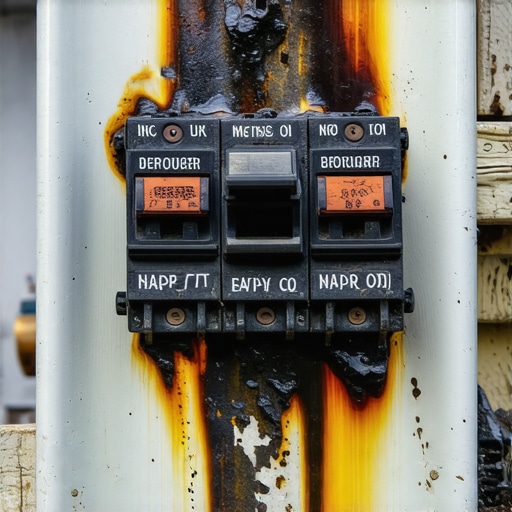
I remember my journeyman back in ’88, a man who had more scars from ‘live’ encounters than a stray cat. He used to smack my hand if I even thought about stripping a wire with a pocket knife. ‘You nick that copper, you create a hot spot, and that hot spot is a funeral waiting to happen,’ he’d growl. He wasn’t being dramatic; he was being a pro. He taught me that electricity isn’t some invisible magic—it’s a physical force that demands respect, and your main service panel is the only thing standing between your family and a structural inferno. When I walk into a house for a thermal imaging inspection, I’m not looking for pretty wires; I’m looking for the forensic evidence of failure. If your home was built between 1960 and 1980, you aren’t just living in a house; you’re living on top of a ticking clock. Mid-century panels, specifically those manufactured by Federal Pacific Electric (FPE) or Zinsco, are notorious for ‘cold creep.’ This is a physical phenomenon where aluminum conductors expand and contract at different rates than the steel lugs holding them. Over decades, this cycle of thermal expansion causes the connection to loosen. A loose connection creates resistance. Resistance creates heat. And heat in a panel doesn’t just trip a breaker—it melts the bus bar.
“Aluminum wire connections can overheat and cause a fire without tripping the circuit breaker.” – CPSC Safety Alert 516
The Anatomy of a Failed Bus Bar
When I pull the dead front off an old FPE panel, I often see the ‘Stab-lok’ breakers literally welded to the bus bar. In a healthy system, the breaker is designed to trip when it detects an overcurrent. But these vintage units suffer from jammed pivots and internal oxidation. You might be out there doing a holiday light installation, plugging in three extra strands of LEDs and a couple of inflatable reindeer, thinking your breakers will protect you. In reality, that 15-amp circuit is drawing 22 amps, the wire is getting soft, and the breaker is just sitting there, silent. This is why AFCI breaker services are no longer optional in modern code; they detect the specific signature of an arc before the heat even starts to build. If you hear a ‘sizzling’ sound or smell something like burnt fish near your panel, that is the smell of phenolic resin liquefying. That’s your signal to stop reading and call for free electrical estimates immediately. Don’t trust your tick tracer to tell you everything is fine; those non-contact voltage testers are notorious for giving false negatives when there’s phantom voltage present. I trust my Wiggy—a solenoid tester that puts a physical load on the circuit—to tell me what’s actually happening.
The Invisible Enemy: Corrosion and Underground Decay
For homes with underground wiring services, the danger is often buried three feet down. I’ve seen trenching electrical conduit that was installed thirty years ago where the PVC has cracked or the galvanized steel has rusted through, allowing moisture to wick into the main service entrance. This moisture travels up the cable like a straw, right into your main lugs. If you see white, chalky powder (oxidation) on your breakers, your panel is already dying from the inside out. This is especially critical for those requiring dock electrical services or swimming pool bonding. Water and electricity are the ultimate ‘widow makers.’ If your pool’s bonding grid is compromised, you aren’t just swimming; you’re part of a potential path to ground. A subpanel installation near the water must be perfectly torqued and sealed with monkey shit (duct seal) to keep the moisture out of the conduit. I’ve performed forensic audits on docks where the salt air had turned the copper wire into green dust within five years. Without proper grounding and bonding, that metal ladder in your pool becomes a live electrode.
“The grounding electrode conductor shall be protected from physical damage by being enclosed in rigid metal conduit, intermediate metal conduit, rigid polyvinyl chloride conduit (PVC), or reinforced thermosetting resin conduit (RTRC).” – NFPA 70: National Electrical Code (NEC)
Why a ‘Heavy-Up’ is the Only Real Fix
A lot of guys will tell you they can ‘clean up’ an old panel. They’re lying to get your money. Once the bus bar is pitted from arcing, the integrity of the metal is gone. You need a full service upgrade—what we call a ‘heavy-up.’ This involves replacing the meter can, the service mast, and the panel itself. We don’t just throw in a new box; we run a new home run for critical loads and ensure every circuit is protected by modern AFCI and GFCI technology. If you’re planning on ensuring safe and efficient EV charging station setup at home, your old 100-amp panel likely doesn’t have the headroom. Trying to pull 40 continuous amps for a car on a 1970s bus bar is a recipe for a structural fire. During the rough-in phase of an upgrade, we check the torque on every single lug. If it isn’t torqued to the manufacturer’s inch-pound specification, it’s a failure. I’ve used my dikes to snip out miles of ‘handyman specials’ where people used electrical tape to fix a nicked wire. Don’t let your home be the next case study in an insurance adjuster’s manual. Whether it’s troubleshooting for lighting installations or a full panel replacement, do it once, do it right, and use a torque wrench.