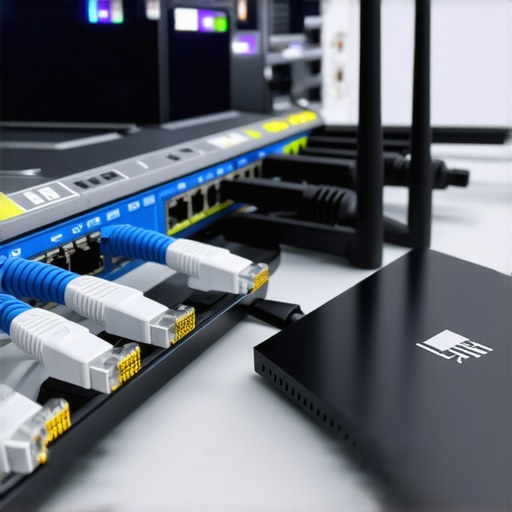
The Invisible Autopsy of a Dropped Signal
I walked into a ‘fully renovated’ office space last Tuesday where the tenant was ready to sue the developer. They had the latest Wi-Fi 7 routers strapped to every pillar, yet their VoIP phones sounded like they were underwater and the 4K security feeds looked like a Lego set. I didn’t reach for a laptop; I pulled out my Tick Tracer and a thermal camera. I found the ‘flipper special’ buried behind the drywall: the data guy had run unshielded Cat5e—not even Cat6—wrapped around the high-voltage lines for the industrial motor controls of the HVAC system. The electromagnetic interference (EMI) was so thick it was basically a digital blender. When you see a connection drop, you’re usually looking at a physical failure of the medium, not a software glitch. This is the autopsy of why your wireless dreams are dying in a world of physical interference.
The Physics of the ‘Airtime Lie’
Wi-Fi 7 promises speeds that look great on a glossy retail box, but it’s operating on the 6GHz band, which has the penetrating power of a wet paper towel. In a retail store wiring environment, you have metal studs, foil-backed insulation, and mirrored displays that turn your signal into a pinball. Every time a microwave starts or a generator transfer switch kicks in, the RF noise floor rises. Wireless is a shared medium—a ‘collision domain’ in networking terms. Only one device can truly talk at a time. Ethernet, specifically a Home Run of Cat6A or Cat8, is a dedicated pipe. It’s the difference between a private highway and a muddy footpath where everyone is shouting at once. When we perform a power quality analysis, we often see that ‘slow internet’ is actually just dirty power causing packet loss at the router level.
“Aluminum wire connections can overheat and cause a fire without tripping the circuit breaker.” – CPSC Safety Alert 516
Component Zooming: The Anatomy of the Twist
Why does a physical wire beat a radio wave? It comes down to the twist rate and differential signaling. In a high-end office lighting upgrades project, we often install access control wiring alongside data. If those wires aren’t twisted correctly, you get ‘Crosstalk.’ This is where the electrical signal from one pair leaks into another. Cat6A uses a plastic spline—a physical separator inside the jacket—to keep those pairs at a specific distance. This prevents ‘Near-End Crosstalk’ (NEXT). When a handyman nicks that jacket during a rough-in, he’s not just damaging plastic; he’s changing the impedance of the line. I’ve seen circuit breaker replacement jobs where the installer shoved data lines into the panel gutter. That’s a widow maker move for your data. The 60Hz hum from the bus bars creates an induction field that physically slows down the electrons carrying your data. You can’t fix that with a software update.
Industrial Interference and the Ground Loop Trap
In commercial settings, industrial motor controls are the primary enemy of Wi-Fi. These devices use Pulse Width Modulation (PWM), which throws off massive amounts of RF noise. If your business relies on wireless for critical tasks, you’re building on sand. Furthermore, I’ve seen cases where swimming pool bonding issues in hotels created a potential difference between the equipment ground and the data ground. This creates a ‘ground loop.’ Suddenly, your Ethernet cable is trying to be a grounding rod, carrying current it wasn’t meant for. This fries NIC cards and causes phantom reboots. A proper electrical inspection ensures that your data racks are referenced to the same ground as your service entrance, preventing these invisible killers. If you are serious about uptime, you need a professional electrical evaluation of your infrastructure before you buy more routers.
“The separation of communications cables from light or power conductors shall be at least 2 inches (50 mm).” – NEC Article 800.133
The Cost of Convenience vs. The Value of Reliability
People hate wires because they hate the trim-out process—the drilling, the fishing, the monkey shit (duct seal) used to plug the holes. But a wired connection is a one-time capital expense that lasts 20 years. Wi-Fi hardware is obsolete every four. When we handle office lighting upgrades, we always advocate for pulling extra low-voltage lines. It’s cheaper to do it while the ceiling is open than to realize your ‘smart’ office is a ‘dumb’ office because the signal can’t get through the LED drivers. For those with a priority service membership, we check these data pathways during annual inspections because a loose terminal on a circuit breaker replacement doesn’t just flicker a light—it creates transient spikes that can kill a PoE (Power over Ethernet) switch.
Final Verdict: Torque It and Forget It
If you’re tired of the spinning loading wheel, stop looking for a better router and start looking for a better path. Ethernet wiring is the backbone of any serious infrastructure, from access control wiring to retail store wiring. It’s about more than speed; it’s about the physics of reliability. Don’t let a ‘flipper’ tell you that ‘wireless is just as good.’ I’ve seen the charred remains of ‘just as good.’ If you want it done right, ensure your wires are torqued, your grounds are bonded, and your data is shielded.