
The Fossilized Fuses Behind Your Plaster
I’ve spent thirty-five years dragging my Wiggy through crawlspaces that would make a sewer rat gag. Most homeowners see a 1940s colonial and think about the ‘character’ of the crown molding. I see a tinderbox wrapped in a ‘flipper special’ paint job. When I walk into a basement and see those frayed, soot-covered cotton jackets hanging from the joists like dead snakes, my skin crawls. Old Man Miller, my first journeyman, didn’t talk much, but he had a habit of smacking my hand with his dikes if I moved too fast around that stuff. I remember one humid August afternoon in a bungalow where I was about to tug on a piece of rag-wire to get some slack for a GFCI outlet installation. Miller grabbed my wrist with a grip like a pipe wrench. ‘You nick that jacket, kid, and the ghost of this house will follow you home,’ he growled. He made me use a tick tracer to show me how the insulation was so brittle that the mere vibration of me moving the conductor was causing the ‘hot’ to bleed through the carbonized dust. He was right. That wire wasn’t just old; it was a fossilized fuse waiting for the right moment to ignite.
The Physics of Decay: Why Cloth Insulation Fails
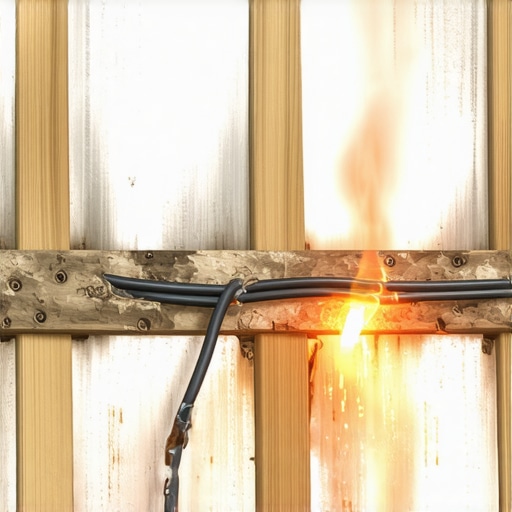
To understand the danger, you have to look at the chemistry of the 1920s through the 1950s. We didn’t have THHN or modern thermoplastics back then. We had copper wrapped in rubber, then encased in a braided cotton jacket saturated with asphalt. Over seventy years, a process called vulcanization turns that rubber from a flexible insulator into a hard, crystalline shell. Every time you turn on a space heater or a vacuum, the copper expands. When you turn it off, it contracts. This thermal cycling creates microscopic fractures in the brittle rubber. Eventually, the rubber simply turns to dust inside the cloth braid. [image placeholder] At that point, the only thing keeping your house from a fire damage wiring restoration project is a few millimeters of flammable cotton and a prayer.
“Aluminum wire connections can overheat and cause a fire without tripping the circuit breaker.” – CPSC Safety Alert 516
While that quote specifically targets the aluminum craze of the 60s, the principle of resistance-based heating applies doubly to old cloth-covered copper. In these systems, we often see what I call the ‘widow maker’—a situation where the insulation has completely fallen off inside a metal junction box, and the only thing preventing a dead short is the fact that the wire hasn’t been touched since the Eisenhower administration. But the moment you try a doorbell camera install or replace a light fixture, you disturb that delicate balance. The dust settles, the bare copper touches the grounded box, and you get an arc that can reach 10,000 degrees Fahrenheit in milliseconds.
The Modern Load Trap: Why Your 1940s Grid is Screaming
The architects of the mid-century never imagined a world with 1500-watt air fryers, 4K televisions, and home offices. In a tiny home wiring setup, we calculate every amp because space is tight, but in an old mansion with cloth wiring, people just keep plugging stuff in. This leads to ‘pyrolytic carbonization.’ When wood studs or cotton insulation are exposed to low-level, long-term heat from an overloaded wire, their chemical structure changes. They become charcoal. The ignition temperature of that wood drops until one day, the wire isn’t even ‘hot’ by professional standards, but it’s enough to ignite the carbonized wood it’s stapled to. This is why a whole house surge protection system is useless if the underlying ‘veins’ of the house are compromised. You can’t protect a crumbling foundation with a new roof.
We also see a total lack of an equipotential grid in these old builds. There is no dedicated grounding conductor. Instead, these old systems relied on the armor of the cable (if it was BX) or nothing at all. This means if a fault occurs, the entire metallic path of your plumbing or HVAC can become energized. I’ve seen bonding jumper services skipped by handymen who thought ‘a ground is a ground,’ only to find the homeowner getting shocked by their kitchen faucet because a cloth wire leaked current into the drain pipe.
The Forensic Inspection: Spotting the ‘Slow Burn’
When I do a rough-in inspection for a cloth insulated wiring replacement, I’m looking for the ‘fishy’ smell. That’s the scent of phenolic resin and cotton cooking. If you smell something odd near your outlets, don’t call a plumber; call for certified journeyman services. We use thermal imaging to find the hotspots where the home run enters the panel. Often, the fire alarm system install in these houses is the only thing that saved the family, but by the time the smoke detector goes off, the fire is already inside the wall cavity, fed by the very oxygen that circulates through your lath and plaster.
“Where the grounded conductor is likely to be interrupted, a bonding jumper shall be installed.” – NFPA 70 (NEC) Article 250
If you’re wondering if your home is at risk, look at the service head. If you see ‘monkey shit’ (that gray duct seal) dried and cracked where the wires enter the house, moisture has likely wicked down the cloth braid into your main lugs. This moisture accelerates the oxidation of the copper, increasing resistance and heat. If you are planning on ensuring-safe-and-efficient-ev-charging-station-setup-at-home, you absolutely cannot run that load on an original service. The heat will melt the cloth off the wire before the first 10% of the battery is charged. For more on high-load safety, check out this guide on EV charging setup.
The Solution: Tearing Out the Past
There is no ‘patch’ for cloth wiring. You can’t just wrap it in electrical tape and hope for the best. A full cloth insulated wiring replacement is the only way to sleep at night. During a trim-out, we replace those old two-prong outlets with modern, grounded receptacles. We ensure every circuit is protected by an AFCI (Arc-Fault Circuit Interrupter) breaker. Unlike a standard breaker that only trips during a massive surge, an AFCI is smart enough to detect the ‘hissing’ of an arc through brittle insulation and shut the power down before the cotton catches fire. If you’re dealing with flickering lights, you might find some answers in how electricians tackle troubleshooting, but if the culprit is cloth, the answer is always replacement.
Electricity is the only utility that wants to return to the earth as fast as possible, and it doesn’t care if your house is in the way. Don’t treat your home’s wiring like a ‘set it and forget it’ hobby. If you’re worried about your home’s safety, contact us for a forensic evaluation. It’s a lot cheaper to replace a wire than it is to rebuild a life.