
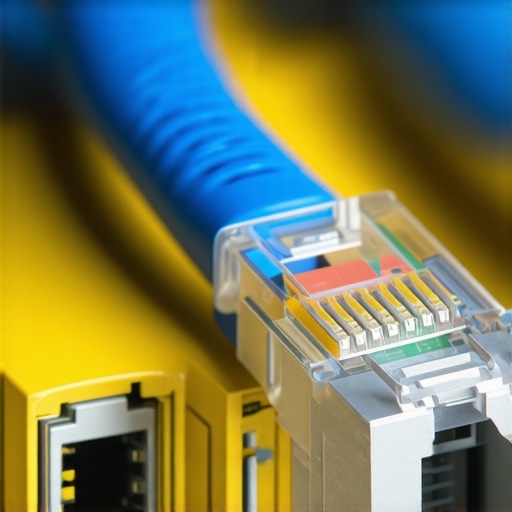
The Ghost in the Gigabit: Why Your High-Speed Wiring is Lying to You
You spent the money. You hired a guy—or maybe you did it yourself after watching a couple of videos—to pull CAT6 through the walls of your 1970s split-level. You bought the expensive shielded connectors. You even got the gold-plated router that looks like a dead spider. But when you run a speed test, it’s a joke. You’re getting 100Mbps on a line rated for ten times that. You blame the ISP. You reboot the modem until the buttons wear out. But as a forensic electrical inspector who has spent three decades chasing stray voltage and hunting down high-impedance neutrals, I can tell you exactly what’s happening: your data is being choked to death by the copper surrounding it.
The Forensic Breakdown: The Flipper Special
I walked into a ‘fully renovated’ home last month where the owner was ready to sue his internet provider. This was a classic mid-century ranch that had been ‘modernized’ by a flipper. I found the problem within ten minutes using my tracer. The flipper had buried a junction box behind the master bedroom drywall, but more importantly, he had bundled the new CAT6 data lines tightly against the 120V Romex feeding the kitchen’s microwave and dishwasher. To save five minutes of drilling, he used the same structural holes for both high-voltage and low-voltage lines. I pulled the cover off the media cabinet and saw a ‘Spaghetti Monster’ of tangled wires that would make a journeyman weep. He’d even used ‘Dikes’ to trim the zip ties so tight they were crushing the cable jackets, changing the geometry of the twisted pairs inside. When those kitchen appliances kicked on, the electromagnetic interference (EMI) was so loud on the data line that the router just gave up. This wasn’t a software issue; it was a physics failure.
The Physics of the Failure: Inductive Coupling and Cross-Talk
Data cabling isn’t just ‘wire.’ In a CAT6 cable, the twist rate is precisely engineered to cancel out noise. When you run that cable parallel to a 120V or 240V power line, you are essentially building a long, inefficient transformer. This is called Inductive Coupling. The magnetic field from the 60Hz AC current in your Romex ‘leaks’ into the data line. In the trade, we call this a ‘widow maker’ for your bandwidth. The router sees this noise as corrupted packets and has to resend them. This is why ev-charger-troubleshooting-expert-tips-to-fix-common-issues often involve looking at where the data lines are placed; a high-load EV charger can obliterate a nearby home network signal if the separation isn’t maintained. You need at least 6 to 12 inches of clearance between power and data, or a grounded metallic conduit if they have to cross.
“Communication conductors shall not be placed in any raceway, compartment, outlet box, junction box, or similar fitting with conductors of electric light, power, Class 1, non–power-limited fire alarm, or medium power network-powered broadband communications circuits.” – NEC Section 800.133(A)(2)
Component Zooming: The Geometry of the Twist
Let’s talk about Cold Creep and cable stress. CAT6 relies on its internal plastic spline to keep the four pairs of wires separated. When a ‘handyman’ pulls that cable around a sharp 90-degree corner in a tight attic, they often exceed the bend radius. This stretches the copper. High-frequency data travels via the ‘Skin Effect’—it moves along the outside of the conductor. If you nick the copper while stripping it with a pocket knife instead of a proper tool, or if you crush it with a staple, you create a point of high resistance. This causes a reflection in the signal. It’s like a water hammer in a plumbing pipe; the signal hits the ‘dent’ in the wire and bounces back, crashing into the next wave of data coming down the line. This is why proper how-electricians-tackle-troubleshooting-for-lighting-installations often reveals that the data lag is actually a physical wiring deformity caused during the rough-in phase.
The Data Closet: Where Speed Goes to Die
Most homeowners treat their data closet like a junk drawer. I’ve seen data closet organization so bad that the heat buildup alone was thermal-throttling the switch. If you have energy storage systems or a main panel nearby, the EMI is even more intense. You need to treat your data hub with the same respect as your main service entrance. That means no ‘Monkey Shit’ (duct seal) globbed into the ports, no loose connections, and proper labeling. If you are struggling with a mess of wires, a virtual consultation wiring session can often help identify the most egregious violations before you start ripping out drywall. For complex issues, especially those involving insurance claim electrical work after a surge or a poorly executed ‘renovation,’ you need a pro who understands NEC code updates and the nuances of signal integrity.
“Aluminum wire connections can overheat and cause a fire without tripping the circuit breaker.” – CPSC Safety Alert 516
While the CPSC quote refers to power wiring, the principle applies to signal stability: poor connections are the enemy. If your ‘CAT6’ was actually old aluminum-clad copper (CCA) junk bought from a shady online marketplace, the oxidation layers at the termination points will eventually turn your gigabit line into a 10Mbps relic. I always check the terminations with a ‘Wiggy’ or a high-end tester during a trim-out to ensure the resistance is within spec. If it’s not, we start looking at underground wiring services or outdoor runs where moisture might have wicked into the jacket because someone forgot to use drip loops or proper sealing.
The Fix: Getting Your Speed Back
The first step is a forensic audit. We look for those parallel runs. If you’re planning an EV charger installation or adding massive Christmas light services that draw significant amperage, we need to ensure those new power runs don’t cross your existing ‘home run’ data lines. If the damage is done, we might recommend permit pulling services for a partial rewire, using shielded CAT6A (STP) that is properly drained to a ground bus. This isn’t a hobby; it’s infrastructure. You wouldn’t let a plumber use a garden hose to pipe your house; don’t let a ‘handyman’ use data cabling techniques from 1995. Ensure your installer follows lockout tagout training protocols when working near your main panel to avoid becoming part of the circuit. For a proper setup, check out ensuring-safe-and-efficient-ev-charging-station-setup-at-home to see how we handle high-interference environments. If you’re tired of the lag, contact-us and get it fixed by someone who knows the difference between a good connection and a fire hazard.
Conclusion: Sleep Better with Torqued Terminals
At the end of the day, your internet is only as fast as the physical medium it travels through. You can have a 10-gigabit switch, but if your CAT6 is stapled to a Romex line and terminated with a dull pair of dikes, you’re throwing money away. Get a forensic inspection, fix the interference, and finally get the speed you’re paying for. It’s about more than just Netflix; it’s about having an electrical system that is code-compliant and built to last. For more info on our policies, see our privacy-policy.