
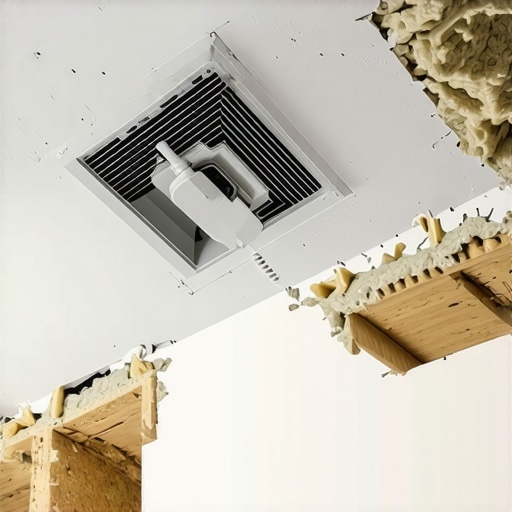
The Sensory Warning: The Scent of Damp Dust and Burnt Plastic
I can usually tell a bathroom is about to catch fire before I even open my tool bag. It is a specific, cloying smell—a mixture of 50-year-old damp attic dust and the sharp, chemical tang of melting PVC. When you flip that switch and the fan groans like a dying animal before settling into a rhythmic, clicking hum, you are not just looking at a nuisance; you are looking at a forensic case study in progress. Most homeowners treat the bathroom fan as a minor appliance, something they can slap into the ceiling with a couple of drywall screws and some leftover scrap wire. They are wrong. In my 35 years of crawling through the dark, cramped spaces of mid-century homes, I have seen more ‘handyman specials’ in bathrooms than anywhere else, and they are almost always a ticking time bomb of moisture and heat.
The Old Timer’s Lesson: The High Cost of a Nicked Wire
My journeyman, a man who had more scars on his knuckles than I have tools in my van, used to smack my hand with a pair of dikes if he saw me stripping a wire with a pocket knife. ‘You nick that copper, kid, and you just built a heater,’ he’d scream. He wasn’t being a jerk; he was teaching me the physics of resistance. When you nick a solid copper conductor, you reduce its cross-sectional area. In the high-humidity environment of a bathroom, that nick becomes a point of concentrated resistance. Heat builds up, the copper oxidizes faster, and suddenly that 14-gauge Romex is acting like a filament in a toaster. This is especially dangerous in mid-century homes where we often see the transition from old ungrounded systems to modern wiring. If you are dealing with older infrastructure, it is not just about the fan; it is about the entire circuit integrity, much like the precision required for a level 2 EV charger installation. You cannot afford a single weak link.
“Aluminum wire connections can overheat and cause a fire without tripping the circuit breaker.” – CPSC Safety Alert 516
The Forensic Breakdown: Why DIY Fans Fail
The most common mistake I see is what I call the ‘Mold Factory’—venting the fan directly into the attic insulation rather than through the roof or soffit. From a forensic perspective, this is a disaster. The warm, moist air from your shower hits the cold attic air, condenses, and turns your fiberglass batts into a Petri dish. But the electrical failures are even more insidious. Most DIYers fail to use a proper connector where the Romex enters the metal fan housing. Without a connector, the sharp edge of the knockout vibrates against the wire insulation every time the fan runs. Eventually, it cuts through, creating a ground fault that might not even trip an old-fashioned breaker if the grounding electrode install was done poorly decades ago. I have seen fans where the housing was ‘hot’—energized with 120 volts—just waiting for someone to touch the metal grille while standing on a damp floor. That is what we call a ‘Widow Maker.’
Component Zooming: The Physics of Resistance and Airflow
Let’s talk about the Rough-in phase. Most people grab the cheapest fan they can find, not realizing that the motor is rated for a specific ‘Equivalent Duct Length.’ If you use flexible ribbed ducting and snake it all over the attic, you create massive static pressure. The motor has to work harder, it draws more current, and it generates more heat. In the electrical world, heat is the enemy. I have used drone thermography scans to look at bathroom fans from above, and it is shocking to see the heat signatures on units where the ducting is restricted. It looks like a glowing coal in the ceiling. If you are also tying this fan into a circuit that handles smart home wiring or high-draw appliances, you are asking for a nuisance trip at best, and a fire at worst. Proper installation requires a dedicated circuit or at least a very careful load calculation, similar to what we perform for lighting installations made easy.
The Home Run and Circuit Protection
In modern code, we want a Home Run—a dedicated line—for bathroom circuits, especially if you have a heater/fan/light combo. I’ve walked into ‘renovated’ bathrooms where the flipper tied the fan into the same circuit as the kitchen range hood wiring or even a pendant light hanging in the next room. This is a violation of the basic principles of load distribution. When you have a high-moisture environment, your protection must be absolute. This means GFCI (Ground Fault Circuit Interrupter) protection is non-negotiable if the fan is over a tub or shower. I’ve seen many DIYers use a standard switch, skipping the GFCI because ‘the old one didn’t have it.’ That is a gamble with your life. If you are unsure about your panel’s capacity, you might even be looking at a meter socket replacement to handle the modern electrical loads of a fully updated home.
“All 15A and 20A, 125V receptacles located in bathrooms must have GFCI protection for personnel.” – NEC 210.8(A)(1)
The ‘Handyman Special’ vs. Code Compliance
I once used my Wiggy (a solenoid voltage tester) on a fan that ‘wasn’t working’ and found 90 volts. The DIYer had used a ‘bootleg ground,’ connecting the neutral to the ground screw because the old house didn’t have a ground wire. This created a voltage drop that was killing the motor and heating up the entire branch circuit. It is the same kind of laziness I see in fence line lighting or solar panel electrical hookup jobs done by amateurs. They want the result without doing the math. If your wiring looks like a bird’s nest of electrical tape and wire nuts that aren’t even twisted properly, you are inviting disaster. When we do a Trim-out, every wire is stripped to the exact length, every wire nut is torqued until the wires twist together, and the grounding path is verified with more than just a Tick Tracer.
The Fix: How to Sleep at Night
If you want to do this right, you start by verifying the load. If you are adding a high-CFM fan, treat it with the same respect you would give to troubleshooting for lighting installations in a commercial building. Use rigid ducting where possible. Ensure the fan housing is securely fastened to the joists—vibration leads to loosened wire nuts. And for the love of all that is holy, use a proper 14/2 or 12/2 Romex with a dedicated ground. If your panel is a Zinsco or a Federal Pacific, stop what you are doing and call a professional for a panel changeout before you even think about hot tub wiring services or new fans. Electricity isn’t a hobby; it is an invisible force that is constantly trying to find a path to ground, and your body or your house shouldn’t be that path. If you need a pro who knows the difference between ‘it works’ and ‘it is safe,’ you can contact us today.