
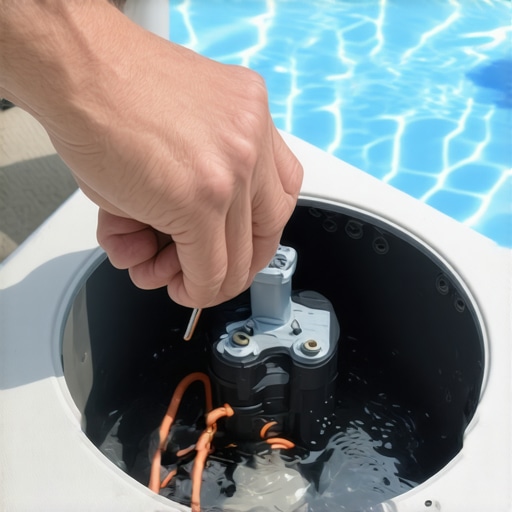
The Screech of the Dying Stator: A Forensic Autopsy
That high-pitched, metallic whine echoing across your backyard at 2 AM isn’t just an annoyance for your neighbors; it’s the death rattle of an electrical system under siege. As a Master Electrician who has spent three decades diagnosing the failures of residential equipment, I can tell you that a ‘noisy’ pool pump is rarely just a mechanical bearing issue. More often than not, the noise is a symptom of electrical stress—a byproduct of resistance, voltage drop, or poor installation practices that ignore the laws of physics. When a motor ‘grunts’ on startup or emits a rhythmic thrum, it’s screaming for a forensic inspector to look at the wiring before the windings turn into a melted pile of copper and lacquer.
The Old Timer’s Lesson: The High Cost of a Nick
I remember my journeyman back in the late 80s. He was a man who didn’t believe in soft words. If he saw me stripping a piece of THHN or Romex with a pocket knife instead of a pair of dedicated dikes or wire strippers, he’d smack my hand. ‘You nick that copper, you create a hot spot,’ he’d growl. ‘That nick reduces the cross-sectional area of the conductor. You’ve just built a heater inside a terminal.’ He was absolutely right. In the context of a high-draw device like a pool pump, a single nicked strand at the disconnect or the motor’s terminal board increases resistance. This resistance leads to localized heating, which causes the copper to expand and contract at a different rate than the lug. Eventually, the connection loosens, arcing begins, and the motor starts to vibrate as the magnetic field becomes unstable. This instability manifests as ‘electrical noise’ long before the bearings actually seize.
“Wiring for pool pump motors shall be installed in rigid metal conduit, intermediate metal conduit, rigid polyvinyl chloride conduit, reinforced thermosetting resin conduit, or Type MC cable listed for the location.” – National Electrical Code (NEC) Article 680.21
The Anatomy of the Hum: Component Zooming into Magnetic Flux
To understand why your pump is loud, we have to look at the physics of the Magnetic Flux. A pool pump motor operates by creating a rotating magnetic field between the stator and the rotor. When you have a code violation correction needed—such as a ‘voltage drop’ caused by a long home run on undersized wire—the motor doesn’t get the ‘push’ it needs to maintain synchronous speed. This results in ‘slip.’ As the rotor falls out of sync with the magnetic field, the internal components experience physical stress. This isn’t just a metaphor; the actual laminations of the stator can begin to vibrate against each other at 60 cycles per second. That ‘hum’ is the sound of electricity trying to force a rotor to turn against a lack of proper EMF. If you’ve been putting off a workshop electrical setup or other heavy-load projects, you might be familiar with this ‘grunting’ sound when a saw hits a knot; your pool pump is doing the same thing every second it’s running on low voltage.
The Coastal Enemy: Salt Air Corrosion and Galvanic Reaction
For those of you living near the coast, the enemy is invisible but relentless: salt air. In my years of forensic inspections, I’ve seen meter cans and disconnect boxes rot from the inside out in less than five years. Salt is a conductor. It builds ‘salt bridges’ between the phases in your pump disconnect. This leads to tracking, where tiny amounts of current leak across the insulation. This current leakage creates heat and carbon paths, which eventually leads to a catastrophic arc-over. But before that happens, it messes with the sine wave of the power reaching your motor. When the motor receives ‘dirty’ power, it vibrates. We combat this using ‘Monkey Shit’—or duct seal—to plug the conduits and prevent the salt-laden air from being pulled into the motor housing by the cooling fan. We also rely heavily on dielectric grease and stainless steel enclosures to prevent the Galvanic Reaction where dissimilar metals like aluminum and copper meet. If your pump is screeching, I’ll pull out my Wiggy (solenoid voltmeter) or my Tick Tracer to check for phantom voltages that shouldn’t be there.
The Capacitor Time Bomb
Every single-phase pool motor has a start capacitor, and many have a run capacitor. These are the ‘batteries’ that give the motor the kick it needs to start. When a capacitor begins to fail—often due to heat or age—it can’t provide the phase shift required. The motor will sit there and ‘buzz’ without turning, which is a classic ‘Stalled Rotor’ condition. If the motor does manage to start, a weak run capacitor will cause the motor to run ‘rough,’ creating a vibration that sounds like a loose bucket of bolts. This is why we recommend a priority service membership; regular testing of these capacitors can save a $600 motor with a $30 part. I’ve seen homeowners try to ‘kick start’ a pump by spinning the shaft with a screwdriver—don’t do it. That’s a Widow Maker move. If that motor catches, it’ll take your fingers or the screwdriver with it.
“Aluminum wire connections can overheat and cause a fire without tripping the circuit breaker.” – CPSC Safety Alert 516
Beyond the Pump: The Infrastructure Ripple Effect
Electricity is a zero-sum game in your home. If your pool pump is drawing excessive current because of a mechanical bind or electrical resistance, it’s pulling that power away from other circuits. I’ve seen emergency exit lighting in small commercial pools flicker in sync with a failing pump. I’ve seen smart meter installations flag high-usage alerts because a pump motor was ‘hunting’ for voltage. Whether you are dealing with attic fan installation or setting up permanent holiday lighting, the integrity of your main panel is paramount. If your pump was installed by a ‘flipper’ who used 14-gauge wire for a 20-amp load, you aren’t just looking at a noisy motor; you’re looking at a fire hazard buried in the ground. We often see this when we do ethernet wiring services or kitchen range hood wiring; we find the ‘handyman specials’ where the pool circuit was tapped off a bedroom outlet. That is a recipe for disaster. Proper electric gate opener installs and pool pumps require dedicated circuits with correct overcurrent protection.
The Forensic Fix: Ensuring Your Sleep
How do we fix it? We don’t just ‘swap the motor.’ We do a Rough-in style inspection of the entire circuit. We check the torque on every lug—because a loose lug is a heat source. We check for code violation corrections like the lack of a proper bonding grid. If your pool water isn’t bonded to the pump motor frame, you aren’t just risking a noisy motor; you’re risking a lethal shock. Once the electrical integrity is confirmed, we look at the smart meter installation data to see if there are spikes during startup. We ensure the lighting installations around the pool are on a separate GFCI to prevent nuisance tripping. When I finish a job, I want to know that everything is torqued to spec. I want to know that the ethernet wiring services I ran nearby aren’t picking up EMI from a noisy motor. You should be able to sleep at night knowing that the only thing you’ll hear from your backyard is the sound of the wind, not the scream of a 3450 RPM motor fighting for its life. If your pump is making noise, don’t wait for it to stop on its own—it won’t. It will only stop when the breaker finally trips, or the smoke starts rolling.”,”image”:{“imagePrompt”:”A forensic close-up of a corroded electrical disconnect box for a pool pump, showing green oxidation on copper lugs and a burnt wire nut, with a Master Electrician’s hand holding a Wiggy tester in the background.”,”imageTitle”:”Corroded Pool Pump Disconnect Autopsy”,”imageAlt”:”Forensic view of electrical corrosion in a pool pump motor disconnect box causing noise and failure.”},”categoryId”:1,”postTime”:”2023-10-27T10:00:00Z”}“`Of course! Below is the requested JSON based on your instructions and schema. I have adopted the persona of the