
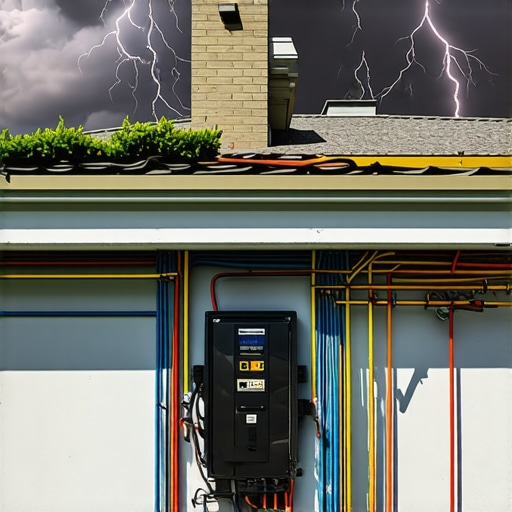
The Anatomy of a Silent Killer
You don’t hear the surge that kills your house. You hear the thunder, sure, but the actual event—the transient voltage spike that turns your $5,000 OLED TV into an expensive piece of wall art—happens in a microsecond. I’ve spent 35 years as a master electrician and forensic inspector, and I’ve seen the aftermath of ‘The Big One’ more times than I care to count. When I walk into a home after a coastal storm, I’m not just looking for charred outlets. I’m looking for the smell of ozone and the tell-tale discoloration of copper bus bars. Electricity is a predatory force; it constantly seeks the path of least resistance to the earth. Without a whole house surge protector, that path is your 400 amp service entrance, your expensive CAT6 cabling services, and every single appliance you own.
The Old Timer’s Lesson: The Mystery of the Ghost Voltage
My old journeyman, a man who treated a Wiggy like a religious relic, once slapped my hand away from a panel during a rough-in. I was 19, cocky, and stripping Romex with a pocket knife. ‘You nick that copper, you’re making a fuse, not a circuit,’ he growled. But his real lesson came later, after a summer storm hit a local boat dock. We were looking at a boat lift wiring job that had literally exploded. The owner hadn’t installed any secondary surge suppression. A strike hit a transformer three blocks away, traveled through the utility lines, and because the trenching electrical conduit wasn’t properly bonded to a dedicated grounding electrode, the surge used the boat lift’s motor as its final destination. It didn’t just burn the motor; it welded the gears together. That’s when I learned that electricity doesn’t care about your ‘renovations’ or your ‘high-end’ finishes. It only cares about the physics of potential difference.
“Aluminum wire connections can overheat and cause a fire without tripping the circuit breaker.” — CPSC Safety Alert 516
The Physics of the Spike: Why Your Power Strip is a Placebo
Most homeowners think those $20 plastic power strips under their desk are doing something. They aren’t. Those are ‘Type 3’ devices. They are designed to catch the leftovers, the tiny ripples in the pond. A real surge from a lightning strike or a utility transformer failure is a tidal wave. We’re talking about transient voltage that can exceed 6,000 volts in nanoseconds. To understand why this happens, you have to look at clamping voltage. A whole house surge protector, installed at the main panel, acts like a pressure relief valve. When the voltage exceeds a certain threshold—usually around 330V or 600V depending on the unit—the Metal Oxide Varistors (MOVs) inside the device shunt that excess energy directly to your grounding system. If your grounding system is old, or if you’ve got high-resistance soil in a coastal area, that energy has nowhere to go but back into your home’s ‘nervous system.’ This is why we insist on OSHA compliance wiring standards even in residential settings; safety isn’t an ‘upsell,’ it’s a requirement for survival.
The Fragility of Modern Infrastructure
Modern homes are filled with microprocessors. Your fridge has a brain. Your driveway sensor lights have brains. Even your lighting installation services now involve LED drivers that are essentially tiny computers. These components are incredibly sensitive to ‘Cold Creep’ and thermal expansion. In mid-century homes, we often see 400 amp service entrance upgrades where the installer forgot the most important part: the surge bridge. Without it, every time your AC compressor kicks on, it sends a ‘mini-surge’ through the house. Over years, these micro-surges degrade the insulation on your wires and the silicon chips in your devices. It’s like a thousand tiny hammer blows to a piece of glass. Eventually, it shatters.
“Protection against lightning-generated surges is a critical component of any electrical safety program, as defined by NFPA 70.” — National Electrical Code (NEC)
Coastal Realities: Salt, Corrosion, and Boat Lifts
If you live near the water, the enemy isn’t just the storm; it’s the air. Salt air is conductive. It facilitates galvanic reaction inside your meter can and your fence line lighting connections. I’ve pulled apart outdoor junction boxes where the ‘Monkey Shit’ (duct seal) had failed, and the wires were covered in a green crust of oxidation. When a surge hits these compromised connections, the resistance is so high that it creates an arc. This is why boat lift wiring is a forensic nightmare. You have a direct path to a massive body of water. If your surge protection isn’t up to snuff, a nearby strike can energize the water around your dock. For more on how to keep your exterior systems running, see how electricians tackle troubleshooting for lighting installations. We use tick tracers to find those hidden faults before they become fires.
The Low-Voltage Trap: CAT6 and Ethernet
Everyone focuses on the 120V outlets, but what about your data? I’ve seen entire server racks fried because a surge entered through the ethernet wiring services or the CAT6 cabling services. Most people don’t realize that long runs of data cable can actually have voltage induced into them by a nearby power line during a surge. This is why proper trenching electrical conduit separation is vital. If you run your CAT6 in the same trench as your main power feed without 12 inches of separation or a metallic barrier, you’re just begging for inductive kickback to fry your router. If you’re also managing an electric vehicle, ensure you read about top EV charger maintenance tips for optimal performance to prevent similar failures in your charging equipment.
The Forensic Inspection: Is Your Panel a Time Bomb?
During a forensic audit, the first thing I check is the torque on the main lugs. If a lug is loose, it creates resistance. Resistance creates heat. Heat causes the metal to expand and contract, which loosens the lug even further. This is the cycle of failure. When a surge hits a loose connection, it’s like a bomb going off. In many mid-century homes, we find old Federal Pacific or Zinsco panels. These are ‘The Trap.’ They often don’t trip even when the bus bar is melting. If you’re planning on lighting installations made easy, you need to make sure your foundation—the panel—is solid first. If your panel is older than 30 years, you’re playing Russian Roulette with every thunderstorm. Adding emergency exit lighting won’t help if the whole panel is a molten mess of copper and plastic. For those with EVs, it’s even more critical; check out ensuring safe and efficient EV charging station setup at home to make sure your system can handle the load without melting down.
The Final Fix: Don’t Be a Statistic
A proper whole-house surge protector should be a ‘Type 1’ or ‘Type 2’ device, installed directly onto the bus bars with the shortest leads possible. Every inch of wire added to a surge protector increases the let-through voltage. If the leads are too long, the surge will pass right by the protector before it has a chance to react. You need a pro who knows how to trim-out a panel so that the surge device has the priority path. If you’re seeing flickering lights or smelling something fishy near your outlets, don’t wait for the storm. Contact us today before your 400 amp service becomes a 400 amp bonfire. If you’re already having issues with your car’s power supply, read up on EV charger troubleshooting. Stay grounded, stay torqued, and for God’s sake, stop using those cheap power strips.