
The Hidden Danger Lurking in Your Walls Since 1972
Most homeowners view their electrical system like the plumbing: if it isn’t leaking or clogged, it must be fine. But as a forensic inspector who has spent three decades documenting the charred remains of ‘renovated’ mid-century homes, I can tell you that electricity is a patient killer. It doesn’t leak; it smolders. When the mercury drops and you start cranking the heat, that’s when the Time Bomb begins its countdown. The transition from fall to winter is the most stressful period for a residential or commercial electrical grid. We aren’t just talking about a tripped breaker; we are talking about the physics of material failure in systems that were never designed for the 21st-century load. My old journeyman used to smack my hand if I stripped a wire with a knife. ‘You nick the copper, you create a hot spot,’ he’d scream while pointing his Wiggy at a sparking junction box. He was right. That microscopic nick reduces the cross-sectional area of the conductor, increasing resistance and generating heat that can’t escape. In the winter, this problem is magnified tenfold.
“Aluminum wire connections can overheat and cause a fire without tripping the circuit breaker.” – CPSC Safety Alert 516
The Physics of Cold Creep and Aluminum Failures
If your home was built between 1965 and 1978, you likely have aluminum branch circuit wiring. The industry pushed it because copper prices skyrocketed, but they didn’t account for ‘Cold Creep.’ Aluminum has a much higher coefficient of thermal expansion than copper. Every time you turn on your kitchen range hood wiring or a heavy-duty heater, the wire expands. Because the aluminum is soft, it deforms against the steel terminal screws in your outlets. When the load drops and the wire cools, it contracts, but it doesn’t snap back to its original shape. It leaves a gap. That gap is an invitation for oxygen to enter, creating a layer of aluminum oxide—a highly resistive material. Now, instead of a solid connection, you have a heating element inside your wall. This is why a certified journeyman services professional doesn’t just look for lights that work; we look for evidence of thermal cycling at every home run. In retail store wiring, this is even more critical as harmonic filter services are often needed to deal with the non-linear loads of LED drivers and computer systems that can overheat neutrals.
Why Your EV Charger is Stressing an Aging Panel
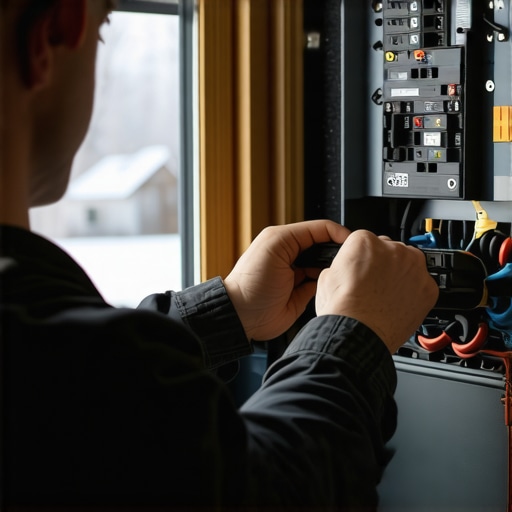
Installing a Level 2 EV charger in a home with a 1970s Federal Pacific or Zinsco panel is like asking a marathon runner to sprint while breathing through a straw. These panels are notorious for ‘jamming.’ The internal pivots of the breakers corrode or weld shut, meaning they won’t trip even during a massive overcurrent event. When we perform a winter check, we aren’t just looking for EV charger troubleshooting; we are performing a load calculation to see if your 100-amp service can actually handle the continuous 40-amp draw of a vehicle alongside your HVAC and water heater. If you are ensuring safe and efficient EV charging station setup at home, you cannot ignore the health of the main bus bars. I’ve seen bus bars so pitted from arcing that they looked like the surface of the moon. This is where augmented reality troubleshooting is starting to change the game, allowing us to overlay thermal imaging data directly onto the physical components to see heat signatures that the naked eye misses.
The Winter Maintenance Checklist: Beyond the Breaker Box
Winter maintenance contracts are often dismissed as an unnecessary expense until the pool pump electrical system freezes up or the swimming pool bonding fails. In the winter, ground moisture can freeze and heave, potentially snapping the thin copper wire used for bonding your pool’s metal components to the grounding grid. Without that bond, a fault in the pump motor could energize the water itself. During a routine inspection, we check the integrity of these connections, often applying ‘monkey shit’ (duct seal) to prevent moisture from entering conduits where it can freeze and crack the PVC. We also look at phone line installation points; while low voltage, these often provide a path for surges if the primary building ground has shifted due to frost. If you notice flickering when the wind blows, your service mast might be loose, or your neutral is failing. This isn’t a job for a handyman; it requires same day service appointments from a pro who carries a Tick Tracer and knows how to use it safely.
“All equipment shall be installed and used in accordance with the instructions included in the listing or labeling.” – NEC Article 110.3(B)
The Forensic Reality: Why ‘Just Working’ Isn’t Enough
I’ve walked into too many ‘autopsies’ where the homeowner said, ‘Everything was working fine until it wasn’t.’ Usually, they had just finished a DIY project, perhaps a kitchen range hood wiring job where they used the wrong wire nut or failed to secure the Romex to the cabinet. In the cold months, the house shifts, the materials contract, and that loose wire finally vibrates free. A maintenance contract provides a rough-in and trim-out level of scrutiny every single year. We check the torque on every lug in the panel. We check for the smell of ozone, which indicates active arcing. If you’re managing a commercial space, retail store wiring requires even more frequent checks to ensure harmonic filter services are functioning to prevent transformer overheating. Don’t wait until you’re searching for expert tips to fix common issues in the middle of a blizzard. Get the system checked while the weather is mild, and ensure your home isn’t the next forensic case study on my clipboard.
[PLACEHOLDER_IMAGE_1]