
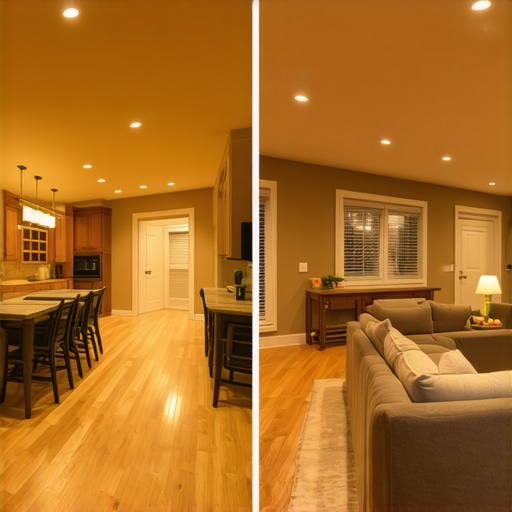
The Forensic Reality of Basement Illumination
I walked into a ‘fully renovated’ basement last December, right in the middle of a string of holiday emergency calls, where the homeowner complained of a persistent ‘ozone smell’ near their new home theater. I pulled out my tracer and started sniffing around the drop ceiling. What I found was a classic flipper special: they had buried three live junction boxes behind the drywall and tapped a 15-amp track light circuit into a 30-amp dryer feed using nothing but electrical tape and hope. The wire nuts had partially melted, and the Romex was discolored from localized heating. It’s a miracle the place hadn’t gone up. When you’re choosing between track lighting and recessed cans for a basement, you aren’t just picking an aesthetic; you’re deciding how you’re going to manage heat, moisture, and the structural integrity of your floor joists. If you don’t respect the physics of the load, the house will eventually remind you why I carry a fire extinguisher in my truck.
The Anatomy of a Recessed Can: Thermal Chimneys in Your Joists
Recessed cans, or ‘pot lights’ as the old-timers call them, are the gold standard for clean, low-ceiling basements, but they are frequently installed by people who shouldn’t be allowed to hold a pair of dikes. The core issue with a recessed light is heat dissipation. In a basement, you’re often dealing with tight joist spaces and insulation. If you use a non-IC (Insulation Contact) rated fixture and bury it in fiberglass, you’ve created a thermal bomb.
“A luminaire that is properly identified as being suitable for installation in direct contact with insulation shall be permitted to be in contact with the insulation.” – NEC Section 410.116(A)(2)
Modern LED ‘wafer’ lights have changed the game slightly, but the driver boxes still generate significant heat. Component zooming reveals the danger: the thermal protector—a small bi-metal switch inside the housing—is designed to cut power if the unit overheats. If that switch fails closed, the fixture will continue to bake the surrounding wood until it reaches its ignition point. When we do a rough-in for recessed lighting, we ensure every home run back to the panel is secured and that the cans are spaced to avoid compromising the structural load of the floor above. Nobody wants their kitchen to sag because a ‘handyman’ turned their basement ceiling into Swiss cheese.
Track Lighting: The Vulnerable Workhorse
Track lighting is often the ‘easy’ solution for basements with exposed beams or finished ceilings where fishing wires is a nightmare. But ‘easy’ doesn’t mean ‘safe.’ In my 35 years, I’ve seen more track lighting failures due to physical damage and poor torque than almost anything else. Because the track is exposed, it’s a target. I’ve seen kids throw a ball and hit a track, slightly unseating a head and creating a high-resistance arc. You can’t see the arc, but you can hear it on your AM radio or see the interference on your network cable installation. Track connectors are notorious for ‘cold creep’—the physical deformation of the metal over time due to thermal expansion and contraction. If those screws aren’t torqued to spec, the connection loosens, resistance rises, and the plastic housing begins to carbonize. If you’re considering this for a workshop or a gym area, you need to be aware that the track itself acts as a massive bus bar. Any moisture from a basement bathroom exhaust fan that isn’t vented properly can lead to surface tracking and eventual failure of the track’s insulation.
Voltage Drop and the Basement Environment
Basements are notoriously damp. Even if you don’t have standing water, the humidity levels are higher, which accelerates oxidation on copper and aluminum surfaces. When we handle lighting installations, we have to consider the environment. If you’re running a long track of lights, you have to account for voltage drop. A 120V circuit that drops to 105V at the end of a long run isn’t just dim; it’s inefficient and hard on the electronics in modern LED heads. For those planning a high-end basement with complex needs—perhaps a server room or a space requiring troubleshooting for lighting installations later—the choice of infrastructure matters. Recessed cans offer a sealed system that is less susceptible to the ‘dust and damp’ cycle of a basement, whereas track lighting is an open invitation for spiders to build nests and moisture to settle on the copper rails.
“Aluminum wire connections can overheat and cause a fire without tripping the circuit breaker.” – CPSC Safety Alert 516
While most modern tracks are copper, I still see old mid-century tracks in basements that used aluminum-clad rails. If you have those, rip them out. They are a literal ticking clock.
The Decision: Which One Keeps You Safe?
If your basement has a low ceiling (under 8 feet), recessed cans are your only real option. Track lighting hangs down and becomes a ‘widow maker’ for anyone over six feet tall walking in the dark. However, if you have a finished basement and don’t want to tear out the ceiling for a rewire, track lighting is the logical choice. But don’t just slap it up. You need to ensure the circuit isn’t already overloaded by things like hot tub wiring services or heavy laundry appliances. We use a Wiggy to check for phantom voltage and ensure the ground is solid. A ‘bootleg ground’ in a basement is a death sentence; if the neutral fails, the metal track of your lights could become energized. Always ensure your electrician is bonded and insured before they start drilling holes or mounting tracks. If you’re also looking into modern upgrades like EV charging station setup at home, your panel needs to be evaluated for the total load, including your new basement lights. Don’t be the person who calls me on Christmas Eve because their basement is glowing, and it’s not the holiday decorations. Get it done right, get it torqued, and sleep at night knowing your basement isn’t a fire hazard. For any concerns or to schedule a real inspection, you can always contact us to ensure your home meets the highest safety standards.