
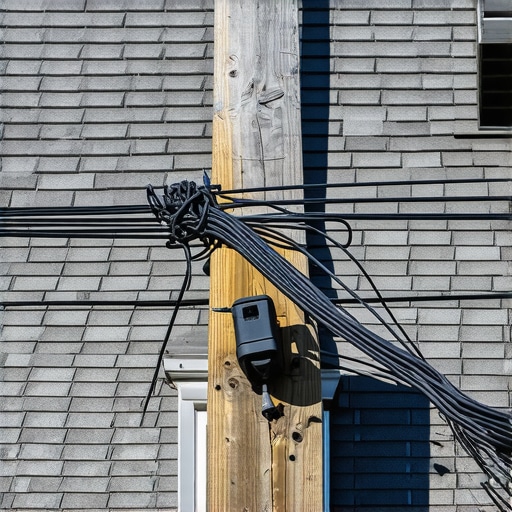
The Sound of a Potential Catastrophe: When Physics Meets Your Service Mast
You’re sitting in your living room when a storm rolls through, or maybe a neighbor’s tree finally gives up the ghost. You hear a sickening crunch and the lights flicker like a horror movie before everything goes black. Outside, the overhead service drop—those heavy conductors carrying thousands of volts from the utility pole—is now resting on your gutter or, worse, pulling your weatherhead out of the siding. This isn’t just a power outage; it’s a structural and electrical nightmare. As a forensic inspector who has spent 35 years looking at the charred remains of service entrances, I can tell you that what you do in the next sixty minutes determines if your house stays standing or becomes a case study in insurance claim electrical work.
The Old Timer’s Lesson: Why the Nick Matters
I remember my first week as an apprentice, trying to strip the heavy insulation off a 4/0 service entrance cable with a dull pocket knife. My journeyman, a guy who had probably forgotten more about Ohm’s law than most people ever learn, smacked my hand so hard I thought I’d broken a finger. ‘You nick that copper, you create a hot spot,’ he barked. ‘You’re creating a point of resistance where heat will build up every time the AC kicks on. You want to be the guy who burns down a family’s home because you were lazy with your dikes?’ He was right. When an overhead service drop is hit by a tree limb or a falling mast, those conductors are stretched to their breaking point. Even if the lights stay on, those internal copper strands might be half-severed, creating a high-resistance fault that a standard breaker won’t always catch. This is why you need certified journeyman services to perform a forensic inspection immediately after an impact.
“Aluminum wire connections can overheat and cause a fire without tripping the circuit breaker.” – CPSC Safety Alert 516
The Anatomy of the Impact: Component Zooming into the Failure
When we talk about an overhead service drop, we aren’t just talking about a wire. We are talking about a complex mechanical system under constant tension. First, there is the Triplex—two insulated conductors wrapped around a bare neutral messenger wire. This neutral is the only thing holding that weight. When a branch hits it, the tension is transferred directly to the point of attachment on your house. If you have an older home, that attachment is likely a porcelain insulator screwed into a 2×4 that’s been rotting for forty years. The physics of Cold Creep and thermal expansion come into play here. Aluminum, commonly used in service drops, expands and contracts at a different rate than the steel or copper components it’s bolted to. A sudden impact causes mechanical stress that can loosen the lugs in your meter can, leading to arcing. You might not see it, but that arcing is screaming at 3,000 degrees Fahrenheit behind your siding. If you’re planning on an EV charger installation or a subpanel installation, your entire system’s integrity starts here, at the mast. A compromised mast cannot handle the load of a modern workshop electrical setup.
The Forensic Breakdown: The Hidden Dangers of the Service Mast
When I arrive on a scene where a service mast has been hit, the first thing I pull out is my Wiggy. I want to see if there is potential on the mast itself. A ‘widow maker’ scenario occurs when the insulation on the hot legs is shaved off by the sharp edge of a bent weatherhead, energizing the entire metal pipe and the gutters attached to it. I’ve seen homeowners try to ‘propping up’ the wire with a wooden ladder—don’t be that guy. You need to understand the ‘Home Run.’ The service entrance conductors go from the weatherhead, down the mast, through the meter, and directly to your main lugs. There is NO fuse between the utility pole and your main breaker. If those wires short out because the mast is crushed, the only thing stopping the flow of energy is the transformer on the pole blowing up—and that takes a lot of current. This is why we use ‘Monkey Shit’ (duct seal) at the top and bottom of the entrance; it keeps moisture from following those wires into your panel and causing bus bar corrosion, which is a common find during troubleshooting for lighting installations after a storm.
Structural Integrity and Insurance Claim Electrical Work
Most homeowners assume the utility company owns everything. Wrong. They usually own the wire to the point of attachment. You own the mast, the weatherhead, the meter base, and everything inside. When that mast gets bent, it’s a structural failure. You can’t just bend it back. The galvanized coating cracks, oxygen gets in, and within two seasons, you have rust-weakened steel holding up live high-voltage lines. If you’re dealing with insurance claim electrical work, insist on a full mast replacement. This is also the time to consider a heavy-up. If you’re already paying for the labor to fix a storm-damaged service, why put back a 100-amp tin can when you could upgrade to 200-amp service? This provides the headroom for optimal performance of high-draw appliances and smart lighting installation. I’ve seen insurance companies try to lowball by suggesting a ‘re-attachment.’ I tell them to read the NEC. You don’t patch a service entrance; you restore its mechanical and electrical integrity.
“All electrical equipment shall be installed in a neat and workmanlike manner.” – NEC Article 110.12
The Ripple Effect: From the Mast to the Workshop
The impact doesn’t stop at the roofline. The jarring force of a service drop being pulled can loosen the neutral wire at the main lug. This is a forensic inspector’s biggest fear: The Floating Neutral. When you lose a solid neutral connection, 120V circuits can suddenly see 240V. I’ve walked into homes where the Christmas light services were literally smoking, and the PA system installation in the basement was fried because the neutral was dangling by a thread after a tree limb hit the service drop. This surge can destroy everything from your EV charger to your permanent holiday lighting controllers. Always have an electrician use a Tick Tracer and a load tester on every circuit after a service impact to ensure no ‘invisible’ damage occurred behind the drywall. For those with senior discount services, ensuring the reliability of medical equipment or stairlifts after such an event is non-negotiable.
The Solution: Code-Compliant Repair vs. The Handyman Special
I once saw a ‘handyman’ repair a hit service drop by using Romex connectors on a 2-inch rigid pipe and sealing the gaps with bathroom caulk. It was a fire waiting for a place to happen. A real repair involves checking the grounding electrode system—those grounding rods driven into the earth. Often, the jolt of the impact can snap the ground wire where it exits the house. Without that ground, your surge protectors are useless, and your lighting installations become a shock hazard. We ensure everything is torqued to the specific inch-pounds required by the manufacturer. We don’t guess; we use torque wrenches. Whether it’s a workshop electrical setup or a simple residential repair, the goal is to make sure you sleep at night knowing the only thing your electricity is doing is powering your home, not trying to burn it down. Don’t wait for the fishy smell of melting plastic. If your service drop was hit, get a pro out there before the next rain turns a minor ding into a major disaster.