
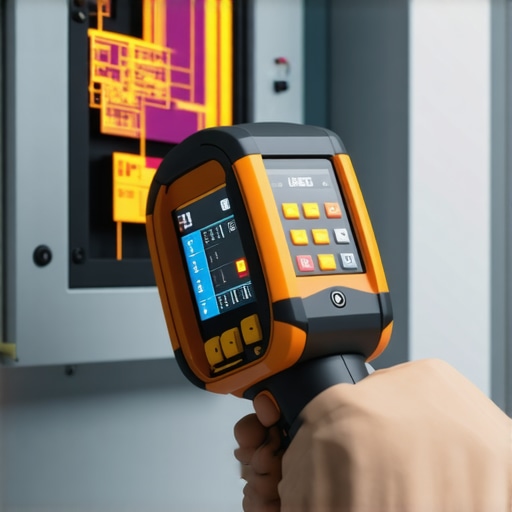
The Invisible Enemy: Why You Can’t Trust Your Eyes with High Voltage
I’ve spent thirty-five years pulling 12-gauge Romex through spider-infested crawlspaces and smelling the unmistakable, sickly-sweet scent of scorched phenolic resin. If there is one thing I’ve learned, it’s that electricity is lazy and incredibly destructive. It always wants the path of least resistance, but when it encounters high resistance—due to a loose lug or an oxidized terminal—it turns that energy into heat. By the time you see smoke or smell that ‘fishy’ aroma, you aren’t just looking at a repair; you’re looking at a structural failure. This is why infrared thermography scans are the most critical tool in my bag. I don’t care if your house was built in 1920 or 2024; heat is a silent killer of electrical components.
The Flipper’s Ghost: A Forensic Discovery
I recently walked into a ‘fully renovated’ office space where the client complained about a intermittent flickering in their new office lighting upgrades. The drywall was pristine, the paint was fresh, but my gut was screaming. I didn’t reach for my Wiggy or my Tick Tracer first; I pulled out the thermal imager. I panned the wall near the ceiling and saw a glowing purple-and-white bloom behind the plaster. The ‘flipper’ who renovated the space had buried a junction box—a massive code violation—where they’d tapped into an old circuit to power a new bathroom exhaust fan. The wire nuts were loose, and the heat was radiating at 185 degrees Fahrenheit. Without that scan, that wall would have been a chimney within a month. This is the reality of code violation corrections: they aren’t about being picky; they’re about preventing a catastrophe.
“Aluminum wire connections can overheat and cause a fire without tripping the circuit breaker.” – CPSC Safety Alert 516
The Physics of Failure: Why Components Get Hot
To understand why thermal imaging inspections are non-negotiable, you have to understand the physics of an electrical connection. Every time you turn on a heavy load—like a space heater or an EV charger—the copper wire heats up and expands. When the load turns off, it cools and contracts. This is the cycle of thermal expansion. Over years, this cycle can cause screws on a bus bar to back out just a fraction of a millimeter. This creates a gap, which leads to arcing. Once arcing starts, carbon starts to build up. Carbon is a poor conductor, which creates more resistance, which creates more heat. It’s a localized feedback loop that ends in a molten pile of copper and plastic.
In older homes with a 100 amp service upgrade requirement, the problem is compounded. These panels were never designed for the simultaneous load of a heat pump, an induction stove, and modern CAT6 cabling services powering a home server rack. When you push a 100-amp service to its limit, the main lugs are the first to show the strain. During a power quality analysis, we often find that the service entrance cables are running 40 degrees hotter than the ambient air temperature, indicating that the system is gasping for breath. This is usually the point where I recommend a comprehensive electrical panel upgrade to safely handle modern demands.
The Danger of the ‘Handyman Special’
I’ve seen ‘pros’ try to fix flickering lights by just tightening every screw they see. That’s a amateur move. If a connection has already been overheated, the metal has likely undergone a process called annealing, making it soft and prone to further loosening. You can’t just ‘torque it down’ and walk away. This is especially true with spa grounding services. Water and electricity are a lethal combination, and high-resistance grounds can lead to stray voltage in the water. We use infrared thermography scans to check the bonding jumpers and ground rods because a faulty ground won’t trip a breaker, but it will show up as a heat signature on a high-end camera.
“Thermal imaging allows for the identification of ‘hot spots’ that indicate potential equipment failure or fire hazards before they occur.” – NFPA 70B Recommended Practice for Electrical Equipment Maintenance
Why Office Environments Are High-Risk
In a commercial setting, the stakes are even higher. Office lighting upgrades often involve retrofitting old fixtures with LED drivers. If those drivers are buried in a plenum ceiling without proper airflow, they become miniature ovens. Furthermore, CAT6 cabling services and data racks generate significant heat. If a data room’s electrical supply isn’t monitored via annual thermal scans, a single loose neutral can fry thousands of dollars in hardware. We look for ‘phase imbalance’—where one leg of your three-phase power is pulling more current than the others—which causes the transformer to hum and heat up, eventually leading to a total blackout.
When we perform thermal imaging inspections, we aren’t just looking for bright spots. We are looking for the ‘Delta T’—the temperature difference between a suspect component and a known good one. If I see a 10-degree Celsius difference between two breakers on the same load, I’m pulling the panel cover. I’m looking for ‘Monkey Shit’ (duct seal) that’s dried out and allowing moisture into the electrical panel upgrade, or worse, evidence of ‘Cold Creep’ where the conductors have literally deformed under pressure. This is the level of detail required for troubleshooting for lighting installations and ensuring long-term safety.
Your Maintenance Checklist: Beyond the Visual
Visual inspections are 10% of the job. The other 90% is understanding what’s happening at the molecular level. If you haven’t had your panel scanned in over a year, you are flying blind. Whether it’s ensuring safe EV charging station setup or checking the circuits for a new bathroom exhaust fan, the infrared camera doesn’t lie. It sees the oxidation you can’t, and it detects the loose lugs that your dikes and screwdrivers haven’t touched yet. Don’t let your home or office become a forensic case study. Get the scan, find the heat, and fix it before the copper starts to glow. If you have questions about your system’s health, it’s time to contact us for a professional evaluation. Safety isn’t a suggestion; it’s the law of the circuit.