
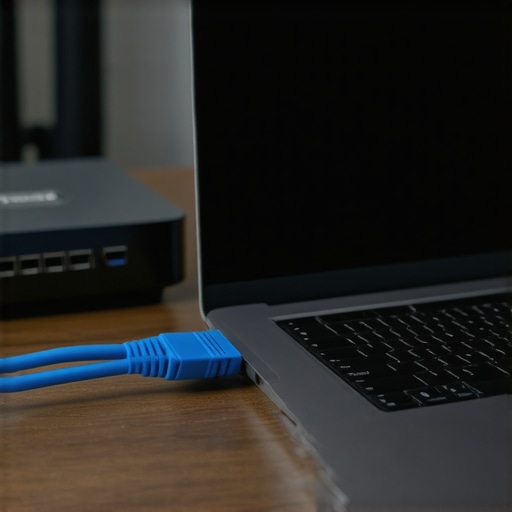
The Invisible Decay of the Wireless Promise
You’ve been told the lie. You spent four hundred dollars on a sleek, white mesh Wi-Fi system that looks like a high-end air freshener, yet your Zoom calls still stutter like a cold engine on a January morning. I’ve spent over 35 years in the trades, from rough-in to trim-out, and I’ve seen homeowners try to duct-tape their digital lives with radio waves while their actual infrastructure is a 1960s horror show. Wireless is a convenience; copper is a guarantee. When you’re pushing gigabit speeds in a home office, relying on mesh is like trying to fill a swimming pool with a squirt gun through a screen door. You lose pressure, you lose volume, and eventually, you lose your mind.
The Forensic Breakdown: The Flipper Special and the Hidden Network Trap
I recently walked into a ‘fully renovated’ 1970s ranch style home in the suburbs. The owner was complaining that his high-speed fiber connection felt like dial-up whenever the microwave was running. He’d been told the house was ‘fully rewired’ for the modern age. I pulled out my tick tracer and my Wiggy, and within ten minutes, I found the culprit. The flipper had indeed installed CAT6 wall plates in every room to look ‘high-tech,’ but behind the drywall, he hadn’t run a single new wire. He had spliced into the old, unshielded 1970s telephone lines—CAT3 at best—using nothing but electrical tape and a prayer. He’d even buried a live junction box behind the master bedroom closet’s shiplap, which I only found because my tracer started screaming at a ghost in the wall. This ‘renovation’ was a digital time bomb. The old telephone wires weren’t twisted tightly enough to reject the electromagnetic interference (EMI) from the nearby Romex. Every time the refrigerator compressor kicked on, the packet loss would skyrocket. That’s the reality of ‘wireless’ reliance in an old structure; you are at the mercy of the physics of the building. This is why a dedicated home run of shielded CAT6 is the only way to ensure your office isn’t fighting with your toaster for bandwidth.
“Proper grounding and bonding of communication cables are essential for protection against lightning and power surges.” – NEC Article 800.100
The Physics of Failure: Why Mesh Can’t Compete
Let’s talk about signal attenuation and latency. A mesh node has to use a portion of its bandwidth just to talk to the other nodes. This is called ‘backhaul.’ If you’re using a dual-band system, your office computer is essentially standing in a crowded room trying to hear a whisper through three people who are also whispering to each other. Hardwired CAT6, however, utilizes 23 AWG solid copper conductors twisted at specific rates to cancel out crosstalk. In my 35 years, I’ve seen how fire damage wiring restoration often reveals how heat can degrade the dielectric properties of wire insulation. The same happens with your signal. In a mesh network, every wall, every piece of foil-backed insulation, and every structural beam acts as a dampener. Hardwired connections eliminate the inverse square law problems of radio waves. When I perform an electrical panel upgrade to support a growing home office, I always tell the client: if you don’t hardwire your desk, you’re building a mansion on a swamp.
The Anatomy of a Professional CAT6 Install
When I do a lighting install, I’m worried about lumens and heat. When I do a data rough-in, I’m worried about the ‘bend radius.’ You can’t treat CAT6 like 14/2 Romex. If you kink that data cable, you change the distance between the twisted pairs, creating a ‘hot spot’ for data collisions. I use my dikes to cleanly snip the spline—that plastic cross in the middle of the cable that keeps the pairs separated. This spline is critical for maintaining the geometry required for 10-Gigabit speeds. Most people don’t realize that an RV hookup installation and a high-speed home office actually share a common requirement: a solid grounding electrode install. Without a clean ground, your network equipment is vulnerable to common-mode noise that can bypass even the best mesh encryption. If you’re serious about your work, you need a system that doesn’t care if the neighbor is using their 1980s microwave.
“Reliable data infrastructure reduces electromagnetic interference (EMI) which can compromise emergency systems.” – NFPA 70-2023 Handbook
Beyond the Office: Integrating the Whole House
Modern homes require more than just a good router. They need an infrastructure that supports everything from ensuring safe and efficient EV charging station setup at home to emergency exit lighting for safety. A hardwired backbone allows you to offload all high-bandwidth devices—TVs, gaming consoles, and workstations—leaving the airwaves clear for things that actually need to be mobile, like your phone. I’ve even started using augmented reality troubleshooting to map out these systems for clients, showing them where the interference ‘nodes’ are in their walls. If you’re a veteran, always ask about military discount wiring services, as we take extra care to ensure the mission-critical reliability of your home infrastructure. We offer a lifetime workmanship guarantee because when I torque a lug or punch down a keystone jack, it stays put until the house comes down. Whether you need three phase power services for a workshop or just a stable Zoom connection, the answer is always the same: stop trusting the air and start trusting the copper.
Conclusion: Sleep Better When It’s Torqued
At the end of the day, electricity and data are both just forms of energy moving through a medium. In my decades of crawling through attics filled with monkey shit (duct seal) and old insulation, I’ve learned that shortcuts always lead to a service call. Don’t be the homeowner who waits for a failure to realize their mesh system was a ‘Time Bomb’ of inconsistency. Hardwire your life, ensure your grounding electrode install is up to code, and let the professionals handle the heavy lifting. You’ll find that a hardwired office doesn’t just speed up your downloads; it lowers your blood pressure. For more on how we handle complex residential systems, check out our guide on lighting installations made easy and ensure your home is as bright as your network connection.