The Anatomy of a Disaster: Why Your Generator is a Sleeping Giant
I’ve spent thirty-five years pulling burnt copper out of walls and smelling the distinct, metallic tang of ozone that lingers after an electrical fire. You haven’t lived until you’ve stood in a dark basement with a Tick Tracer that won’t stop screaming because a homeowner decided to ‘backfeed’ their house with a homemade male-to-male extension cord. We call those Widow Makers in the trade for a reason. If you think you’re being clever by bypassing your panel’s main breaker during a blackout, you’re not just risking a fine; you’re betting your life and the lives of the linemen working on the overhead service drop on a ten-dollar piece of Romex and a prayer.
My journeyman used to smack my hand if I stripped a wire with a knife. ‘You nick the copper, you create a hot spot,’ he’d scream. He was right. Electricity is a lazy, violent beast. It wants to find the path of least resistance to ground, and it doesn’t care if that path is through your energy storage systems or your chest cavity. When you plug a portable generator directly into a wall outlet without a dedicated transfer switch, you are creating a lethal scenario where your house’s electricity can travel backward through your meter, into the transformer on the pole, and step up from 240 volts to 7,200 volts or higher. That’s enough to vaporize a utility worker before they even know the line is hot. This isn’t a ‘handyman’ fix; it’s a forensic investigation waiting to happen.
“Transfer equipment shall be designed and installed so as to prevent the inadvertent interconnection of all sources of supply in any operation of the transfer equipment.” – National Electrical Code (NEC) Section 702.5
The Physics of the ‘Time Bomb’ in Your Panel
Let’s talk about Blueprint C: The Load Calculation. Most homeowners look at a generator and see a gas-powered savior. I see an unbalanced load that’s about to cook a neutral wire. Your average home built between 1960 and 1980 likely has a 100-amp or 150-amp panel, perhaps even a dreaded Federal Pacific or Zinsco unit that hasn’t tripped a breaker since the Nixon administration. These panels are prone to ‘Cold Creep’—a phenomenon where aluminum conductors expand and contract at different rates than the steel lugs, eventually loosening the connection. When you introduce the ‘dirty’ power of a portable generator—high in Total Harmonic Distortion (THD)—you’re putting a massive thermal strain on those loose connections.
Without a power quality analysis, you don’t realize that your generator’s sine wave looks like a jagged mountain range instead of a smooth curve. This harmonic distortion creates heat. In a three phase power services environment, we manage this with massive neutral bars, but in your residential split-phase system, that heat has nowhere to go but into the insulation. I’ve seen AFCI breaker services trip repeatedly because the generator’s interference mimics the signature of a dangerous arc. If you don’t have a transfer switch to isolate your level 2 EV charger or your spa grounding services, you are inviting that ‘dirty’ voltage to fry the sensitive circuit boards in your expensive appliances. If you’re having trouble with your high-draw items, you might need expert tips to fix common issues before you even think about backup power.
Component Zooming: The Transfer Switch vs. The Interlock
When I do a rough-in for a generator system, I’m looking at the physics of the transfer switch itself. A manual transfer switch is a break-before-make mechanical device. It is physically impossible for the utility power and the generator power to meet. Imagine it like a railroad switch; the train can only go on one track at a time. The ‘interlock kit’ is a cheaper alternative, but it relies on a sliding metal plate to prevent the main breaker and the generator backfeed breaker from being ‘on’ at the same time. While code-compliant in many jurisdictions, I’ve seen cheap, unlisted interlocks jam or bend, leading to a catastrophic phase-to-phase short that turns the panel into a localized sun.
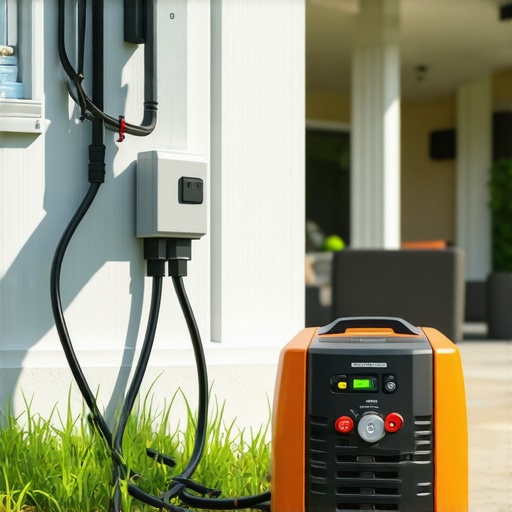
The installation process isn’t just about slapping a box on the wall. It involves a home run of heavy-gauge wire from the outdoor inlet box to the transfer switch. I use Monkey Shit (duct seal) to plug the hole in the foundation to prevent moisture from causing salt air corrosion—a major enemy if you’re near the coast. Moisture leads to galvanic reaction, where the copper and aluminum start eating each other. A proper pathway lighting install or up lighting services should also be considered here, as you need to see your way to the generator in a storm without tripping over your dikes or a stray grounding rod. Ensuring everything is torqued to spec is the difference between a system that works for twenty years and one that melts down during the first blizzard.
“Aluminum wire connections can overheat and cause a fire without tripping the circuit breaker.” – CPSC Safety Alert 516
Why a ‘Heavy-Up’ is Often Mandatory
People often call for after hours electrical repair because their generator ‘died,’ only to find out they tried to run their whole house, including a level 2 EV charger and the AC, on a 5,000-watt pull-start unit. This is where Ohm’s Law becomes a cruel mistress. If you try to pull 40 amps through a system designed for 20, you generate heat proportional to the square of the current. You’re not just blowing a fuse; you’re degrading the crystal structure of the copper. This is why we often recommend a service ‘heavy-up’ alongside a generator install. If your panel is a crowded mess of Romex, we need to organize the trim-out so that the critical loads—refrigerator, well pump, furnace—are isolated. If you’re planning an EV charging station setup, you absolutely need to factor this into your backup plan.
Don’t trust a guy with a Wiggy and a roll of electrical tape to do this. You need a forensic-level lighting installations expert who understands that every connection is a potential point of failure. Whether it’s ensuring your spa grounding services are isolated during a switch-over or confirming the overhead service drop tension is correct, the details matter. If you’re unsure of your current setup, it’s time to contact us for a real inspection before the next storm hits. Sleep at night knowing your lugs are torqued, your neutral isn’t floating, and you aren’t the guy who sent a lineman to the hospital because you wanted to save three hundred bucks on a transfer switch. Electricity isn’t a hobby; it’s a force of nature that we just happen to have invited into our walls. Treat it with the fear it deserves.
Comments
One response to “Why Your Portable Generator Needs a Dedicated Transfer Switch”
This article really hits home on the importance of proper transfer switch installation. Having experienced a minor electrical scare during a storm, I understand firsthand how critical it is to use a UL-listed transfer switch rather than cheaper interlock kits, which might seem like a budget solution but could lead to catastrophic failures if they jam or bend. I’ve also learned that even a seemingly small detail, like ensuring all connections are torqued to spec and sealed properly against moisture, can extend the lifespan of the system significantly. It makes me wonder—what are some common signs homeowners might notice that indicate their panel or transfer switch isn’t installed correctly or needs maintenance? Regular inspections, perhaps, or maybe noticing unusual heat or buzzing sounds? Sharing practical tips on identifying these issues early could help many avoid serious dangers down the line. Overall, safety should always come first with backup power systems, especially considering the potential risks highlighted in this post.