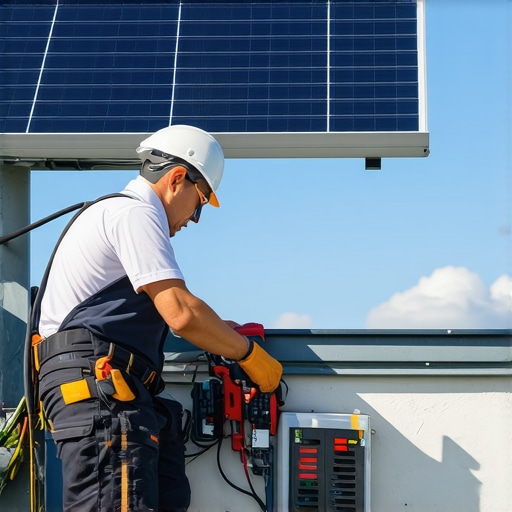
4 Solar Panel Electrical Hookup Fixes for 2026 Site Permits
You can smell a bad electrical job before you see it. It’s a sharp, metallic tang in the air—ozone mixed with the scent of roasting phenolic resin. I’ve spent 35 years pulling Romex through spider-infested crawlspaces and tracing shorts in panels that looked like a bird’s nest, and if there is one thing I know, it’s that the 2026 site permits for solar integration are going to eat ‘handymen’ alive. We aren’t just talking about mounting a few racks on a roof anymore. We are talking about high-voltage DC strings, micro-inverters, and the brutal physics of thermal expansion in aging service panels. If your licensed master electrician isn’t checking the torque on every single lug with a calibrated wrench, you aren’t building a power plant; you’re building a slow-motion arson project. My old journeyman used to smack my hand if I stripped a wire with a knife. ‘You nick the copper, you create a hot spot,’ he’d scream. He was right. That microscopic notch creates a point of high resistance where electrons bottle up, generating heat that eventually melts the insulation. In the world of solar hookups, where systems run at peak capacity for eight hours a day, those ‘hot spots’ become catastrophes.
“Aluminum wire connections can overheat and cause a fire without tripping the circuit breaker.” – CPSC Safety Alert 516
The Load Calculation Crisis: Why Your Panel is a Time Bomb
The biggest hurdle for 2026 permits is the load calculation. Most homeowners think they can just slap a 10kW solar array onto a 1970s-era 100-amp panel that is already straining under the weight of a hot tub wiring services upgrade and a modern HVAC. It doesn’t work that way. When you feed power back into a busbar from the opposite end of the main breaker, you risk overloading the physical metal of the bus itself. This is the ‘120% Rule’ in the NEC, and it’s the first thing inspectors look for. If you’re adding an EV charger alongside solar, you need to be ensuring safe and efficient EV charging station setup at home by calculating the simultaneous demand. I’ve seen structured wiring panels melted into a puddle because someone ignored the ‘Home Run’ heat build-up. For 2026, the fix is often a ‘Line Side Tap’ or a complete panel heavy-up. We’re moving away from standard breakers to smart structured wiring panels that can shed loads automatically when the solar production drops and the pool pump electrical demands spike. If you don’t account for the heat generated by continuous loads, the lugs will undergo ‘Cold Creep’—a phenomenon where the metal expands and contracts until the connection looses, arcs, and welds itself into a fire hazard.
Grounding, Bonding, and the ‘Stray Voltage’ Ghost
In 2026, the inspectors are getting surgical about spa grounding services and solar bonding. If your solar array isn’t bonded correctly to the house’s main grounding electrode system, you’re creating a giant lightning rod that uses your hot tub wiring services as a path to earth. That’s a recipe for a heart attack. I’ve walked onto jobs where the pathway lighting install was picking up 40 volts of stray current because the solar installer didn’t understand the difference between a neutral and a ground. This is especially critical for boat lift wiring in coastal areas. Salt air is the enemy of conductivity. It creates a galvanic bridge between phases. When I’m doing a rough-in for a dock, I use ‘Monkey Shit’ (duct seal) to plug every conduit and dielectric grease on every terminal. Without it, the salt air rots the copper from the inside out, turning a perfectly good licensed master electrician job into a ‘Widow Maker’ within three seasons. You need to ensure your fence line lighting and holiday light installation aren’t tied into the same subpanel as your solar inverter without proper isolation, or you’ll be chasing ‘ghost trips’ with your Tick Tracer for the rest of your life.
“The grounding electrode conductor shall be installed in one continuous length without splice or joint.” – NEC Article 250.64
The Transfer Switch and Backup Power Paradox
One of the most common 2026 permit failures involves the generator transfer switch. People want their solar to work when the grid goes down, but unless you have an islanding inverter and a legitimate generator transfer switch, that solar array is a death trap for line workers. You cannot have power backfeeding into the grid during an outage. I’ve used my Wiggy to test lines that should have been dead, only to find them screaming hot because some DIY-er installed a ‘suicide cord’ instead of a proper transfer system. For solar integration, the fix is a microgrid interconnect device (MID). This automatically disconnects you from the utility when it senses a voltage drop. Whether you are running pool pump electrical or a simple pathway lighting install, the logic remains the same: electricity must be contained. If you’re struggling with flickering or failures, how electricians tackle troubleshooting for lighting installations often involves looking for these exact backfeed issues. We use dikes to clip out the old, brittle 12-gauge Romex and replace it with high-temp THHN wire that can actually handle the current density of a modern 2026-spec home.
The Forensic Reality of Solar Maintenance
Finally, we have to talk about the ‘Trim-out’ and long-term maintenance. Solar panels are exposed to the most brutal conditions on the planet—UV radiation, hail, and extreme thermal cycling. The connections at the DC optimizer are the most common failure points I find during forensic inspections. If the installer didn’t use a proper MC4 crimping tool and instead used a pair of pliers, that connection is going to arc. I’ve seen solar arrays that were supposedly ‘pro-installed’ where the fence line lighting was used as a secondary ground—a total code violation. You need a licensed master electrician who understands that solar is a 25-year investment, not a weekend project. If you are experiencing issues with your system, checking the ev-charger-troubleshooting-expert-tips-to-fix-common-issues might reveal that your solar-to-EV handoff is where the bottleneck lies. Remember, electricity isn’t a hobby. It is a fundamental force of nature that is constantly trying to return to the earth, and it will go through your house, your holiday light installation, or your body to get there if you don’t respect the path. Keep your lugs torqued, your grounds bonded, and your permits clean. That is the only way you’ll sleep at night when the 2026 standards go into full effect.