
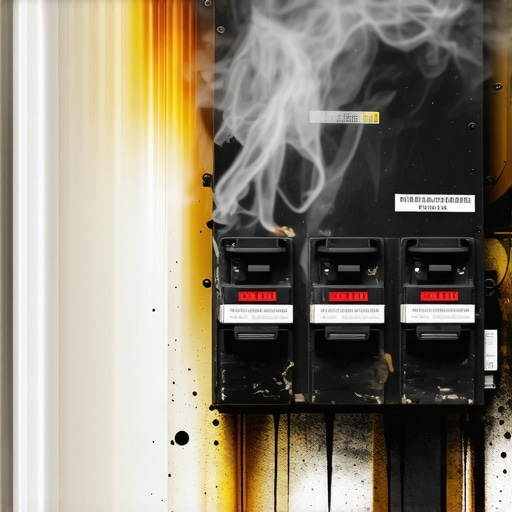
The Invisible Time Bomb: Why Your Electrical Panel History Matters
Most homeowners treat their main breaker panel like a toaster—they expect it to work forever without a second thought. But if your home was built between 1960 and 1980, you aren’t just looking at an old piece of grey metal; you’re looking at a potential time bomb. Back when I was a green apprentice, my journeyman, a guy who smelled like stale coffee and lead solder, used to smack my hand if I stripped a wire with a pocket knife. ‘You nick the copper, you create a hot spot,’ he’d bark. He wasn’t being a jerk; he was teaching me about the physics of cross-sectional area and resistance. That tiny nick reduces the wire’s ability to carry current, turning that point into a miniature toaster element inside your wall. Today, we see those ‘hot spots’ on a massive scale inside aging breaker panels that were never designed for the digital age, let alone the massive draw of a modern EV charger or a data center power setup running in a spare bedroom.
1. The Brand Name ‘Widow Makers’: Federal Pacific and Zinsco
If you open your panel door and see the names Federal Pacific Electric (FPE) or Zinsco, you don’t need a Tick Tracer to know you have a problem. These aren’t just old; they are fundamentally flawed. The FPE Stab-Lok breakers are notorious for a ‘no-trip’ defect. In a standard setup, if a circuit overloads, the bi-metallic strip inside the breaker heats up and trips the mechanism. In an FPE panel, the breakers frequently jam. The current keeps flowing, the copper Romex starts to melt its insulation, and the bus bar begins to liquefy. It’s a silent failure. You won’t know it’s broken until the smoke starts rolling out of the wall.
“Aluminum wire connections can overheat and cause a fire without tripping the circuit breaker.” – CPSC Safety Alert 516
This is especially true in these mid-century panels where the connection between the breaker and the bus bar was often poorly engineered, leading to catastrophic failure points.
2. The ‘Frying Bacon’ Sound: Audible Arcing
Electricity should be silent. If you stand near your panel and hear a persistent humming, buzzing, or a sound like frying bacon, you are hearing the sound of arcing. This is where electricity is jumping a gap between a loose wire and a terminal or between the breaker and the bus bar. We call this a high-resistance connection. Zooming into the components, the physics here is brutal: as the contact point degrades, the resistance increases, which generates more heat, which causes further oxidation, which increases resistance further. It’s a death spiral of thermal physics. If you’re planning a shed wiring install or adding patio cover outlets, adding that extra load to a panel that’s already arcing is like pouring gasoline on a campfire. You might need to look into ev charger troubleshooting if you notice these sounds specifically when your vehicle is plugged in, as the sustained high amperage will expose every weakness in your panel’s Home Run connections.
3. The 60-Amp Bottleneck: Why a Service Upgrade is Mandatory
Many homes built in the mid-20th century were outfitted with a 60-amp or 100-amp service. In 1970, that was plenty for a fridge, a few lights, and a black-and-white TV. Today, between the doorbell camera install, the solar panel electrical hookup, and the high-end HVAC systems, a 60 amp panel upgrade is no longer a luxury; it’s a safety requirement. When you pull 55 amps on a 60-amp main breaker for hours, the heat soak is immense. The main lugs begin to undergo ‘Cold Creep’—a phenomenon where the metal expands under heat and contracts when cool, slowly loosening the physical connection. Eventually, the lug becomes so loose that the air gap becomes a plasma bridge. This is why ensuring safe and efficient ev charging station setup at home usually requires a full panel heavy-up to 200 amps. You can’t squeeze a gallon of water through a straw, and you shouldn’t try to power a 21st-century life through a mid-century panel.
4. Discoloration and the Blue Hue of Overheating
During a forensic inspection, I don’t just look at the wires; I look at the metal of the bus bar itself. If I see a rainbow-like discoloration or a deep bluish-chrome tint on the copper or aluminum, that’s a sign of a massive thermal event. This isn’t just ‘old age’; it’s evidence that the metal has reached temperatures high enough to alter its molecular structure. This often happens in the Rough-in phase of a bad DIY job where the set screws weren’t torqued to spec.
“Each terminal shall be tightened to the torque values specified on the equipment… failure to do so can lead to overheating and fire.” – NFPA 70 (National Electrical Code)
When I do drone light inspections on commercial properties, we use thermal imaging to find these hot spots, but in a residential panel, your eyes and nose are the best tools. If the plastic around the breaker looks slightly melted or deformed, the internal components have already failed.
5. The Smell of Ozone and Burning Plastic
If you catch a whiff of something ‘fishy’ or a sharp, metallic tang in the air near your utility closet, that’s the smell of ozone and phenolic resin melting. By the time you can smell it, the fire has already started—it just hasn’t broken out of the enclosure yet. I’ve seen ‘handymen’ try to fix this by spraying Monkey Shit (duct seal) around the entry points to hide the smell or the draft, but that just traps the heat. This is the stage where you need professional intervention immediately. Use your Wiggy to check for voltage drops across the main breaker; a significant drop means the internal contacts are toast. If you’re at this point, don’t even think about a trim-out for new lights; you need a panel replacement before you go to sleep. We’ve seen homeowners ignore this until they’re looking for contact us details while the fire department is on the roof.
6. Corrosion and the ‘White Rust’ of Aluminum Wiring
In mid-century homes, aluminum wiring was common. The problem is that aluminum oxidizes much faster than copper. This oxidation, or ‘white rust,’ acts as an insulator. When you have an insulator at a connection point, the electricity struggles to pass through, creating—you guessed it—heat. This is why lockout tagout training is so vital for even minor repairs; you never know when a corroded wire might break off and energize the panel cabinet. If you see white powdery residue on your breakers or wires, your panel is reacting to the environment, likely due to a failing service mast seal that’s letting moisture wick down the service entrance cables. This moisture turns your panel into a battery, eating away at the vital connections until they snap.
7. Flickering Lights and Phantom Breaker Trips
If your lights dim every time the refrigerator kicks on, or if you have ‘ghost trips’ where a breaker pops for no reason, your panel is screaming for help. This is often a sign of a failing neutral. A loose neutral can send 240 volts through a 120-volt circuit, frying your electronics instantly. While some guys try augmented reality troubleshooting to visualize load balancing, the old-school reality is often just a loose screw or a pitted bus bar that can no longer hold the breaker’s tension clip. Don’t wait for a total failure. If your panel is over 40 years old, or if it’s one of the ‘danger brands,’ the only code-compliant and sane path forward is a full replacement. You want to know that when you hit the switch, the only thing happening is the light coming on—not a slow-motion fire starting in your basement. Sleep better knowing your home is torqued, balanced, and up to modern standards.