
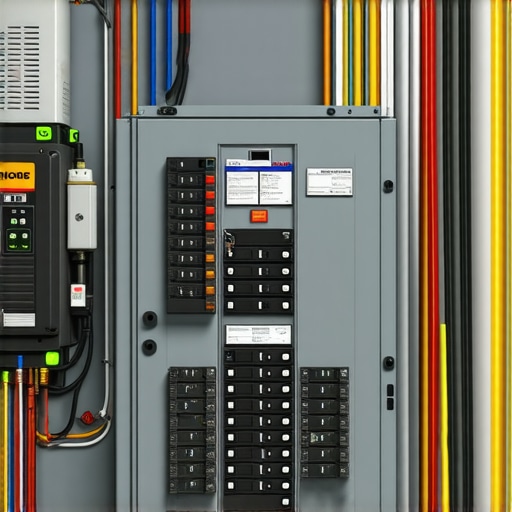
The Anatomy of a Tripped Breaker: Why Your 100-Amp Panel is Screaming for Mercy
I walked into a ‘fully renovated’ garage-turned-workshop last week where the owner complained his table saw kept ‘killing the lights.’ I didn’t even need my Wiggy to know what was wrong; the smell of scorched bakelite was thick enough to chew on. I pulled the cover off the 100-amp main and found a DIY subpanel feed that some weekend warrior had attempted to wire with a 14-gauge extension cord stripped and jammed directly into the main lugs. It was a ‘Widow Maker’ in the purest sense, hidden behind a fresh coat of drywall. This is what happens when modern dreams collide with mid-century infrastructure. If you are trying to run a 21st-century home on a 1970s service, you aren’t just inconvenienced; you are playing a high-stakes game of thermal roulette.
Ohm’s Law and the Physics of Fire
Electricity isn’t some magical fluid; it is the movement of electrons through a conductor, and that movement generates heat. When you pull 40 amps for an EV charger, 30 amps for the dryer, and another 25 for the HVAC on a 100-amp bus bar, you are pushing that copper or aluminum to its limit. In older panels, particularly those with cloth insulated wiring replacement needs, the insulation becomes brittle over decades of thermal cycling. Every time you turn on a high-draw appliance, the wire expands; when it shuts off, it contracts. This ‘cold creep’ eventually loosens the terminal screws. A loose connection creates resistance. Resistance creates heat. Heat creates fire. This is why ensuring safe and efficient EV charging station setup at home is impossible on a saturated 100-amp service.
“Service equipment shall have an ampere rating not less than the load to be served. This load shall be calculated in accordance with Article 220.” – National Electrical Code (NEC) Section 230.79
The Overhead Service Drop: The Bottleneck You Can’t See
Your electrical capacity starts long before the home run hits your panel. It starts at the transformer. If you are eyeing a workshop electrical setup or ADU electrical services, you have to look up. That overhead service drop swinging in the wind might only be rated for 100 amps. If you try to pull 200 amps through a 100-amp triplex wire, the insulation will literally melt and drip off the wire like hot wax. Upgrading to a 400 amp service entrance often requires a complete overhaul of the service mast, the meter can, and the grounding electrode system. I don’t just mean sticking a rod in the dirt; I mean ensuring the path to ground is low-resistance enough to actually clear a fault before your access control wiring fries.
Modern Load Demands: ADUs, Workshops, and Microgrids
We are living in an era of ‘electrification,’ but our panels haven’t caught up. Adding an Accessory Dwelling Unit (ADU) is essentially adding a second house to your existing service. You cannot simply ‘tap off’ the existing breakers with some Romex and hope for the best. A proper ADU electrical services plan requires a load calculation that usually necessitates a transformer installation or at least a service heavy-up. Then there is the microgrid integration. If you are adding solar and battery storage, your panel needs to handle bi-directional power flow. Old panels with ‘split-bus’ designs or those notorious Federal Pacific ‘Stab-Lok’ breakers simply cannot handle the harmonic filter services required to keep clean power flowing to your sensitive electronics.
Forensic Indicators of a Failing System
Before the fire department arrives, your house will try to tell you it’s failing. Have you noticed your LED bulbs flickering when the fridge kicks on? That’s not a ‘ghost’; that’s voltage drop caused by inadequate wire sizing or a failing neutral. If you take your Tick Tracer to the wall and it’s screaming near a junction box that has no business being hot, you’ve got an arc-fault in the making. In workshop electrical setup scenarios, I often see electric gate opener systems tied into the same circuit as heavy machinery. This induces massive surges that burn out the control boards. You need dedicated circuits and proper surge protection, not a ‘handyman special’ power strip.
“Aluminum wire connections can overheat and cause a fire without tripping the circuit breaker.” – CPSC Safety Alert 516
The Solution: From 100 Amps to 400 Amps
When we do a rough-in for a 400-amp upgrade, we aren’t just swapping a box. We are rebuilding the heart of the home. We use Monkey Shit (duct seal) to ensure no moisture migrates down the service mast into the new lugs. We use Dikes to clean up the rats’ nest of old wires, ensuring every neutral is on its own terminal—no more ‘double lugging’ which is a primary cause of arcing. If you’re serious about your home’s future, you stop patching a sinking ship. You invest in a service that can handle your EV, your workshop, and your peace of mind. For those already struggling with existing equipment, check out ev charger troubleshooting expert tips to fix common issues to see if your panel is the culprit. If the diagnostic leads back to a hot bus bar, it’s time to contact us before the smoke detector does the talking.