
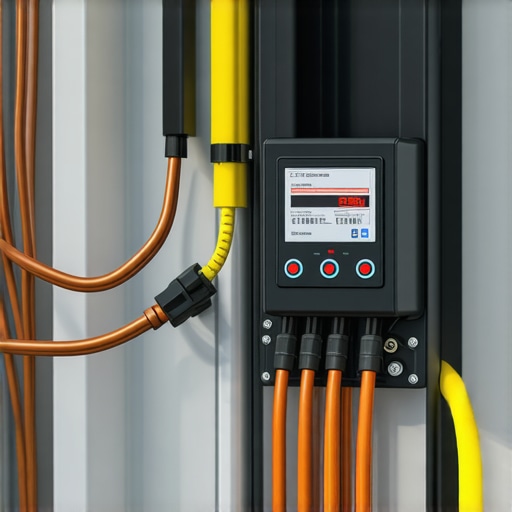
The Hum You Should Never Hear: The Reality of Continuous Load
You probably think your new Level 2 EV charger is just another appliance, like a dryer or a range. You’re wrong. In thirty-five years of pulling wire and inspecting the charred remains of ‘handyman specials,’ I have learned that an EV charger is the most brutal test your home’s electrical system will ever face. Most appliances cycle on and off. A dryer runs for 45 minutes; a water heater kicks in for twenty. But an EV charger? That is a continuous load. It pulls maximum amperage for eight, ten, maybe twelve hours straight. If there is a single weak point in your home run—a loose lug, a nicked wire, or a cheap breaker—that heat will find it. I’ve seen 60-amp breakers singing a high-pitched tune before they finally melted into the bus bar because the installer didn’t understand the physics of $I^2R$ resistive heating. This isn’t just about getting a charge; it’s about making sure you don’t need insurance claim electrical work after your garage goes up in smoke.
“Continuous load is a load where the maximum current is expected to continue for 3 hours or more.” – National Electrical Code (NEC) Article 100
The Journeyman’s Curse: Why Precision is Non-Negotiable
My old journeyman used to carry a heavy brass plumb bob, and he’d threaten to drop it on your toes if he caught you stripping wire with a pocket knife. ‘You nick that copper, kid, and you’ve just built a bottleneck for every electron in the house,’ he’d growl. He wasn’t being a jerk; he was teaching me about hot spots. When you nick a #6 AWG copper conductor, you reduce its cross-sectional area. At 48 amps of continuous draw, that tiny nick becomes a point of massive resistance. Resistance generates heat. Heat causes the metal to expand. When the charger cycles off, the metal cools and contracts. This cycle, known as thermal expansion and contraction, eventually backs the wire right out of the terminal. Before you know it, you’ve got an arc-fault that’s hot enough to melt a pendant light hanging in the room above. That’s why I treat every home EV charging station setup like a heart transplant. There is no room for ‘close enough.’
The Load Calculation: Your Panel’s Death Warrant
Before we even touch a tick tracer or a pair of dikes, we have to talk about electrical load calculations. Most mid-century homes were built with 100-amp or 125-amp services. In the 1970s, that was plenty for a fridge, a few lights, and a color TV. Today, you’re adding a 50-amp or 60-amp circuit for a charger. If you have an electric range, an AC unit, and a hot tub, you are redlining your main breaker. I’ve walked into basements where the main service entrance felt like a warm radiator because the homeowner just kept adding circuits without a permit. If you don’t do the math, you’re asking for a catastrophic failure. This is why a priority service membership is vital; it ensures an expert actually looks at the load before you plug in that Tesla or Rivian. We use AI fault detection and remote electrical diagnostics to monitor how your system handles the stress, but the foundational math has to be right first. You wouldn’t try to run a marathon while breathing through a straw; don’t ask your 100-amp panel to power a modern lifestyle and a high-speed charger simultaneously.
The Mid-Century Time Bomb: Aluminum and FPE Panels
If your home was built between 1960 and 1980, we have an even bigger problem: the infrastructure. If I open your panel and see the words ‘Federal Pacific’ or ‘Zinsco,’ I’m not even going to quote the charger until that panel is in the scrap heap. Those breakers are notorious for ‘jamming.’ They won’t trip even when the wire is glowing orange. Furthermore, many of these homes used aluminum branch wiring. Aluminum has a much higher coefficient of thermal expansion than copper. It undergoes ‘cold creep,’ where the wire literally crawls out from under the screw heads. If you try to pull 40 amps through an old aluminum bus or a loose connection, you aren’t just charging a car; you’re lighting a fuse. We see this often in retail store wiring upgrades where old systems can’t handle modern LED up lighting services or fence line lighting loads. In a residential setting, it’s a death trap.
“Aluminum wire connections can overheat and cause a fire without tripping the circuit breaker.” – CPSC Safety Alert 516
The Anatomy of a Safe Installation: Rough-in to Trim-out
A safe high-power EV charger installation starts with the rough-in. I don’t use Romex for these runs; I prefer 1-inch EMT or liquid-tight flexible conduit with THHN individual conductors. Why? Because THHN has a higher heat rating ($90^\circ C$) than the NM-B cable you find at the big-box stores. When we pull that home run back to the panel, every bend in the conduit is calculated to prevent wire-pulling friction that could damage the insulation. Once we reach the trim-out phase, the most important tool isn’t a screwdriver—it’s a torque wrench. Every EV charger manufacturer specifies an exact inch-pound torque for the lugs. If you over-tighten, you crush the strands and weaken the wire. If you under-tighten, you create resistance. I’ve seen ‘pro’ installers wing it, and six months later, the homeowner is calling because of common EV charger issues like intermittent charging or a ‘fishy’ smell in the garage—the classic scent of melting plastic. We also look at the grounding. A single ground rod isn’t enough for a high-power system; I want to see a copper water pipe bond and potentially a second rod to ensure the fault path is clear. If you’re ever unsure, an electrician’s guide to troubleshooting can help identify where things went wrong, but for an EV, you want it right the first time.
Why Maintenance and Inspections Save Lives
Most people think once the charger is on the wall, they’re done. That’s a dangerous assumption. Because of the vibration of 60Hz current and the constant thermal cycling, those connections should be checked during regular electrical inspections. I recommend a thermal imaging scan of the panel while the car is charging. If I see a lug that’s 20 degrees hotter than the others, I know we have a problem before the smoke starts. This is where top EV charger maintenance comes into play. We also check for ‘monkey shit’ (duct seal) in the conduit to prevent moisture from the outside from migrating into your panel, which is a huge issue with outdoor chargers. Whether you are doing a complex fence line lighting project or a simple 48-amp charger install, the rules of physics do not change. Don’t let a handyman treat your home like a science experiment. Hire someone who knows the difference between a ‘Wiggy’ and a ‘Tick Tracer,’ and who understands that electricity is a tool that’s always looking for a way to turn back into fire.