
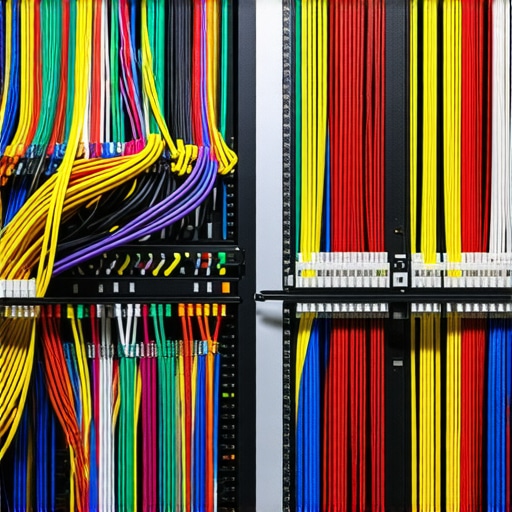
The Sensory Warning: When Your Data Closet Becomes a Kiln
If you walk into your office data closet and the air hits you with the acrid, metallic tang of roasting PVC, you aren’t looking at a minor IT glitch; you’re looking at a forensic site in the making. That smell is the degassing of plasticizers in cable jacketing, a sign that your ‘spaghetti’ has reached a critical thermal mass. In my 35 years of troubleshooting, I’ve seen server rooms that were more likely to spontaneously combust than to process a single packet of data. When you bundle a hundred Cat6 cables together with tight zip ties and run them over a 120V circuit, you aren’t just making a mess; you’re creating an induction heater. I walked into a ‘fully renovated’ office suite last year where the previous contractor had buried three live junction boxes behind a custom server rack. I found them with my tick tracer only after the client complained that the wall felt hot to the touch. The flipper had used ‘monkey shit’ to seal a conduit that was leaking moisture directly onto a bus bar. It was a code violation correction waiting to happen, and the only thing keeping the building from a three-alarm fire was a single, struggling 15-amp breaker that refused to trip.
“The accumulation of abandoned cables in plenum spaces and risers provides a significant fuel load that can contribute to the spread of fire and smoke.” – NFPA 70: National Electrical Code
The Forensic Breakdown: The Physics of Thermal Runaway
Why does ‘spaghetti’ cabling actually fail? It comes down to the physics of Joule Heating and Cold Creep. When you have a massive tangle of cables, you eliminate the surface area required for heat dissipation. In modern offices, we use Power over Ethernet (PoE) for everything from VoIP phones to emergency exit lighting. While each individual cable carries a low current, a bundle of 144 cables produces significant heat. If that bundle is cinched too tight with plastic zip ties, the conductors inside undergo ‘cold creep.’ The copper literally moves under the pressure, thinning the insulation until you get a localized hot spot. This is why I always carry my dikes to snip those zip ties and replace them with hook-and-loop fasteners that allow the cables to breathe. This isn’t just about aesthetics; it’s about preventing the insulation from reaching its glass transition temperature, where it becomes brittle and fails, leading to a direct short. We see this often during storm damage electrical repair when a power surge hits a compromised bundle, turning a data closet into a furnace in seconds.
The Load Calculation: Why Your 20-Amp Circuit is Screaming
Most office data closets are afterthoughts, squeezed into converted broom closets without proper vibration analysis services for the cooling fans or dedicated circuits. You cannot run a modern server rack, a standby generator install transfer switch, and up lighting services off a shared neutral. That leads to harmonic distortion that will fry a motherboard faster than a lightning strike. When we perform a ‘heavy-up’ for a data closet, we look at the total connected load versus the demand factor. If you’re seeing flickering in your bollard light installation outside while the server is under load, you’ve got a voltage drop issue. This is why permit pulling services are vital; a real inspector will verify that your data closet has the required working clearance. You need 36 inches of clear space in front of that panel. If I have to move a mountain of patch cables just to see the breakers, you’re already in violation.
“Aluminum wire connections can overheat and cause a fire without tripping the circuit breaker.” – CPSC Safety Alert 516
Many older commercial buildings still have remnants of aluminum feeders. In the high-heat environment of a data closet, aluminum expands and contracts at a different rate than copper (thermal expansion), which loosens the lugs on your PDU. If those lugs aren’t torqued to spec, you get arcing. Arcing creates carbon tracks, and carbon is a conductor. Once that path is established, the electricity will jump the gap, creating a ‘Widow Maker’ scenario for the next technician who touches the rack. This is why how electricians tackle troubleshooting for lighting installations often starts at the panel; if the heart of the system is failing, the extremities will show the symptoms first.
The Fix: Code-Compliant Taming
Taming the spaghetti requires a rough-in mindset even in a finished space. We start by identifying every home run. We separate power from data by at least 6 inches to prevent EMI (Electromagnetic Interference) which causes ‘ghost’ data loss. If you’re a property manager, don’t forget to ask about senior discount services if you’re upgrading older facilities for accessibility. Proper cable management involves ladder racks and D-rings that maintain the bend radius of the cable. If you kink a Cat6 cable, you change its impedance, which is basically an electrical ‘pothole’ for your data. Once the wiring is managed, we move to the trim-out, labeling every port so you never have to play ‘guess and check’ with a live circuit again. Ensuring the rack is properly grounded to the building’s main grounding electrode is the final, non-negotiable step. Without a solid ground, your expensive surge protectors are just expensive power strips. You can learn more about ensuring safe and efficient EV charging station setup at home if you’re looking to bring this level of electrical discipline to your personal property. Always remember: electricity is a lazy beast; it will always take the path of least resistance. Make sure that path isn’t through your server’s CPU or your hand. For a professional evaluation of your current system, you should contact us before the smell of ozone becomes a plume of smoke.