
The Load Calculation: Why Your Panel Might Not Be Up to the Task
People look at a hot tub and see a relaxing soak. I look at it and see a 50-amp resistive heating element sitting in a giant conductive vat of water. It is the most dangerous appliance at your property if not handled with absolute mechanical precision. My journeyman used to smack my hand with his dikes if I didn’t ream the inside of a conduit after cutting it. ‘You nick that THHN insulation, you create a hot spot,’ he’d bark. He was right. That tiny nick, over five years of thermal expansion and contraction, becomes an arc fault that burns your house down while you’re asleep. When we talk about ensuring-safe-and-efficient-ev-charging-station-setup-at-home or adding a hot tub, the first thing I do is a load calc. If you have a 100-amp service with an overhead service drop from the 1970s, you’re already redlined. You try to run the AC, the dryer, and the hot tub heaters simultaneously, and you’re going to see those main lugs start to cook. I’ve seen whole house surge protection units melted into puddles because the main bus bar was so overloaded it was radiating 200 degrees of heat.
“Aluminum wire connections can overheat and cause a fire without tripping the circuit breaker.” – CPSC Safety Alert 516
The Anatomy of the Home Run: 6AWG Copper and the Resistance Trap
For a 50-amp tub, we’re pulling a home run of #6 copper. Don’t even talk to me about Romex. If I see NMB wire shoved into an outdoor conduit, I know I’m looking at a handyman special that’s destined for a forensic report. We use THHN/THWN-2 conductors because they’re rated for the heat and the moisture. I’ve pulled out plenty of ‘melted’ wire where someone used undersized 8AWG because copper prices were high that week. Resistance creates heat. Heat creates more resistance. It’s a death spiral for your insulation. If you’re also considering a sauna heater installation or a portable generator hookup, we need to talk about total ampacity before we even crack the first knockout in your panel. Many homeowners think a virtual consultation wiring session can replace a physical inspection, but until I get my Wiggy on those lugs to check for voltage drop under load, I don’t trust a thing I see. I’ve walked into ‘renovated’ homes where a home backup generator install was backfed into a dryer outlet—a literal widow maker. Backyard wiring requires that same level of forensic scrutiny.
The Critical GFCI Disconnect: Your Life Insurance in a Metal Box
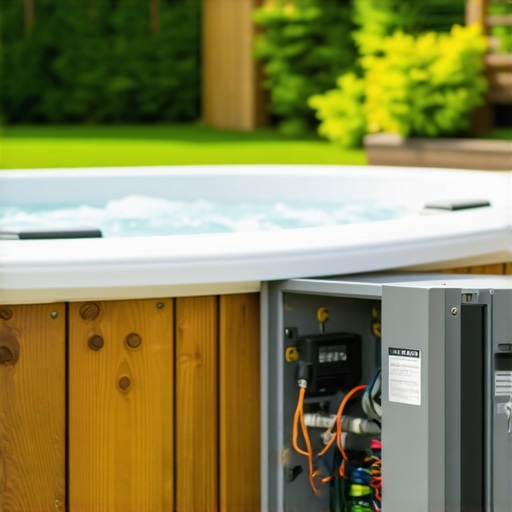
The NEC is very clear about the ‘maintenance disconnect.’ It has to be within sight of the tub but no closer than five feet. Why? Because you shouldn’t be able to touch the water and the energized box at the same time. I’ve seen lighting installation services where someone tried to tap the hot tub feed for driveway sensor lights. That’s a violation of the dedicated circuit rule. That disconnect box needs to be a GFCI-protected breaker. These breakers are sensitive; they’re looking for a 5-milliamp imbalance. If even a tiny bit of current leaks through a pump seal into the water, the GFCI should snap open in less than a 25th of a second. If you’re using an old Federal Pacific panel—the kind that fails to trip 25% of the time—you’re basically sitting in an electric chair. This is why we often recommend a panel changeout before we even touch the backyard. While we’re at it, we often look at emergency exit lighting for the path back to the house, ensuring safety isn’t just about the wires, but the environment.
“All 125-volt, 15- and 20-ampere receptacles located within 20 feet of the inside walls of a pool or outdoor spa shall be protected by a ground-fault circuit-interrupter.” – NEC 680.22(A)(4)
The Equipotential Plane: Bonding vs. Grounding
Here is where the amateurs get lost. Grounding is for clearing a fault. Bonding is for keeping everything at the same potential. I’ve been on sites where people were getting ‘tingled’ in the water. I pull out my Tick Tracer and find 2 volts between the water and the metal handrail. That’s a bonding failure. We have to run a solid #8 bare copper wire around the tub, connecting the pump motor, the heater housing, and any metal within 5 feet. We’re creating a grid so that if a fault occurs, everything—including you—is at the same voltage. If you’re interested in AI fault detection, modern smart breakers can actually sense the signature of a loose neutral before it starts a fire, which is a massive leap over the old thermal-magnetic tech. Whether it’s how-electricians-tackle-troubleshooting-for-lighting-installations or a high-voltage tub, the physics of grounding remains the same. We use Monkey Shit (duct seal) to plug the conduits so moisture from the damp ground doesn’t travel up into the disconnect and rot the lugs from the inside out. I’ve seen lugs so corroded they looked like green moss; that’s pure resistance, and it’s how fires start. Always torque your connections to the manufacturer’s spec—not ‘hand tight,’ but ‘calibrated torque wrench tight.’ That is the only way to sleep at night.