The Autopsy of a Dark Hallway: Why Your Life Safety System is a Ghost
I’ve spent thirty-five years in the dark. Not metaphorically—I’m talking about being shoulder-deep in a commercial ceiling grid, squinting through a layer of itchy insulation, trying to figure out why a Home Run to the emergency circuit is pulling zero volts. The smell of ozone is usually my first clue. It’s that sharp, metallic tang that tells you a capacitor just vomited its guts across a circuit board. Most business owners look at an exit sign and see a plastic box with red letters. I see a critical failure point that’s likely been neglected since the Bush administration. In my decades of preventative electrical maintenance, I’ve learned that electricity doesn’t care about your business goals; it only cares about finding the path of least resistance, and often, that path is through a corroded terminal.
The Old Timer’s Lesson: The Sin of the Nicked Copper
Before we break down the 2026 mandates, you need to understand the physics of failure. My journeyman used to smack my hand if I stripped a wire with a knife. ‘You nick the copper, you create a hot spot,’ he’d scream. He was right. That microscopic gouge in the wire reduces the cross-sectional area, increasing resistance. Resistance generates heat. Heat causes thermal expansion. In a high-stakes environment like a data center power setup, that tiny nick becomes a furnace. I’ve seen subpanel installations where ‘handymen’ used Dikes to strip wire, leaving behind a trail of future fires. When we’re talking about emergency exit lighting, that ‘hot spot’ is what prevents the battery from charging, leaving your employees in pitch blackness when the grid fails. This isn’t just a Rough-in mistake; it’s a death sentence in a smoke-filled corridor.
“The means of egress, including the exit discharge, shall be illuminated at all times the building is occupied.” – NFPA 101, Life Safety Code
Rule 1: The 90-Minute Photometric Reality Check
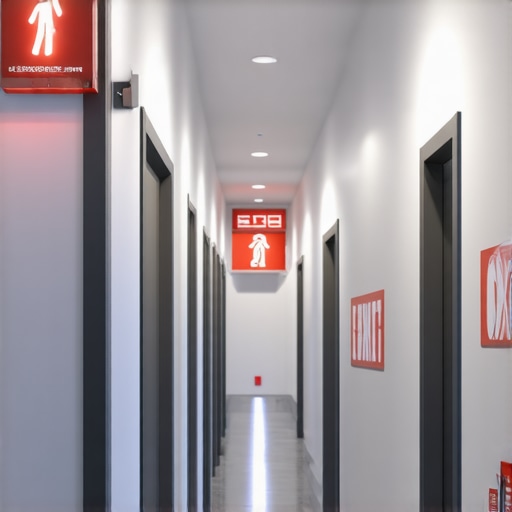
By 2026, the standard for emergency illumination isn’t just ‘on’ or ‘off.’ We are looking at the integration of LiFePO4 (Lithium Iron Phosphate) battery systems. The old lead-acid bricks are heavy, toxic, and prone to ‘sulfation’—a process where lead sulfate crystals build up on the plates, effectively choking the battery’s ability to hold a charge. In a forensic inspection, I often find these batteries swollen like a poisoned pup. The rule is simple: your system must provide 1.0 foot-candle of light along the path of egress for no less than 90 minutes. [image_placeholder_1] This isn’t just a suggestion. If your subpanel installation isn’t dedicated to these loads, a surge from a sauna heater installation or a heavy-duty EV charger could trip a non-critical breaker and leave your emergency lights dead on the vine. For help with these complex setups, see how we handle professional lighting installs.
Rule 2: The ‘Path of Egress’ Beyond the Doorway
The biggest mistake I see in commercial properties is the ‘Doorway Myth.’ People think an exit sign over the door is enough. Wrong. The 2026 safety landscape requires a continuous path of light from the deep interior to the ‘public way.’ This includes electric gate openers at the perimeter and even tree mounted lights if they illuminate the walkway to the assembly point. If you’ve invested in Christmas light services, don’t assume those festive LEDs count for safety. I’ve seen businesses try to use decorative lighting as a shortcut, but without a battery backup or a fiber optic cabling backbone for smart monitoring, you’re looking at a massive liability. The physics of Cold Creep in older aluminum wiring often means those decorative circuits are the first to fail during a winter storm, exactly when you need them most.
Rule 3: Smart Monitoring and the Death of the ‘Push-to-Test’ Button
We’ve all seen it: the guy with the broomstick poking the ‘test’ button on an exit sign. That’s a 20th-century solution for a 21st-century problem. Modern code is moving toward self-diagnostic systems. These units perform their own monthly 30-second discharge and annual 90-minute burn-in, reporting failures via a central hub. If you are financing electrical upgrades, this is where your money should go. When I walk a job site with my Tick Tracer, I can find a dead unit in seconds, but a smart system finds it in milliseconds. This is especially critical in data center power setups where human presence is minimal. You can’t fix what you don’t know is broken. If you’re having trouble with your current equipment, you might find this guide on troubleshooting lighting useful.
“Emergency lighting systems shall be tested and maintained in accordance with the manufacturer’s instructions and NFPA 101.” – OSHA 1910.37
Rule 4: Load Calculation and the Danger of the ‘Easy Add-on’
The 2026 business is a power-hungry beast. Between EV chargers in the parking lot and high-speed fiber optic cabling racks, your electrical panel is screaming for mercy. I’ve performed autopsies on panels where an electric gate opener was double-lugged onto an emergency lighting circuit. This is a Widow Maker setup. When the gate motor kicks in, it creates a voltage drop that can fry the sensitive electronics in modern LED exit signs. You need a dedicated subpanel installation for life safety systems. Don’t let a handyman tell you there’s ‘plenty of room’ in the bus bar. If the torque isn’t set to inch-pounds with a calibrated wrench, that connection will vibrate loose over time, causing arcing and carbon tracking. For those adding high-draw tech, checking safe charging station setups is a good start to understanding load management.
The Forensic Conclusion: Sleep Better When It’s Torqued
At the end of the day, I don’t care if your sauna heater installation works or if your Christmas light services are the brightest on the block. I care that when the smoke is thick enough to chew and the main power is a memory, your people can find the exit. Electricity is a lazy, dangerous element that wants to burn your building down. Preventative electrical maintenance isn’t an ‘upsell’; it’s the only thing standing between a minor inconvenience and a forensic investigator like me standing in the ashes of your business with a Wiggy and a clipboard. If you’re worried about your current system, don’t wait for the smell of Monkey Shit (duct seal) melting to call a pro. Keep your circuits clean, your batteries fresh, and for heaven’s sake, stop nicking the copper.