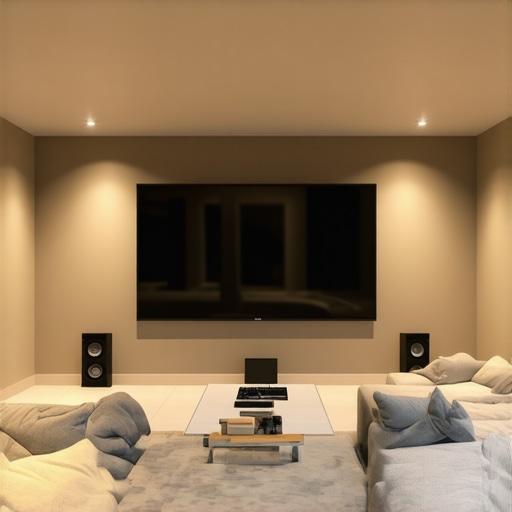
The Sensory Warning: Why Your High-End Media Room Sounds Like a Hive of Bees
I’ve spent thirty-five years pulling melted Romex out of wall cavities and listening to the high-pitched whine of a failing capacitor. When you walk into a high-end media room and hear a faint, 60-cycle hum coming through $20,000 speakers, it isn’t a ‘calibration issue.’ It’s a forensic failure. Most ‘home theater experts’ understand acoustics, but they don’t understand the physics of the electron. They treat electricity like a utility; I treat it like a predator that’s constantly looking for a way to jump out of the wire. My old journeyman used to smack my hand if I stripped a wire with a knife. ‘You nick the copper, you create a hot spot,’ he’d scream while we were roughing-in a 4,000-square-foot commercial job. He was right. That tiny nick reduces the circular mil area of the conductor, increasing resistance. In a 2026 media room pulling massive current for 16-channel amplifiers, that ‘hot spot’ is where the fire starts. If you want a system that doesn’t just sound good but keeps your family from being a statistic, you have to look at the infrastructure under the drywall.
“Audio and video equipment shall be installed such that the temperature rise of the equipment does not exceed its rating during normal operation.” – NEC Article 640.11(B)
Hack 1: The Isolated Ground and the Myth of the ‘Clean’ Circuit
Most homeowners think a ‘dedicated circuit’ is the gold standard. It’s not. It’s the bare minimum. When I’m performing lighting installations, I see people sharing neutrals between the dimmers and the audio rack. That’s a disaster. In 2026, we’re dealing with sophisticated switch-mode power supplies that dump high-frequency noise back onto the neutral. If your speakers are sharing a path with your LED drivers, you’re going to hear every time the kitchen lights are dimmed. The ‘Forensic Hack’ here is a true Isolated Ground (IG) circuit. This involves running a separate, insulated green ground wire all the way back to the main disconnect services or the primary building ground, rather than just bonding it to the metallic conduit or the shared ground bar in a subpanel. This prevents ‘ground loops’ where the signal cable becomes the easiest path for stray current. I’ve used my Wiggy to test systems where the ground potential was so high between components that it was actually sparking during the trim-out. You don’t want that current traveling through your HDMI or CAT6 cabling services. You want a clear, low-impedance path to the earth. When we do troubleshooting for lighting installations, the first thing we look for is this cross-contamination of signal and power.
Hack 2: Thermal Dynamics and the ‘Stack Effect’ in Equipment Closets
Heat is the silent killer of fidelity and safety. I’ve seen custom-built media racks where the flipper buried the gear in a closet with zero ventilation. I walked into one job where the smell of ‘fishy’ plastic—that’s the phenolic resin in circuit boards starting to outgas—was so strong I wouldn’t even turn the system on. In 2026, media processors are essentially supercomputers. They require massive ev charging station setup levels of cooling. The hack isn’t just a fan; it’s the ‘Component Zoom’ approach to airflow. You need to understand the physics of convection. Hot air rises, creating a vacuum that pulls cool air from the bottom. If your cable management is a rat’s nest of Romex and zip ties, you’re blocking that flow. I tell my apprentices to use Velcro ties—never zip ties—because zip ties can actually crush the jacket of high-speed data cables, changing the twist rate and causing packet loss. For these high-density racks, we often recommend contacting us for a dedicated transformer installation if the load exceeds the 80% rule of a standard 20-amp circuit. If you’re pulling 16 amps continuously, that breaker is going to get hot, and a hot breaker is a breaker that’s prone to nuisance tripping or, worse, internal contact welding.
“Overloaded circuits and damaged power cords are the leading cause of home theater fires, often resulting from heat buildup in enclosed spaces.” – CPSC Safety Alert
Hack 3: The Low-Voltage Divorce—Separating CAT6 from High-Voltage
This is where the ‘handymen’ get lazy. They’ll zip-tie a CAT6 cable to a 12/2 Romex line because it ‘looks clean.’ That’s a violation of basic electromagnetic theory. Every time current flows through a wire, it creates a magnetic field. That field induces a current in any nearby wire. This is called ‘crosstalk’ in the data world, but in a media room, it’s digital jitter and audio grain. In 2026, with 8K and 12K video streaming, the bandwidth requirements are so high that even a minor induction from a pathway lighting install circuit can cause signal dropouts. The hack is the 12-inch rule: never run signal and power parallel for more than a few feet unless there is at least 12 inches of separation or a grounded metal barrier. If they must cross, cross them at a 90-degree angle to minimize the magnetic field overlap. I always carry my Tick Tracer to find hidden live wires before we pull the home theater wiring. If that tracer starts chirping three inches away from your data line, your Netflix is going to buffer, and your speakers are going to crackle. We see this often in ev charger troubleshooting where the high-amperage lines interfere with the home’s smart grid communication.
Hack 4: Fire Alarm Integration and the ‘Kill Switch’ Logic
In a 2026 media room, you are often wearing noise-canceling headphones or sitting in a sound-dampened ‘bunker.’ If a fire starts in the kitchen because of a bad RV hookup installation or an overloaded transformer, you won’t hear the smoke detector. The forensic hack is integrating the fire alarm system install with the media room’s power sequencer. We use a shunt-trip breaker or a contactor tied to the fire alarm’s auxiliary relay. If the smoke detector goes off, the power to the entire media rack is cut instantly, and the house lights go to 100% brightness. This is a standard in commercial electrical services and OSHA compliance wiring, but it’s rarely done in homes. It’s the difference between getting out alive and being trapped in a soundproof box while the attic is on fire. I’ve seen too many ‘Widow Makers’—those cheap non-contact voltage testers that fail when you need them—and I’ve seen too many systems that weren’t grounded properly. Don’t let your media room be a tomb. Ensure your ev charger maintenance and your home theater power are both handled by someone who knows how to torque a lug to the proper inch-pounds using a calibrated torque wrench. When I finish a job, I don’t just ‘flip the switch.’ I use a thermal imager to check for hot spots. If it’s glowing, it’s going—back to the drawing board until it’s cold. Sleep at night knowing your wiring is as solid as the foundation of your house. Don’t trust a handyman with the physics of a fire. [image placeholder: A high-end AV rack with meticulously labeled CAT6 and power cables, organized with Velcro ties, showing the separation between high and low voltage.]