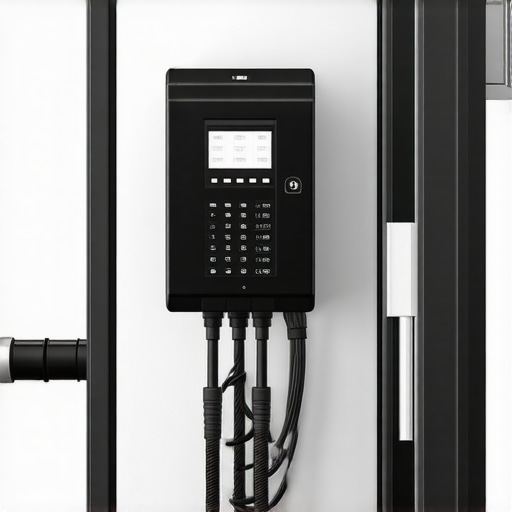
The Scent of a Failed Circuit: Why Your Security Fails Before the Door Opens
I can usually tell a building’s security status before I even see the control panel. It’s a specific, acrid scent—part ionized oxygen, part melting PVC insulation. When I walk into a modern ‘smart’ facility, people expect the high-tech biometrics to be the point of failure. They’re wrong. The failure is almost always buried in the wall, born from a lack of respect for the physics of electricity. My journeyman used to smack my hand if I stripped a wire with a knife. ‘You nick the copper, you create a hot spot,’ he’d scream. He was right. That tiny notch reduces the cross-sectional area of the conductor, creating a bottleneck for electrons. In a 2026 access control environment, where we are pushing more power over thinner conductors to fuel PoE++ (Power over Ethernet) devices and high-torque maglocks, those nicks are thermal time bombs. When you’re dealing with electrical wiring services, there is no room for ‘close enough.’
“Equipment intended to interrupt current at fault levels shall have an interrupting rating at nominal circuit voltage at least equal to the current that is available at the line terminals of the equipment.” – NEC 110.9
We are seeing a massive shift in how buildings handle entry. It’s no longer just a buzzer and a button. We’re integrating facial recognition, real-time logging, and cloud-based authentication. But all that ‘innovation’ relies on 18-gauge or 22-gauge copper that is often installed by low-voltage ‘techs’ who wouldn’t know a Wiggy from a screwdriver. This forensic breakdown looks at why these systems are failing and how to fix them before the smoke starts rolling.
Fix 1: Rectifying the Voltage Drop in Electric Strikes and Maglocks
The most common failure I see in access control is the ‘lazy strike.’ You scan your badge, the relay clicks, but the door doesn’t budge. You have to pull the handle just right to get it to release. Most people think it’s a mechanical alignment issue. It’s not. It’s a voltage drop issue. When a strike or maglock is at the end of a long home run, the resistance in the wire causes the voltage to sag. If a 24VDC maglock only receives 19V, it won’t have the magnetic flux necessary to hold or release properly under load. To fix this, we don’t just ‘hope’ the wire works; we zoom into the circular mil area of the conductor. If you’re running 300 feet, 22/2 wire is a joke. You need to upgrade to 18/2 or even 16/2 to ensure the current remains stable. This is where warranty backed repairs become essential. We don’t just swap the part; we verify the terminal voltage under load. If your panel is overloaded, you might even need a 200 amp panel install to handle the cumulative draw of an entire building’s security suite and HVAC needs. For complex diagnostics, see how electricians tackle troubleshooting for lighting installations, as the principles of circuit integrity are identical.
Fix 2: Forensic Data Closet Organization and Thermal Management
Walk into a data closet organization nightmare and you’ll see ‘spaghetti’ wiring. Aside from being an eyesore, it’s a fire risk. When low-voltage data cables are bundled too tightly with high-voltage lines, you get electromagnetic interference (EMI) and ‘cross-talk.’ Even worse, the heat can’t escape. I’ve seen Romex jackets melted into Cat6 cables because someone thought it was okay to zip-tie them together. In 2026, your data closet is the brain of the building. It needs dedicated circuits. If you’re pulling power for a sauna heater installation or heavy machinery in the same conduit or even the same wall bay as your security data, you’re asking for ghost signals in your access logs. Proper organization involves separating power classes and ensuring that every home run is labeled and tested with a Tick Tracer for stray voltage. We also recommend AFCI breaker services for the circuits feeding these rooms to prevent parallel arcing from damaged patch cords.
“Aluminum wire connections can overheat and cause a fire without tripping the circuit breaker.” – CPSC Safety Alert 516
Fix 3: Trenching Electrical Conduit for Perimeter Security
External gates and pedestals are where the real ‘forensic’ work happens. I’ve dug up conduits that were filled with ‘monkey shit’ (duct seal) but were still rotted through because the installer used the wrong schedule of PVC or, god forbid, didn’t use underground wiring services correctly. Water is the ultimate intruder. It gets into the conduit, freezes, expands, and shears the wire. Or, it sits there and creates a slow-acting galvanic reaction that eats the copper. When we perform trenching electrical conduit, we use Schedule 80 PVC for high-traffic areas and ensure we are below the frost line. We also look at the grounding. If your gate isn’t properly bonded to a grounding rod, a lightning strike 50 yards away will fry every reader in your building. While you’re digging, it’s often a good time to consider up lighting services for the perimeter; it’s easier to lay the wire when the ground is already open. If you’re also planning for the future, ensure your infrastructure can handle 2026 demands, such as ensuring safe and efficient EV charging station setup which often requires similar trenching logic.
Fix 4: Shielding and Signal Integrity Against Interference
The fourth fix involves the invisible. 2026 security systems use high-frequency signals for encrypted fobs. If your electrical wiring services provider didn’t use shielded twisted pair (STP) and didn’t drain the shield properly at the panel end, your system will be plagued by ‘false denies.’ I’ve seen systems where a nearby fluorescent ballast or an improperly grounded transformer caused the readers to reboot every time the lights flicked on. This is where the old-school tools come out. I’ll take a Wiggy to check for phantom voltage on the ground. We ensure that all low-voltage security wiring is crossed at 90-degree angles to high-voltage lines, never run in parallel. This prevents the induction of 60Hz hum into the data lines. For residential-turned-commercial spaces, we often find that senior discount services are used for basic maintenance, but when it comes to high-security wiring, you need a forensic eye to ensure that ‘bootleg grounds’ (neutral-to-ground jumps) aren’t creating a dangerous path for current that could energize the metal frame of a door—a literal Widow Maker scenario.
The Professional Standard: Torqued and Tested
In the end, electricity doesn’t care about your ‘smart’ features or your sleek software interface. It only cares about resistance, heat, and path of least resistance. If you’re managing a building in 2026, don’t let a ‘handyman special’ be the reason your security fails. Whether you need a full 200 amp panel install to support a growing data center or specialized AFCI breaker services to protect against hidden arcs, the details matter. Don’t wait for the smell of ozone to tell you there’s a problem. If you’re seeing flickering readers or sluggish locks, contact us for a forensic inspection. We provide warranty backed repairs that ensure when you lock the door at night, it stays locked, and the wires behind the wall stay cool. It’s not just about passing a code inspection; it’s about making sure the building doesn’t burn down while you’re sleeping. Use your dikes to cut out the bad work of the past and let’s rough-in a future that actually works.