
The Sound of a Ticking Clock: Why Your Electrical Room is a Liability
I’ve spent 35 years in the trade, and if there’s one thing that keeps me awake at night, it isn’t a missed deadline or a picky inspector—it’s the low-frequency hum of a misbehaving three-phase power service. You don’t just hear it; you feel it in your teeth. I walked into a ‘recently renovated’ distribution center last month where the previous contractor—a real ‘flipper special’ type—had buried a series of live junction boxes behind a new layer of industrial fireboard. My tracer was screaming, and when I finally cut the wall open, I found a nightmare of ‘monkey shit’ (duct seal) used to hide burnt insulation and wires that had been stripped with a pocketknife, creating jagged hot spots ready to ignite. These aren’t just mistakes; they are tactical errors that lead to an arc flash—a phenomenon that turns copper into vapor and air into a conductor in milliseconds.
What is an Arc Flash? The Physics of a 35,000-Degree Sun
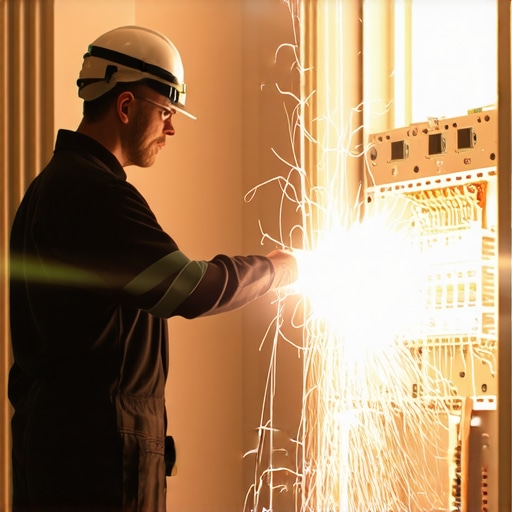
When most facility managers think of a fault, they think of a breaker tripping. That’s a controlled event. An arc flash is anything but. It is the sudden release of energy through an air gap when insulation or proximity fails between energized phase-to-phase or phase-to-ground conductors. The air ionized, creating a plasma cloud. We aren’t talking about a spark; we are talking about temperatures reaching 35,000 degrees Fahrenheit—four times hotter than the surface of the sun. At those temperatures, copper doesn’t just melt; it expands 67,000 times its original volume as it vaporizes. This expansion creates a pressure wave, an arc blast, that can throw a grown man across a room and collapse a human lung. If you are operating a facility with aged infrastructure, you aren’t just running a business; you’re sitting on a pressurized bomb.
“The arc flash hazard is a dangerous condition associated with the release of energy caused by an electric arc.” – NFPA 70E Standard for Electrical Safety in the Workplace
[IMAGE_PLACEHOLDER]
The Anatomy of Failure: From ‘Tick Tracers’ to ‘Widow Makers’
In the field, we see a lot of guys relying on ‘tick tracers’—those non-contact voltage detectors—and thinking they’re safe. In a high-voltage commercial environment, we call those ‘widow makers’ for a reason. They can give a false sense of security or fail to pick up ghost voltages that are still high enough to initiate an arc. To truly understand your risk, you need a comprehensive Arc Flash Hazard Analysis. This isn’t a ‘handyman’ walk-through; it’s a forensic engineering project. We look at the ‘incident energy’—the amount of thermal energy at a specific distance from an arc. This calculation dictates everything from the PPE my crew wears to the boundary lines we paint on your floor. If you haven’t had your gear labeled with these energy levels, you are in direct violation of OSHA and NFPA 70E. If an accident happens, your insurance company won’t just deny the claim; they’ll walk away from the table entirely.
The Danger of the Mid-Century Load: 200 Amp Panel Installs and EV Chargers
Most industrial facilities built between 1960 and 1980 were designed for a different era of power. They were built for lighting and heavy motors, not the continuous, high-draw loads of modern technology like a fleet-wide EV charger installation. When you start adding 50-amp chargers or a massive lighting installation to an old 200 amp panel install, you are testing the limits of thermal expansion. Aluminum bus bars in mid-century panels like Federal Pacific or Zinsco are notorious for ‘cold creep.’ The aluminum expands under load and contracts when it cools, slowly backing out the screws on the lugs. A loose connection creates resistance, resistance creates heat, and heat leads to carbon tracking. Once that carbon path is established, it’s only a matter of time before the current jumps the gap. This is why we advocate for bonded insured electrical professionals to perform regular thermal imaging of your gear.
Why Every Facility Manager Needs a Proactive Plan
Waiting for a ‘fishy smell’ or flickering lights to call for after hours electrical repair is a recipe for disaster. A proactive Arc Flash Hazard Analysis identifies the ‘bolted fault current’ and calculates the clearing time of your overcurrent protective devices. If your breakers are ‘jammed’—meaning the internal lubricants have turned to grease-like glue over 40 years—they won’t trip. Instead of the breaker clearing the fault in 0.03 seconds, it lingers for 2 seconds. That difference is the difference between a minor repair and a total facility loss. Whether you are managing a kitchen range hood wiring project in a commercial kitchen or a portable generator hookup for emergency backup, the grounding and bonding must be flawless. Any impedance in the ground path increases the likelihood that a fault will seek a path through you instead of the wire.
“A circuit breaker that has been involved in a fault shall be inspected and tested before being returned to service.” – NEC 240.83(C)
The Bottom Line: Torque and Tension
At the end of the day, electricity is lazy. It wants to go home to the transformer, and it will take the easiest path to get there. My job is to make sure that path is the copper we installed, not the air around it. From installing whole house surge protection (or in this case, facility-wide protection) to ensuring every lug is torqued to the specific inch-pound requirements listed on the panel door, we don’t guess. We use a ‘Wiggy’ (solenoid voltmeter) to verify real voltage, and we treat every ‘rough-in’ like a forensic site. Don’t let your facility become a cautionary tale for the next master electrician who walks in with a camera. Get the analysis, label your gear, and sleep at night knowing your team is safe from the plasma fireball you hopefully never have to see.