
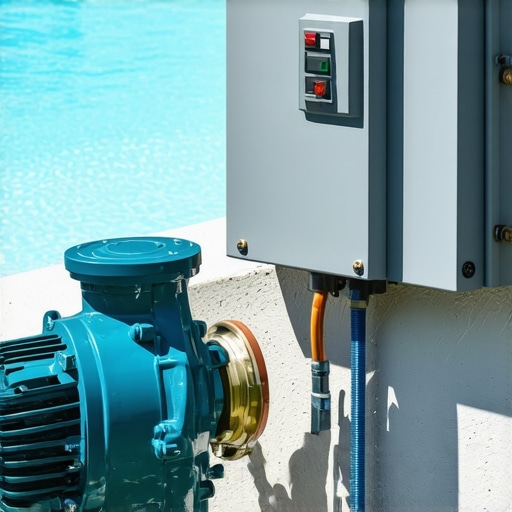
The Sound of a Dying Capacitor: Why Your Pool Is a Power Hungry Beast
You’re standing by the pool, and instead of the steady hum of a well-oiled machine, you hear it—that rhythmic, strained groan of a motor struggling to turn. Then, snap. The breaker trips. You head to the panel, flip it back, and maybe it stays for an hour or maybe it trips immediately. This is the hallmark of an overloaded circuit, and it’s usually because someone tried to save $500 by tapping the pool pump into the same line as your outdoor kitchen or fence line lighting. Electricity isn’t a hobby, and it certainly isn’t magic; it is raw physics that will bite you if you don’t respect the load calculation.
When I was just starting out, my journeyman used to smack my hand if I stripped a wire with a pocket knife instead of a proper pair of dikes or strippers. ‘You nick that copper, kid, and you’ve just created a hot spot that’ll melt a wire nut in five years,’ he’d bark. He wasn’t being a jerk; he was teaching me about the forensic reality of electrical failure. In a pool environment, where water and salt air are constantly trying to bridge the gap between your hot leads and the ground, those tiny mistakes are magnified a thousand times. If you don’t have a dedicated circuit for that pump, you’re not just breaking code—you’re inviting a house fire.
Blueprint C: The Load Calculation and the Physics of Inrush Current
A pool pump is what we call an inductive load. Unlike a toaster, which uses a simple resistive heating element, a motor uses electromagnetism to rotate an impeller. When that motor first kicks on, it requires ‘inrush current’—a massive spike of amperage that can be three to five times the motor’s running rating. If your pump is on a shared circuit, that spike can starve other devices or, more commonly, generate enough heat to start the slow degradation of your wire insulation. This is where infrared thermography scans become invaluable; I’ve seen sub-panels through a thermal lens where the pool breaker was glowing like a charcoal briquette because the homeowner tried to run their landscape lighting install off the same 20-amp feed.
“To provide for the safe operation of equipment, the National Electrical Code (NEC) requires that most permanently installed pool motors be supplied by a dedicated branch circuit.” – NEC Article 680
In coastal areas, we deal with an even nastier enemy: salt air. Salt is an electrolyte. It gets into your outdoor enclosures and creates a conductive film over your bus bars. This leads to ‘tracking,’ where electricity literally crawls across the surface of your plastic components. If you aren’t using stainless steel enclosures and applying monkey shit (duct seal) to the ends of your conduits to keep the moist air out, your ‘dedicated’ circuit will be a corroded mess within three seasons. This is why we insist on warranty backed repairs—because we know the salt is coming for your copper.
The Anatomy of a Home Run: Wiring It Right
A true dedicated circuit is a home run—a continuous run of Romex or THHN wire from the main service panel directly to the pump disconnect. No junction boxes, no ‘pigtailing’ into a GFCI outlet for the patio, and no shortcuts. When we perform a rough-in for a pool, we calculate the voltage drop based on the distance. If your pump is 100 feet from the panel, we might need to up-size the wire to #10 or even #8 to ensure the motor doesn’t burn out from ‘brownout’ conditions. This is the same level of care we use for a level 2 EV charger installation, which you can learn more about in our guide on ensuring safe and efficient EV charging station setup at home.
I’ve walked onto too many jobs where a 24 hour emergency electrician was called because the ‘handyman’ used a 14-gauge extension cord buried six inches deep to power a 1.5 horsepower pump. That wire gets hot, the insulation turns brittle, and eventually, the soil becomes energized. That’s a widow maker scenario. Proper grounding electrode install and bonding of the pool water are the only things keeping you from becoming part of the circuit when you jump in for a swim. Don’t forget the importance of smart thermostat wiring for your pool heater, but that too belongs on its own protected line to avoid signal interference from the motor’s magnetic field.
Forensic Breakdown: Why Shared Circuits Fail
Why can’t you just share a circuit? It comes down to thermal expansion. Every time a motor turns on, the wire heats up and expands. When it turns off, it cools and contracts. This ‘breathing’ of the metal eventually loosens the screws on your breakers and outlets. If you have multiple loads on one circuit, the heat is constant, leading to ‘cold creep’ in the conductors. Eventually, you get an arc. I’ve seen data closet organization projects ruined because a pool pump on a shared line sent a massive surge through the house, frying every piece of unshielded access control wiring in the building.
“All 15- and 20-amp, single-phase, 125-volt through 250-volt receptacles located within 20 feet of the inside walls of pools shall be GFCI protected.” – NFPA 70 (National Electrical Code)
If you’re dealing with flickering lights when the pump kicks on, you’re already in the danger zone. You need to pull out the Wiggy or a high-quality multimeter and check the voltage drop. If it’s more than 3%, you’re killing your equipment. For those who want to avoid these headaches, checking our troubleshooting guide for lighting installations can give you an idea of how we track down these ghost loads and phantom trips.
Final Verdict: Sleep Better with a Dedicated Feed
Is it more expensive to run a dedicated line? Yes. Is it cheaper than replacing a $1,200 variable speed pump or rebuilding your house after an electrical fire? Absolutely. When we do a trim-out, we make sure every lug is torqued to the manufacturer’s specifications. We don’t guess. We use a torque screwdriver because we know that a loose neutral is a fire waiting to happen. Whether you are installing a new pump or just upgrading your system to handle more modern tech, ensure your pro is looking at the total load. If you’re also considering adding car charging to your garage, make sure to read our EV charger maintenance tips to keep your entire high-voltage infrastructure in top shape. Don’t let your pool become a forensic case study. Wire it once, wire it right, and keep the tick tracer in the toolbox.