
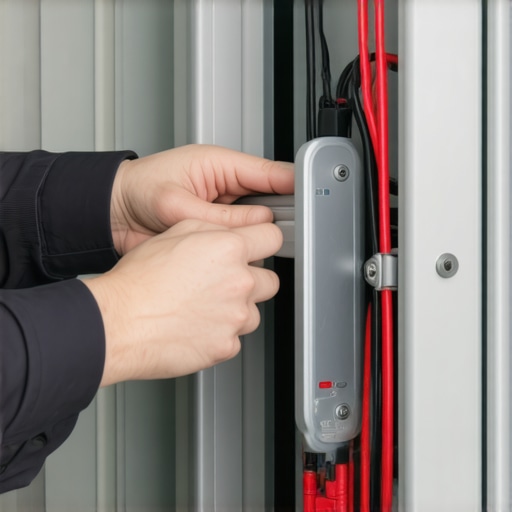
The Autopsy of a Death Trap: Why Mag Locks Aren’t Just ‘Two Wires and a Magnet’
I walked into a ‘fully renovated’ tech startup office last month where the manager complained the front door was ‘acting sticky.’ I didn’t even pull out my Wiggy before I smelled it: that unmistakable, cloying scent of melting PVC and overheated copper. The previous installer, some ‘low-voltage specialist’ who probably learned his trade watching 10-minute videos, had buried a series of live junction boxes behind a double-layered drywall soffit. He had daisy-chained three 600-pound mag locks onto a single 22-gauge pair of wires. I found them with my tracer, and when I finally cut into the wall, the insulation was charcoaled. This wasn’t just a bad install; it was a fire-starting time bomb. Magnetic locks, or ‘mag locks,’ are binary creatures. They are either holding with the strength of a thousand pounds of force, or they are dead weight. When you’re dealing with emergency fail-safe access control, you aren’t just wiring a door; you’re managing a life-safety system. If the demand response systems or a fire alarm trigger doesn’t drop power to that magnet instantly, you’ve effectively turned an exit into a wall. This is where OSHA compliance wiring meets the cold, hard physics of electromagnetic induction.
“Access-controlled egress doors shall be permitted to be locked in the direction of egress where the building is protected throughout by an approved, supervised automatic fire detection system.” – NFPA 101: Life Safety Code
The Forensic Breakdown: The Physics of Magnetic Failure
To understand the ‘why’ of a failure, you have to look at the Home Run. In a fail-safe configuration, the lock requires constant power to remain locked. This means the transformer is under a continuous load 24/7. Most failures I investigate as a forensic inspector stem from two things: heat and voltage drop. When you run thin-gauge wire over a long distance, resistance increases. In a DC system, that resistance turns into heat. This is Cold Creep in the making. The wire expands, the terminals loosen, and suddenly you have arcing inside the frame. If you’re using a cheap power supply without a battery backup, a brownout can cause the lock to chatter. This chattering rapidly oscillates the magnetic field, generating massive inductive kicks that fry the sensitive relays in your access control board. We don’t do ‘handyman specials’ here; we do lifetime workmanship guarantee installs because a door that won’t open during a fire is a liability no insurance company will touch.
The Anatomy of a Fail-Safe System
Wiring a mag lock for emergency fail-safe access control requires a specific sequence of components that must work in harmony. You start at the electrical panel upgrade. If your building’s core infrastructure is rotting—maybe you need a meter socket replacement because the old one is pitted and oxidizing—your low-voltage systems will suffer first.
“Aluminum wire connections can overheat and cause a fire without tripping the circuit breaker.” – CPSC Safety Alert 516
From the panel, you run to a dedicated 12V or 24V DC power supply with a fire alarm tie-in. This is non-negotiable. The fire alarm control panel (FACP) must have a dry contact that breaks the positive leg of the power to the locks. If the smoke heads hit, the circuit breaks, and the magnets drop. Period. Anything less is a violation of OSHA compliance wiring. You’ll also need a Request-to-Exit (REX) PIR sensor and a manual ‘Push to Exit’ button. These are wired in series on the break side of the circuit. I always use my dikes to trim the Romex feeding the power supply to a clean, square edge; any nick in the copper is a future hotspot. For those managing larger facilities, integrating this with parking lot lighting and emergency exit lighting ensures that when the power drops, the path to safety is illuminated. For the best results, you should look into how electricians tackle troubleshooting for lighting installations to see how we manage these complex circuits.
Component Zooming: Wire Gauges and Resistance
Don’t even think about using 22/2 for a 24V mag lock if the run is over 50 feet. I’ve seen ‘pros’ do it, and I’ve seen the Tick Tracer light up while the lock stays dead because the voltage at the end of the line dropped to 18V. The magnet becomes anemic, it hums, and eventually, the internal coil burns out. I recommend 18/2 shielded cable for most standard runs. If you’re doing an RV hookup installation or high-draw industrial gates, you might even step up to 16-gauge. If you’re dealing with insurance claim electrical work, the first thing the adjuster looks for is whether the wire gauge matches the load and distance. It’s about the physics of thermal expansion. A loose screw on a terminal block is a resistive heater. I’ve seen terminal strips melted into a single glob of plastic because someone didn’t torque the downs. This is why we offer same day service appointments for businesses—when an access system fails, it’s a security breach and a fire hazard simultaneously. If you’re also looking into modern tech, like an EV charging station setup, you know that load calculation is everything.
The Installation Protocol: From Rough-in to Trim-out
During the Rough-in, ensure your junction boxes are accessible. Never, ever bury a connection. If I find a hidden splice during a forensic inspection, I’m red-tagging the whole floor. Use Monkey Shit (duct seal) to plug the conduit ends if you’re transitioning from a conditioned space to a cold exterior wall to prevent condensation from dripping into the mag lock housing. During the Trim-out, use a multimeter to verify voltage at the lock while it’s under load. If you’re seeing more than a 5% drop, you’ve got a bottleneck. This meticulousness is what separates a Master Electrician from a guy with a ladder. Whether it’s lighting installations made easy or complex fail-safe locks, the principle is the same: integrity of the connection. If you need help, contact us immediately before a small flicker turns into a structural fire. For those maintaining these systems, checking the top maintenance tips for high-draw equipment can offer insights into keeping your magnets cool and your relays clicking. If you encounter issues, refer to our troubleshooting expert tips which apply many of the same electrical principles found in access control diagnostics.