
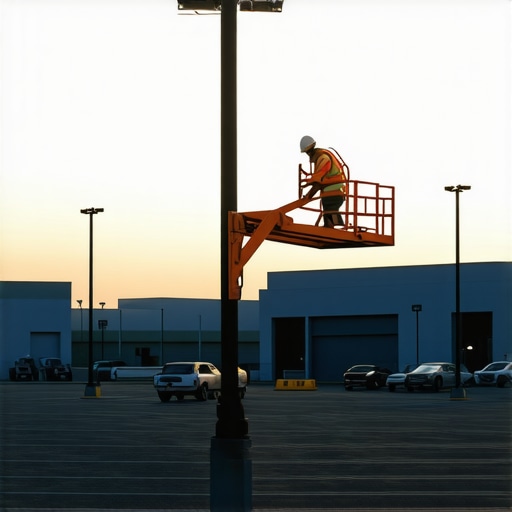
The Anatomy of a Dark Lot: More Than Just a Burnt Bulb
You smell it before you see it. That sharp, metallic tang of ozone hanging in the air near a lighting contactor. Most facility managers see a dark parking lot and think they just need a bucket truck and a case of LEDs. They’re wrong. As a forensic inspector who has spent three decades diagnosing why systems fail, I can tell you that a dead light is rarely the problem—it is the symptom. My journeyman used to smack my hand with a pair of dikes if I didn’t use a torque wrench on every single lug. ‘A loose wire is a fire looking for a place to happen,’ he’d growl. He wasn’t being a jerk; he was teaching me that in industrial settings, vibration and thermal expansion are the silent killers of electrical infrastructure. When we talk about industrial parking lot lighting, we are talking about high-voltage systems exposed to the most brutal environmental stressors imaginable. From wind-induced harmonic resonance to the chemical warfare of salt-laden air, your outdoor lighting is under constant attack.
“All electrical equipment shall be installed and used in accordance with the instructions included in the listing or labeling.” – National Electrical Code (NEC) Section 110.3(B)
If you aren’t following the forensic path of maintenance, you are just waiting for a catastrophic failure. This isn’t about aesthetics; it’s about avoiding a 480V arc flash incident that could level a service room. When I perform vibration analysis services on 40-foot light poles, I’m not just looking for loose bolts. I’m looking for the structural integrity of the base and the condition of the internal wiring. Wind turns these poles into giant tuning forks. Over time, that vibration causes ‘Cold Creep’ in the conductors. The aluminum or copper begins to move under the pressure of the terminal screw, creating a microscopic gap. That gap increases resistance, resistance creates heat, and heat creates fire. This is why how electricians tackle troubleshooting for lighting installations involves much more than a simple continuity test.
The Physics of Failure: Why Connections Go South
Let’s talk about the ‘Widow Maker.’ That’s what we call a pole where the grounding has failed and a hot lead has rubbed raw against the internal raceway. You touch that pole while standing on damp asphalt, and you’re the path of least resistance. This is why bonding jumper services are non-negotiable. I’ve seen poles where the installer skipped the bonding jumper because they thought the mounting bolts were enough. Between the rust and the galvanized coating, you might as well have no ground at all. Forensic inspection requires checking the impedance of that ground path with a Wiggy or a high-end fluke meter, not just waving a Tick Tracer near it and hoping for the best. If you don’t have a solid bond, your breakers won’t trip during a fault, leaving the entire pole energized and waiting for a victim.
Then there is the issue of moisture. I always keep a tub of ‘Monkey Shit’ (duct seal) in my kit. Why? Because the temperature differential between the hot interior of a light fixture and the cold night air creates a vacuum. It sucks humid air up through the conduit like a straw. If you don’t seal those entries, you get condensation inside your enclosures. That water mixes with the nitrates in the air to create a corrosive soup that eats through insulation. This is especially true for complex setups like pool pump electrical or sauna heater installation where moisture is a constant, but it’s a hidden killer in parking lots too. When we perform lighting installations made easy, we emphasize that ‘easy’ means doing it right the first time so you aren’t chasing ghosts three years later.
High-Tech Forensics: Drone Light Inspections and Arc Flash Studies
In the old days, I’d spend twelve hours in a bucket truck just to find one cracked insulator. Today, we use drone light inspections to get a bird’s eye view of the thermal signature of every fixture. A hot ballast shows up on an infrared camera like a beacon. If I see a fixture running 40 degrees hotter than its neighbors, I know that capacitor is about to pop. This proactive approach is the core of modern industrial maintenance. We also integrate arc flash studies into the maintenance cycle. You need to know the exact energy potential at every disconnect so your team knows what level of PPE is required. Opening a 480V lighting panel without knowing the fault current is like playing Russian roulette with all chambers loaded.
“Aluminum wire connections can overheat and cause a fire without tripping the circuit breaker.” – CPSC Safety Alert 516
We see this ‘Cold Creep’ frequently when facilities try to save money by using inferior connectors on high-draw circuits. Whether it’s for kitchen range hood wiring in a commercial cafeteria or a massive parking lot grid, the metallurgy matters. Aluminum expands at a different rate than the steel lug. Without an antioxidant compound and proper torque, the connection will eventually fail. For those managing modern facilities, demand response systems are also being integrated into lighting grids to shave peak loads. This adds layers of complexity—relays, sensors, and low-voltage control wiring that all need to be shielded from the high-voltage noise. If your installer didn’t rough-in those cables with enough separation, your lights will flicker every time the HVAC kicks on.
Total System Integration: From EV Chargers to Heavy-Ups
Industrial lots aren’t just for lights anymore. We are seeing a massive surge in the need for same day service appointments to repair damaged pedestals for EV charger troubleshooting. The load on a parking lot’s electrical service has tripled in some cases. When you add EV stations, you are often pushing the existing transformer to its absolute limit. I’ve walked into sites where the main service mast was literally vibrating from the harmonic load of twenty Level 2 chargers running at once. That’s when you need a ‘Heavy-Up’ or a full service upgrade. You can’t just slap a new breaker in the panel and hope the bus bar can take the heat. We provide ensuring safe and efficient EV charging station setup at home and in commercial lots to prevent these ‘melt-down’ scenarios.
Regular maintenance must include checking the torque on every main lug and looking for signs of pitting on the contactors. If you see ‘pitting’ (tiny craters in the metal), that means you have arcing. Arcing means air is bridging the gap, and air is a poor conductor that generates thousands of degrees of heat. If your maintenance guy says ‘it’s just a little spark,’ fire him and call a pro. That spark is the sound of your building’s insurance policy becoming void. Whether it’s sauna heater installation or 1000-watt stadium lights, the physics remain the same: tight connections, proper grounding, and moisture control. Sleep better at night knowing your lot is torqued to spec and your bonding jumpers are solid. Don’t let your parking lot become a forensic crime scene because you saved fifty bucks on a ‘handyman’ who doesn’t know the difference between a neutral and a ground.