
The Living History of a Fire Trap
Most homeowners look at their attic as free real estate for holiday decorations and old tax returns. To a licensed master electrician, that space is a pressure cooker. If your home was built between the late 1920s and the early 1960s, you aren’t just looking at storage; you’re looking at a legacy of asphalt-impregnated cotton and rubber insulation that has been slowly baking for decades. This isn’t the modern thermoplastic stuff we pull today. This is a organic material that is reaching its expiration date, and stacking cardboard boxes against it is like placing kindling next to a dying ember.
The Old Timer’s Lesson: The Toasted Marshmallow Wall
I remember my first year as an apprentice. My journeyman, a guy who had more scars than a prize fighter, dragged me into a crawlspace in an old Victorian. He pointed his light at a section of cloth-covered wire where the homeowner had stuffed old denim insulation to keep out a draft. He didn’t say a word; he just handed me his Wiggy. I didn’t even need the tester to see the problem. The denim wasn’t on fire, but it was charred dark brown, smelling like a burnt marshmallow. ‘That’s a thermal trap, kid,’ he growled. ‘The wire can’t breathe, the heat builds up, and the insulation turns into a carbon path.’ He was right. That day taught me that electricity doesn’t need an open flame to start a disaster; it just needs a lack of respect for thermodynamics.
The Forensic Breakdown: The Physics of Cloth Decay
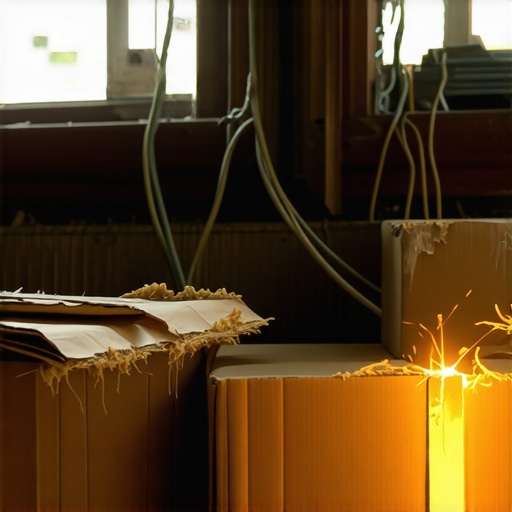
To understand the risk, we have to perform a forensic look at the conductor itself. Old cloth wiring—often referred to as ‘rag wire’ in the trade—consists of a copper core wrapped in a layer of rubber, then encased in a woven cotton or rayon sheath saturated with asphalt or lacquer. Over seventy years, a process called de-polymerization occurs. The rubber loses its plasticizers and becomes brittle. The moment you touch it or move it to slide a suitcase into a corner, that insulation flakes off like dried mud, exposing the bare copper. [IMAGE_PLACEHOLDER] When you pile items on top of these wires, you are creating a ‘Thermal Blanket.’ Under normal electrical load calculations, a wire generates a specific amount of heat based on the resistance of the copper. In a wide-open attic, that heat dissipates into the air. But when you bury that home run under layers of flammable Christmas trees and plastic bins, the heat has nowhere to go. This leads to ‘Cold Creep’ at the terminals and accelerated oxidation of the copper, which further increases resistance. It is a feedback loop that ends in an arc-fault.
“Aluminum and older copper-clad systems, particularly those with aged organic insulation, pose a significantly higher risk of fire when thermal dissipation is restricted by household storage or over-insulation.” – CPSC Safety Alert 516
The Arcing Nightmare and the AFCI Shield
Standard breakers in an old panel are designed to trip when there is a massive surge—a short circuit. They are blissfully unaware of a ‘glowing connection’ or a low-level arc caused by cracked cloth insulation. This is where AFCI breaker services become non-negotiable. An Arc-Fault Circuit Interrupter is like a computer for your panel; it listens for the specific ‘noise’ of an electrical arc—the sound of electricity jumping across a gap in that brittle cloth. If you are living with an old system, you need to be troubleshooting these hidden vulnerabilities before they manifest as a 911 call. Often, the best path forward involves a subpanel installation to move heavy modern loads—like your kitchen appliances or garage wiring services—off the fragile old circuits.
Trade Cant and the Reality of ‘Monkey Shit’
When we do a rough-in for a modern home, we use Romex with tough outer jackets. In these old houses, we often find what we call ‘Monkey Shit’—duct seal or old putty—hastily smeared over cracked wires where they enter a junction box. It’s a band-aid on a gunshot wound. If I walk into a house and see a tick tracer lighting up through a pile of newspapers in the attic, I know I’m looking at a widow maker. The homeowner might be worried about CAT6 cabling services or permanent holiday lighting, but my priority is ensuring the storm damage electrical repair they had five years ago didn’t just mask deeper issues in the infrastructure. We have to look at the ‘Load Calculation’ of the entire home. A 1940s house wasn’t designed for air conditioners, 70-inch TVs, and home backup generator install systems.
The Forensic Inspection: What to Look For
If you must store items in an area with cloth wiring, you need a licensed master electrician to verify the integrity of the insulation. We look for ‘Carbon Tracking’—fine black lines on the outside of the cloth that indicate electricity is already trying to find a path through the dust. We check for ‘brittleness’ by gently feeling the wire; if it sounds like dry leaves, it’s a hazard. Don’t wait for the smell of ozone. If you notice flickering when the wind blows—indicative of a loose service entrance—or if your lights dim when the fridge kicks on, your cloth-wired system is screaming for help. Whether you need a contact-us for an emergency inspection or a planned upgrade, the goal is the same: peace of mind. You shouldn’t have to wonder if your attic is planning to kill you while you sleep.
“Arc-faults in aging branch circuit wiring are a leading cause of residential fires, often exacerbated by physical damage or thermal insulation coverage.” – NFPA 70E Safety Standards
Conclusion: Respect the Current
Electricity is a lazy, dangerous beast that always wants to find the shortest path to the ground. In an old home, that path is often through your stored memories and a layer of 70-year-old cotton. Upgrading your system isn’t just about ‘resale value’ or ‘seamless’ power; it’s about not being a statistic. From electrical load calculations to the final trim-out of a new panel, every step is about safety. Don’t let your storage bins be the fuel for a fire that could have been prevented with a few AFCI breaker services and a bit of respect for the trade.