
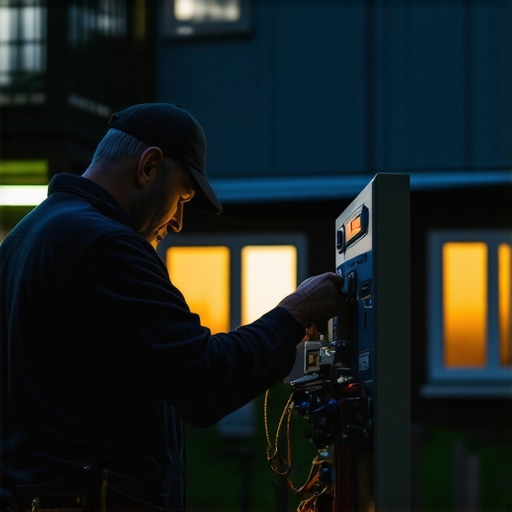
The Autopsy: Why Your Power Didn’t Just ‘Go Out’—It Failed Under Duress
When the lights die in the middle of a dinner rush at your restaurant or your home theater wiring suddenly lets out a puff of magic blue smoke, your first instinct is panic. My first instinct is to find the point of catastrophic failure. Electricity doesn’t just quit because it’s tired; it stops because resistance met heat, and heat met a structural weakness. Most ‘electricians’ show up and flip a breaker. A forensic inspector, like me, looks for the carbon tracking on the bus bar. I’ve spent thirty-five years pulling Romex through rat-infested crawlspaces and diagnosing why a subpanel installation turned into a molten heap of plastic. If you want the quickest way to restore power, you don’t need a guy with a ladder; you need a guy who understands the physics of why your house is trying to burn down.
The Old Timer’s Lesson: The Microscopic Origin of Failure
My journeyman used to smack my hand if I stripped a wire with a knife. ‘You nick the copper, you create a hot spot,’ he’d scream. He was right. That tiny nick reduces the cross-sectional area of the conductor, increasing resistance. Over twenty years, that spot undergoes thousands of thermal expansion and contraction cycles. Eventually, the copper crystallizes and starts to arc. This is the forensic reality of code violation corrections. What looks like a simple outage is often the final stage of a decade-long failure chain initiated by a lazy installer who didn’t respect the material.
“Aluminum wire connections can overheat and cause a fire without tripping the circuit breaker.” – CPSC Safety Alert 516
Forensic Breakdown: The Anatomy of a Power Collapse
Whether it’s parking lot lighting that suddenly goes dark or a camper electrical panel that’s humming like a swarm of angry hornets, the investigation starts at the service entrance. In older homes—the ones built between 1900 and 1950—we aren’t just dealing with age; we’re dealing with the death of insulation. The old cloth-covered wire becomes brittle. Touch it, and it crumbles. This is where the Tick Tracer and the Wiggy come out. A non-contact voltage tester (the ‘Tick Tracer’) might tell you there’s power, but only a solenoid tester like a Wiggy can put a load on the circuit to see if that power is actually ‘real’ or just phantom voltage leaking through a carbon track.
When we perform a restaurant kitchen electrical emergency repair, we’re usually looking at massive Over-Current Protection Device (OCPD) failure. Commercial kitchens are brutal environments. Steam, grease, and heat cause ‘Monkey Shit’ (duct seal) to fail, allowing moisture into the conduits. This moisture creates a bridge between phases, leading to a phase-to-ground fault that can blow a main lug clean off the bus bar. Restoring power here isn’t just about replacing a fuse; it’s about a full forensic scrub to ensure the lighting install isn’t shorted out internally. You can learn more about how we handle these high-pressure situations by reviewing how electricians tackle troubleshooting for lighting installations.
The Hidden Killers: Fence Lines and Sign Lighting
Outdoor systems like fence line lighting and sign lighting installation are subject to the ‘ground loop’ nightmare. Most ‘handymen’ bury Romex directly in the dirt or use thin-walled EMT that rots out in three seasons. When the moisture hits the copper, you get cupric oxide. This green crust is a semi-conductor. It’ll let just enough current through to heat up, but not enough to trip a 20-amp breaker. That’s how you get ‘hot soil’ that can shock a pet or a child. If your outdoor lights are flickering, you aren’t just looking at a bad bulb; you’re looking at a potential electrocution hazard that requires architectural lighting experts to trace the fault before the system is re-energized.
“A ground-fault circuit-interrupter (GFCI) is the only protection against the ‘leaking’ current that causes electrocution.” – NFPA 70E Safety Standard
The Forensic Fix: Why Same-Day Service Must Be Precise
The quickest way to restore power is to identify the Home Run—the main line from the panel to the first device—and isolate it. We don’t just ‘hope’ it works. We use insulation resistance testers (Meggers) to push 500 volts through the wire to see if the insulation holds. If it leaks, we don’t turn it on. Period. This is why home theater wiring often fails; installers use low-voltage techniques on high-voltage circuits, leading to induction heating that melts the jacket inside the wall.
If you’ve got a dead circuit, don’t keep flipping the breaker. Every time you flip it, you’re creating an arc-flash event that pits the contacts and weakens the spring tension inside the breaker. After three or four ‘test flips,’ that breaker is junk. It’s a widow maker waiting to happen. Instead, you need a rough-in forensic analysis. We check the torque on every lug. Did you know the NEC now requires torque wrenches for a reason? A loose lug is a heater. A heater is a fire. For immediate assistance with these critical safety issues, you should contact us immediately before a flicker becomes a flame.
Upgrading the Infrastructure for Modern Loads
A 100-amp service from 1970 was never designed for an EV charger, a hot tub, and a subpanel installation for a workshop. We see ‘cold creep’ in these old panels—where the aluminum feeders have literally moved out from under the screws because they expand and contract at different rates than the steel lugs. This creates a high-resistance connection. When we do a lighting install or a heavy-up, we use antioxidant paste and AlumiConn connectors to stop this physical movement. It’s not just about getting the lights back on; it’s about ensuring the molecular bond between the wire and the lug is solid enough to handle the Inrush Current of your AC compressor. You can see our guide on proper setups here: lighting installations made easy. Don’t let a ‘handyman’ with a pair of dikes and a roll of electrical tape gamble with your life. Get it torqued, get it tested, and sleep through the night without sniffing for smoke.