
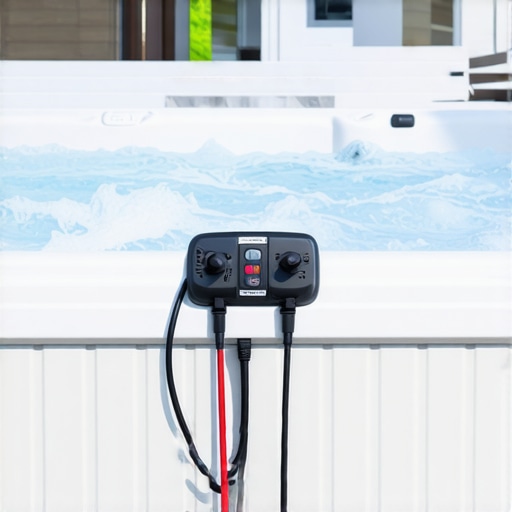
The Tingling Warning: Why Your Hot Tub Is Trying to Tell You Something
I have spent over thirty-five years sniffing out the scent of ozone and scorched PVC in attics and crawlspaces. I have seen the results of ‘handyman specials’ that would make a sane person move into a tent. But nothing quite matches the visceral dread I feel when a client tells me they felt a ‘little tingle’ while stepping into their hot tub. In my world, a tingle isn’t a quirk; it’s a failure of the equipotential plane. It is the sound of the reaper sharpening his scythe. When you mix five hundred gallons of water with a 240-volt, 50-amp circuit, you aren’t just installing a luxury; you are managing a potential lightning strike in your backyard. Most people assume that if they have a ground wire, they are safe. They are wrong. Most dangerous hot tub installations I’ve inspected had a ground wire. What they lacked was a bonding grid.
The Old Timer’s Lesson: Why Precision Prevents Pyrotechnics
My journeyman used to smack my hand if I stripped a wire with a knife. ‘You nick the copper, you create a hot spot,’ he’d scream. He was right. That lesson stayed with me for four decades. If you create a microscopic notch in a 6 AWG copper conductor, you’ve fundamentally changed the resistance of that wire at that specific point. Under the heavy draw of a hot tub heater and two jet pumps, that nick becomes a point of thermal expansion. Over time, that heat cycles, the metal fatigues, and suddenly you have a ‘widow maker’ hiding in your conduit. This level of precision is exactly what’s missing in the DIY world. Whether it is a level 2 EV charger or a 220V spa pack, the physics don’t care about your weekend schedule.
“The equipment grounding conductor shall be an insulated copper conductor… not smaller than 12 AWG.” – NEC Section 680.21(A)(1)
The Forensic Breakdown: Grounding vs. Bonding
Let’s talk about the ‘Load Calculation’ reality. Most people trying to add a spa to their home are already pushing the limits of their service. I’ve seen 100-amp fuse boxes from the 1940s trying to feed a modern home automation setup, a double oven, and then the homeowner decides to drop a 12kW hot tub into the mix. This is where we see code violation corrections become a matter of life and death. The core error in hot tub safety is confusing the ground with the bond. Grounding is your safety path back to the panel to trip the breaker. Bonding is the process of connecting all metal parts—the pump motor, the heater shell, even the rebar in the concrete pad—together to ensure they are at the same electrical potential. If your concrete deck isn’t bonded to the water, and there is a tiny leak of current from a failing pump seal, you become the bridge. When you touch the water while standing on the deck, you aren’t just a person; you are a resistor in a parallel circuit.
Component Zooming: The Physics of Stray Voltage
When we look at the molecular level of a connection, we have to consider the resistance of the path. A ‘Wiggy’ or a standard multimeter might show you 120V at the outlet, but it won’t tell you the story of the stray voltage creeping through the soil. In areas with high moisture, or near the coast where salt air accelerates corrosion, your grounding rods can lose their effectiveness through a process of galvanic reaction. The salt bridges the gap between phases in your meter can, rotting it from the inside out. This is why a fuse box to breaker conversion is often the first step in making a home safe for high-draw appliances. If you’re also looking into ensuring safe and efficient EV charging station setup, you’re doubling the load on your bus bars. You cannot afford a loose neutral. A loose neutral in a multi-wire branch circuit can send 240V through your 120V electronics, literally frying your home automation setup in a microsecond.
“Aluminum wire connections can overheat and cause a fire without tripping the circuit breaker.” – CPSC Safety Alert 516
The Infrastructure Context: Heavy-Ups and Service Masts
If you live in a mid-century home, you’re likely dealing with the legacy of aluminum wiring or those notorious Federal Pacific panels. The breakers in those panels are famous for ‘jamming’—they won’t trip even when the wire is melting. When we do a ‘Heavy-up’ to a 200-amp or 400-amp service, we are looking at the entire system’s health. We look at the service mast, the weather head, and the smart meter installation. We’re checking for ‘Cold Creep’—the tendency of aluminum wire to expand and contract at different rates than the steel lugs, eventually loosening the connection and creating a high-resistance arc. This is why I always recommend a surge protector installation at the main panel. It’s the only way to protect your energy storage systems and sensitive EV components from the spikes that occur when the grid fluctuates.
The Process: Real Code Compliance
When I perform a rough-in for a hot tub, I’m looking at the ‘Home Run’ back to the panel. I don’t want to see any junction boxes buried in the crawlspace. I want a continuous pull of THHN wire in liquid-tight conduit. I’ve had to use my tick tracer to find live ‘dead-ends’ left by previous contractors more times than I can count. People ask about three phase power services for residential hot tubs—usually, you don’t see that unless you’re in a massive estate, but the principles of power factor correction still apply to the efficiency of your motors. If your pumps are drawing more reactive power than they should, you’re paying the utility company for electricity that is doing nothing but generating heat in your wires. If you are experiencing EV charger troubleshooting issues simultaneously, it’s a red flag that your home’s total harmonic distortion is out of whack.
Why Electricity Isn’t a Hobby
You can’t ‘Google’ your way into being a forensic electrician. It takes years of seeing how ‘Monkey Shit’ (duct seal) fails to keep moisture out of a conduit, leading to a short. It takes years of knowing why portable generator hookup interlocks are the only legal way to back-feed a house. When you step into that hot tub, you are trusting the torque settings on a set of lugs inside a GFCI disconnect. I’ve seen those lugs glow cherry red because they were ‘hand-tightened’ instead of using a torque screwdriver to the exact inch-pounds specified. If you aren’t sure about your system, look at our lighting installations made easy guide to see the level of detail required for even simple tasks, or better yet, reach out via our contact us page before you turn that spa on for the first time. Your life isn’t worth a DIY mistake. Sleep at night knowing your system is torqued, bonded, and built to code.
Comments
One response to “The Grounding Error That Makes Hot Tubs Dangerous: What You Need to Know”
This post hits the core of what often gets overlooked in hot tub safety — the importance of proper bonding, not just grounding. I’ve seen backyard setups where the homeowner assumes that a ground wire means everything is safe, but neglects the bonding grid that ensures metal parts are at the same electrical potential. That tiny electrical leak can turn into a serious hazard over time, especially with moisture and corrosion, which are common outside. It makes me wonder how many DIY installations actually meet these detailed standards without specialized knowledge. Does anyone have experience with upgrading older systems or fixing bonding issues? I’d be interested to hear what solutions or testing procedures others have used to verify their setups are truly safe before firing up the hot tub. The physics of stray voltage and the subtle effects of corrosion really underscore that electrical safety in these setups is complex and not a do-it-yourself project for most people. Proper inspection and professional help seem essential.