The Acrid Scent of Negligence: Why Your Inspection Failed
Listen closely, because electricity doesn’t give a damn about your bottom line, your project timeline, or your ‘handyman’s’ optimistic opinion. If a commercial inspector just red-tagged your facility, it’s not a bureaucratic formality—it’s a mercy. I’ve spent 35 years tracking the scent of ozone and charred PVC through warehouses and data closets, and let me tell you, a failed inspection is usually the only thing standing between a business and a total loss. My old journeyman used to smack my hand if I stripped a wire with a pocketknife. ‘You nick the copper, you create a hot spot,’ he’d scream. He was right. That microscopic gouge reduces the cross-sectional area of the conductor, forcing current through a bottleneck. Physics doesn’t negotiate; that bottleneck turns into a radiator, the insulation becomes brittle, and eventually, the building burns. We’re going to perform a forensic autopsy on your failed inspection and look at the four critical fixes—from circuit breaker replacement to three phase power services—that will satisfy the code and keep your roof from collapsing in a firestorm.
“Aluminum wire connections can overheat and cause a fire without tripping the circuit breaker.” – CPSC Safety Alert 516
1. The Forensic Scan: Infrared and Drone Thermography Scans
The first reason inspections fail is what the eye can’t see. You might have a warehouse lighting retrofit that looks clean from the floor, but up in the rafters, a loose lug is screaming at 240 degrees Fahrenheit. This is where infrared thermography scans become the inspector’s best friend and the owner’s worst nightmare. We use high-resolution thermal imaging to detect heat signatures that indicate high resistance. High resistance is often the result of ‘Cold Creep’—a phenomenon in older mid-century buildings where aluminum wiring expands and contracts at a different rate than the steel or brass terminals holding it. Over time, this thermal cycling creates a gap. Electricity, being lazy and aggressive, jumps that gap. That’s arcing. For large-scale facilities, drone thermography scans allow us to inspect rooftop service masts and exterior bollard light installation points without a ladder. If your inspector saw ‘discoloration’ on a bus bar, they are seeing the ghost of a fire that hasn’t happened yet. Modern AI fault detection systems can now monitor these fluctuations in real-time, but for the inspection, you need a certified thermographer to prove your connections are torqued to NEC specifications.
2. The Panel Purge: Circuit Breaker Replacement and Three-Phase Balance
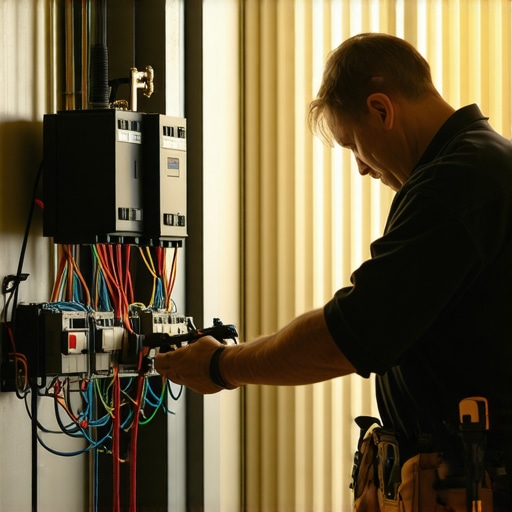
If you’re running a commercial operation on a mid-century panel like a Federal Pacific or a Zinsco, you aren’t just violating code; you’re playing Russian Roulette with a fully loaded 12-gauge. These panels are notorious for ‘no-trip’ failures where the internal pivot jams due to corrosion or poor plating. When we perform circuit breaker replacement, we aren’t just swapping parts; we’re recalibrating the safety heart of the building. In commercial electrical services, especially those involving three phase power services, load balancing is the name of the game. If Phase A is pulling 80 amps while Phase C is sitting at 20, you’re creating inductive heating in your neutral. I’ve seen neutrals in three-phase systems glow cherry red because some ‘maintenance guy’ kept adding 120V circuits to the same leg. This leads to a ‘floating neutral,’ which can send 208V through your 120V PA system installation, frying the boards instantly. You need to ensure your rough-in was done with the correct Romex or MC cable sizing and that your home run doesn’t exceed the fill capacity of the conduit.
“The technical term for a circuit that bypasses safety protocols is ‘a fuse waiting to happen.’” – NFPA 70E Electrical Safety Standard
3. Data Closet Organization and the ‘Spaghetti’ Violation
Inspectors hate a ‘rat’s nest.’ If your data closet looks like a bowl of electrified spaghetti, you’ll fail every time. Data closet organization isn’t about aesthetics; it’s about heat dissipation and accessibility. When cables are piled high, they can’t shed the heat generated by data transmission and power-over-ethernet (PoE) loads. This is where a tick tracer or a Wiggy (solenoid voltmeter) becomes essential for troubleshooting. If I can’t trace a wire because it’s buried under a mile of unlabeled CAT6 and 12-gauge Romex, I can’t verify that it’s not bundled with high-voltage lines—a major code violation that induces noise and creates a fire hazard. Proper trim-out requires labeling every conductor and ensuring that all junction boxes are accessible. Never, and I mean never, bury a junction box behind a wall or a ceiling tile without a cover plate. That’s a ‘Widow Maker’ waiting for the next guy who tries to troubleshoot the circuit.
4. Industrial Upgrades: Warehouse Lighting Retrofit and PA Systems
Finally, many failures occur during a warehouse lighting retrofit. Owners try to save a buck by using existing ballasts or old wiring that was never rated for the thermal output of modern high-output fixtures. When you install a PA system installation or new lighting, you must consider the ‘in-rush’ current. LED drivers have a massive initial draw that can trip sensitive breakers or, worse, weld the contacts of a cheap switch. While you’re at it, check your bollard light installation outdoors. If the Monkey Shit (duct seal) wasn’t applied correctly at the conduit entrance, moisture will wick up into the fixture, causing a ground fault that will trip your GFCI breakers every time it rains. We use dikes to clean up the excess wire and ensure every connection is seated deep in the terminal. If you want to clear your inspection, understanding how electricians tackle troubleshooting for lighting installations is the first step toward a compliant facility. Once the repairs are done, and you’ve verified your grounding electrode system is solid, you can finally sleep at night. Don’t forget to contact us for a professional forensic audit before the inspector returns. Check our privacy policy for how we handle your facility data during AI fault detection scans.
Comments
One response to “Failed Your Inspection? 4 Fixes That Clear Code Violations Fast”
This post is a goldmine for anyone in charge of facility maintenance or electrical systems. I especially appreciate the emphasis on infrared thermography scans—it’s such a powerful non-invasive way to identify potential fire hazards that are invisible to the naked eye. My team recently used drone thermography for exterior inspections of our warehouse rooftop, and it saved us a lot of time and risk compared to manual ladder inspections. The point about load balancing in three-phase systems really hits home; we had an incident where an unbalanced load caused our neutral to overheat, leading to some equipment shutdowns. Has anyone here had to deal with tricky reorganization of data closet wiring, especially in tight spaces? I’d love to hear what solutions or best practices others have found effective. The article does a great job of breaking down complex issues into manageable fixes, which is reassuring for non-electricians trying to keep their facilities compliant.