
The Autopsy of a Silent Killer: Why Your Bonding Jumper Is Failing
I walked into a basement last Tuesday that smelled like a mix of scorched ozone and wet basement dust. The homeowner was complaining about a ‘funny tingle’ whenever she touched the kitchen faucet while barefoot on the tile. I pulled out my tick tracer, and the damn thing started screaming six inches away from the cold water pipe. This wasn’t a minor leak; this was a house looking for a reason to burn down. I went straight to the main service panel, pulled the dead front, and there it was—or rather, there it wasn’t. A ‘flipper’ had been in here six months ago to do a rough-in for a basement bar, and he’d cut the main bonding jumper right out of the panel because it ‘cluttered up the ground bar.’ He left a floating neutral that was using the plumbing as its primary path back to the transformer. That’s not just a code violation; that’s attempted manslaughter.
The Physics of the Path of Least Resistance
In a standard residential system, the bonding jumper is the critical link between the grounded conductor (the neutral) and the equipment grounding conductor (the ground). Its job is simple but absolute: it creates a low-impedance path for fault current. When that jumper is missing or corroded, your breakers become decorative switches. If a hot wire shorts to a metal frame—say, during a ceiling fan installation—and there is no bond, the metal stays energized. The breaker doesn’t trip because the ‘loop’ isn’t closed. It waits for you to become the jumper. This is why we perform arc flash studies in industrial settings; the energy released when a system isn’t properly bonded can be explosive. In your home, it’s a slower, quieter death by heat.
“The main bonding jumper shall be a wire, bus, screw, or similar suitable conductor. It shall be sized in accordance with Table 250.102(C)(1).” – National Electrical Code (NEC) Section 250.28
The Anatomy of Corrosion: Why Copper Turns to Junk
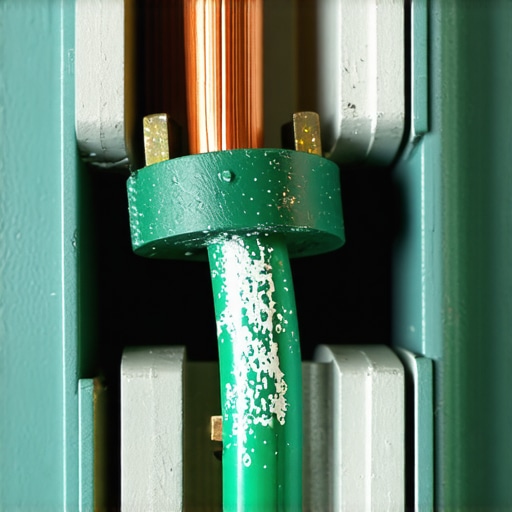
When I see a jumper that’s still present but covered in green crust or white powder, we’re looking at chemical warfare. This is especially common in flood water electrical safety scenarios. If your basement has ever seen a foot of water, that moisture sits in the bottom of the service mast and migrates into the panel via capillary action. Component Zooming: Let’s look at the molecular level. When you have two dissimilar metals—like a copper wire under a steel set-screw—and you add an electrolyte (moisture/humidity), you trigger galvanic corrosion. The less noble metal starts donating ions to the more noble one. This creates an oxidation layer that acts like an insulator. I’ve seen lugs that look tight but have a 20-ohm resistance because of a microscopic layer of aluminum oxide. That resistance generates heat. Heat causes the metal to expand and contract—a phenomenon known as ‘Cold Creep’—which further loosens the connection. Eventually, the connection arcs, the lug glows cherry red, and you’re calling for an after hours electrical repair because your lights are flickering like a horror movie.
Insurance Claims and the Forensic Paper Trail
If you’re dealing with insurance claim electrical work, the first thing the adjuster looks for is ‘signs of negligence.’ A missing bonding jumper is a smoking gun. They’ll argue the fire wasn’t an ‘act of God’ but an ‘act of a hack.’ This is why I always tell folks, whether you’re doing security camera wiring or a full fire alarm system install, the grounding system must be the foundation. You wouldn’t build a skyscraper on a swamp; don’t build a smart home on a floating neutral. We offer military discount wiring specifically because we want the men and women who served to have homes that won’t kill them while they sleep. It’s about integrity, something that flipper in the basement clearly lacked.
“Aluminum wire connections can overheat and cause a fire without tripping the circuit breaker if the bonding and termination points are compromised by oxidation.” – CPSC Safety Alert 516
The Practical Fix: More Than Just a Screw
Fixing a corroded bond isn’t just about grabbing your dikes and stripping a new piece of Romex. It requires cleaning the bus bar with a stainless steel brush, applying a high-quality antioxidant paste (often called ‘monkey shit’ in the field), and using a calibrated torque wrench. Every lug has a torque spec printed on the panel door. If you ‘hand-tighten’ it until it feels ‘good,’ you’re guessing with your life. This is the same precision required for smoke detector installation or complex power factor correction in commercial shops. You need a solid reference to ground. If you’re struggling with your electrical system after a DIY project or a storm, check out our EV charger troubleshooting guide or learn about lighting installations to see how a professional handles the trim-out phase. Electricity is a bored giant; if you don’t give it a safe path home, it will make its own through your water pipes, your appliances, or your heart. Don’t wait for the smell of ozone. If you suspect your panel is out of date or has been tampered with, contact us immediately. It’s better to pay for an inspection than a funeral.