
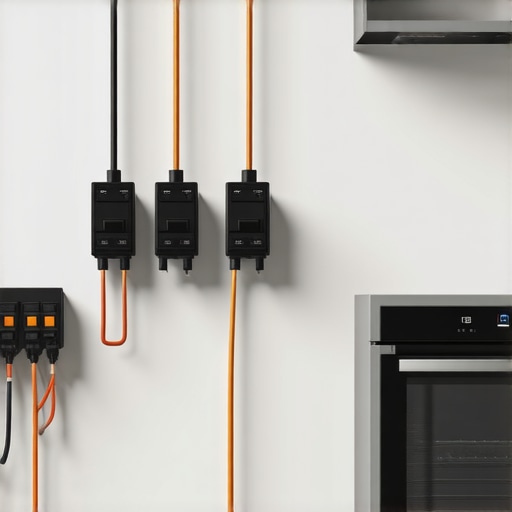
The Hum of Imminent Failure: A Warning from the Service Panel
I walked into a kitchen last month that looked like a million bucks—quartz countertops, stainless steel appliances, and custom cabinetry. But as soon as the homeowner turned on the high-end induction range while the dishwasher was in a heat cycle, I heard it. Not a beep, but a low, guttural vibration coming from the wall. I pulled out my Wiggy and my tick tracer. The flipper who ‘renovated’ the place had buried three live junction boxes behind that expensive backsplash, and he’d tried to run a 50-amp appliance load on a circuit that was daisy-chained through 14-gauge Romex. The copper was so hot the insulation was starting to off-gas that distinct, chemical stench of a house fire in its infancy. This wasn’t just a ‘bad job’; it was a violation of the laws of physics and the National Electrical Code (NEC).
“Arc-fault circuit-interrupter protection shall be provided as required in 210.12(A), (B), (C), and (D).” – NEC 210.12
Modern life is a relentless assault on mid-century electrical systems. We aren’t just plugging in a toaster anymore. We are installing EV chargers, high-draw pool pump electrical systems, and complex speaker system setup arrays that pull steady, high-amperage current for hours. If your home was built between 1960 and 1980, you are likely sitting on a ticking clock of aluminum wiring and Federal Pacific or Zinsco panels that were never designed to handle the continuous thermal stress of a 21-st century load profile. When you add a lighting install or a PA system installation, you aren’t just adding ‘lights’; you’re adding resistance, and resistance creates heat.
The Physics of the Heavy-Up: Why a 100 Amp Service Upgrade Is No Longer Optional
Most 1970s homes were outfitted with 60-amp or 100-amp services. In that era, the biggest load was a dryer or maybe a window A/C unit. Today, a single RV hookup installation or a Level 2 car charger can demand 40 to 50 amps of continuous current. When you push 80% of a panel’s capacity for more than three hours, you enter the territory of continuous loading. This is where Cold Creep happens in older aluminum conductors. The metal expands as it heats and contracts as it cools, eventually backing out from under the terminal screws. This creates a high-resistance connection. A high-resistance connection is essentially a heater inside your wall. By the time you notice the driveway sensor lights flickering, the bus bar in your panel might already be pitted and scarred beyond repair. This is precisely why a 100 amp service upgrade is the bare minimum for modern safety, though most of my forensic inspections now conclude that a 200-amp ‘heavy-up’ is the only way to ensure the temporary power services and permanent loads coexist without melting your main lugs.
The Invisible Danger of Improper Lighting and Audio Installs
People think a lighting install is a DIY weekend project. It’s not. When you transition from old incandescent fixtures to modern LED drivers, the inrush current and harmonic distortion can wreak havoc on older circuits. I’ve seen speaker system setup projects where the installer used ‘bootleg grounds’—connecting the neutral to the ground screw to trick a simple outlet tester. This creates a parallel path for return current, energizing the metal chassis of your electronics. One hand on the amp and one hand on a grounded faucet, and you become the path of least resistance. Whether you are doing a PA system installation for a home theater or just putting in some driveway sensor lights, the rough-in phase must include dedicated home run circuits to the panel to prevent line noise and potential electrocution. If you’re struggling with existing circuits, how electricians tackle troubleshooting for lighting installations can offer a glimpse into the complexity of modern circuitry.
“Aluminum wire connections can overheat and cause a fire without tripping the circuit breaker.” – CPSC Safety Alert 516
Thermal imaging doesn’t lie. During a forensic audit, I look for ‘hot spots’ at every junction. When we talk about pool pump electrical, we are talking about a motor that runs in a wet environment. Without current NEC-compliant GFCI (Ground Fault Circuit Interrupter) protection, that pump can leak current into the water. The old breakers in your 1974 panel don’t have the millisecond response time required to save a life. This is why financing electrical upgrades is a better investment than a new kitchen island. You can’t enjoy a smart fridge if the house is a pile of ash. If you’re adding an EV station, ensuring safe and efficient EV charging station setup at home is the only way to protect your vehicle and your family from catastrophic failure.
Backup Power and the Suicide Cord: The Portable Generator Hookup
Every time a storm hits, I see someone trying a portable generator hookup using a ‘suicide cord’—a double-male plug that backfeeds the house through a dryer outlet. This is a death sentence for utility workers and a fantastic way to fry your modern appliance’s control boards. A proper portable generator hookup requires a manual transfer switch or an interlock kit that mechanically prevents the main breaker and the generator breaker from being on at the same time. This ensures that your temporary power services are isolated from the grid. Without this, you’re not just breaking the code; you’re committing a felony in some jurisdictions. We don’t just pull wires; we manage electrons to ensure they stay where they belong. From the initial rough-in to the final trim-out, every connection must be torqued to the manufacturer’s specifications using a calibrated torque screwdriver—because ‘hand tight’ is a recipe for a widow maker scenario.
Electricity isn’t a hobby, and it isn’t a ‘handyman’ task. It is a lethal force that we’ve tamed with strict adherence to the NEC. If your lights dim when the fridge kicks on, or if you’re smelling ozone near your panel, don’t wait for the fire department to find the problem. You need an upgrade that accounts for the massive energy density of the 21st century. Whether it’s a 100 amp service upgrade or a specialized RV hookup installation, do it right, torque it to spec, and sleep soundly. If you encounter issues with new tech, you might find ev charger troubleshooting expert tips to fix common issues helpful, but remember: the panel is the heart of it all. For any concerns or to schedule a forensic inspection of your system, please contact us immediately. Check our privacy policy for how we handle your data.