
The Invisible Predator in Your Load Center
You probably think your electronics are safe because you plugged your laptop into a $20 plastic power strip from a big-box retailer. I’ve spent 35 years smelling the acrid, metallic stench of fried circuit boards, and let me tell you: those strips are little more than glorified extension cords when a real transient event hits. When we talk about surges, most people think of a cinematic lightning strike. In reality, the ‘Time Bomb’ in your home is the thousands of micro-surges generated every time your bathroom exhaust fan kicks on or your HVAC compressor cycles. These internal spikes eat away at the microscopic traces on your motherboards like a slow-acting acid.
The Old Timer’s Lesson: A Bridge to Disaster
My journeyman used to smack my hand if I stripped a wire with a knife. ‘You nick the copper, you create a hot spot,’ he’d scream. He was right. That lesson applies perfectly to how we view surge protection today. A nick in the wire, a loose terminal, or a sub-par grounding path creates resistance. When a high-voltage spike hits, it doesn’t just pass through; it looks for the path of least resistance. If your 60 amp panel upgrade from the 70s doesn’t have a dedicated path to dump that energy into the earth, it will find that path through your $3,000 OLED TV or your new doorbell camera install. I’ve seen ‘Widow Maker’ non-contact testers light up like a Christmas tree on a dead circuit just because a surge had induced a phantom voltage into a parallel Romex run. The physics of electricity doesn’t care about your convenience; it only cares about the path to ground.
“Surge-protective devices (SPDs) shall be evaluated for the circuit on which they are installed. The SPD must be capable of limiting the voltage to a level that will not damage the equipment it is intended to protect.” – NEC Article 242
Component Zooming: The Anatomy of a Failure
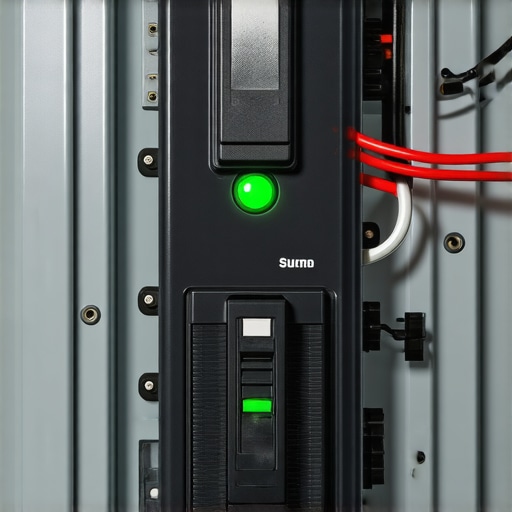
To understand why we push for load center upgrades that include Type 2 Surge Protective Devices (SPDs), we need to look at the Metal Oxide Varistor (MOV). Inside a cheap power strip, you’ll find a tiny MOV about the size of a nickel. Inside a professional-grade whole-house unit, we’re talking about heavy-duty disks engineered to handle massive thermal expansion. When a surge hits, the MOV’s resistance drops instantly, diverting the excess current to the ground wire. In a cheap strip, that MOV often fails catastrophically, sometimes even starting a fire because it lacks thermal fusing. In a proper installation, we’re looking at the ‘clamping voltage’ and the ‘response time’ measured in nanoseconds. If you are doing a pendant light hanging or a home backup generator install, you are adding sensitive control boards to your system that cannot handle even a 10% voltage swing.
The Mid-Century Menace: Aluminum and Corrosion
In mid-century homes, we often find ourselves dealing with the ‘Time Bomb’ of aluminum wiring. Aluminum has a high rate of thermal expansion, a phenomenon we call ‘Cold Creep.’ Over decades, the wire expands and contracts, eventually loosening the screw at the breaker. This creates a high-resistance connection that generates heat. If you combine that with the lack of modern surge protection, you’re asking for trouble. We often perform meter socket replacement alongside a panel upgrade because the old cans are rotted out, allowing moisture to seep in. When we seal those entries, we use ‘Monkey Shit’ (duct seal) to keep the moisture out, but that won’t stop a surge from the utility side. A transient spike hitting a corroded neutral is a recipe for a 240-volt cross-over that will cook everything in your house in milliseconds.
The Solution: Beyond the Plastic Strip
When we perform a virtual consultation wiring review or remote electrical diagnostics, the first thing I check is the grounding system. Is your swimming pool bonding up to code? If not, a surge can travel through your water lines. We recommend a multi-layered approach. A Type 1 SPD at the meter, a Type 2 at the load center, and Type 3 at the point of use. This isn’t an upsell; it’s basic physics. If you’re investing in an ensuring safe and efficient EV charging station setup at home, you absolutely need a whole-house unit. One lightning strike nearby can travel through the charging cable and brick your car’s battery management system. I’ve seen it happen, and it’s a $15,000 mistake that could have been prevented by a $400 protector.
“Aluminum wire connections can overheat and cause a fire without tripping the circuit breaker.” – CPSC Safety Alert 516
The Forensic Breakdown of a Strike
I recently did a forensic inspection where a homeowner had ‘protected’ their house with power strips. A utility transformer down the street blew, sending a massive surge through the line. The power strips ‘tripped,’ but the surge was so fast it jumped the physical gap of the switch (arcing) and fried the motherboard of the furnace and the refrigerator. If they had a whole-house SPD, that energy would have been shunted at the panel before it ever reached the branch circuits. Whether we are doing a rough-in for a new addition or a trim-out for a kitchen remodel, we always check the ‘Wiggy’ (solenoid tester) readings to ensure the voltage is stable before we sign off. For more technical insights, you can check our guide on how electricians tackle troubleshooting for lighting installations or see our EV charger troubleshooting expert tips to see how surges impact modern tech. Ultimately, it’s about peace of mind. I want to know that when you go to bed, your house isn’t one capacitor-pop away from a fire. Don’t trust your safety to a piece of plastic. Torque those lugs, verify your ground, and get the whole-house protection you need. Contact us today to secure your home’s electrical future.