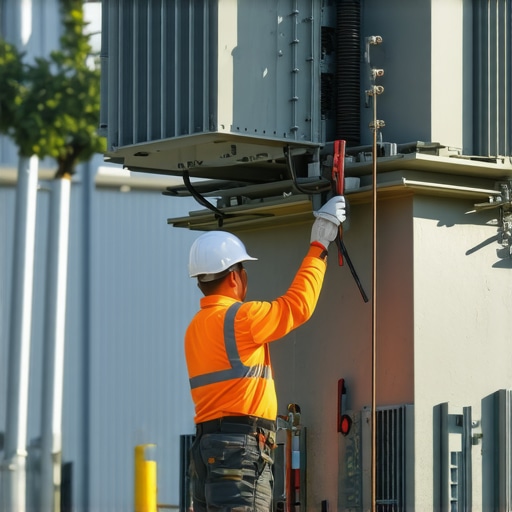
The High-Voltage Reality: Why Your Commercial Transformer Is a Ticking Financial Bomb
I can hear a dying transformer from fifty feet away. It’s a specific, low-frequency thrum—the sound of 60-cycle vibration turning into a physical mechanical failure because some bean-counter decided to skimp on the K-rating. I’ve spent 35 years in the dirt and the grease, and if there is one thing I’ve learned, it’s that electricity doesn’t care about your quarterly budget. It only cares about the path of least resistance and the inevitable laws of thermodynamics. As we head toward 2026, with the grid under more pressure than a pressure cooker with a taped-down valve, understanding the physics of your three phase power services isn’t just an engineering requirement; it’s a survival tactic for your bottom line.
The Flipper Special: A Forensic Discovery
I walked into a ‘fully renovated’ distribution center last month where the tenant was complaining about weird harmonic distortion in their data closet organization. The lights were flickering like a cheap horror movie set. I pulled out my tracer and started sniffing. I eventually found it: a 112.5 kVA dry-type transformer buried behind a double-layer of 5/8-inch Type X drywall. No ventilation, no clearance, just a baked-in fire hazard. The previous ‘electrician’—and I use that term loosely—had hidden a tapped-off home run inside the wall cavity without a junction box. The heat had already turned the Romex sheathing into something resembling overcooked spaghetti. This is the ‘Handyman Special’ on a commercial scale, and it’s why your insurance company is looking for any excuse to drop your coverage.
“Aluminum wire connections can overheat and cause a fire without tripping the circuit breaker.” – CPSC Safety Alert 516
When you ignore the physical reality of thermal expansion, you are inviting a catastrophic arc flash. Commercial transformers are the heart of your facility’s three phase power services. If they aren’t torqued to spec or if the cooling fins are choked with ‘monkey shit’ (duct seal) and dust, you’re throwing money into a furnace.
Tip 1: Respect the K-Factor and Non-Linear Loads
In the mid-century era, transformers were simple beasts. You had motors and incandescent bulbs. Linear loads. Today, your facility is a nightmare of switched-mode power supplies, variable frequency drives, and EV charger installation requirements. These are non-linear loads. They create harmonics—essentially electrical ‘noise’ that reflects back into the transformer. This isn’t just a signal problem; it’s a heat problem. Component Zooming: When harmonics hit a standard transformer, they cause circulating currents in the core and windings called ‘Eddy Currents.’ This leads to core saturation. The transformer starts drawing more current just to maintain the magnetic field, which leads to ‘Cold Creep’ in the lugs as the metal expands and contracts under extreme thermal cycling.
To cut 2026 costs, you must install K-Rated transformers. A K-13 unit is designed to handle the heat of those harmonics without derating. If you try to run a modern data center or a floor full of LED parking lot lighting drivers on a standard general-purpose transformer, you’ll be calling for same day service appointments when the secondary lugs melt off. Proper ensuring safe and efficient EV charging station setup at home and in commercial lots starts at the transformer, not the plug.
Tip 2: The Physics of Trenching and Moisture Migration
If you are trenching electrical conduit for a new exterior transformer pad or an RV hookup installation, the enemy isn’t just the hardpan; it’s condensation. Most commercial failures I see in aging 1970s office parks stem from ‘wicking.’ Moisture enters the conduit at the pad and travels straight into the gear via capillary action. This creates a salt-bridge (especially in coastal zones) that leads to phase-to-ground arcing. Component Zooming: Inside the conduit, temperature differentials between the buried pipe and the ambient air at the transformer stub-up create a dew point. Without proper ‘monkey shit’ sealing and drainage, that water sits against the conductor insulation. Over time, ‘treeing’ occurs—microscopic cracks in the insulation that eventually lead to a full-blown ‘widow maker’ short circuit.
Always specify schedule 80 PVC for high-traffic areas and ensure the trench depth meets NEC Article 300.5. A shallow trench is just a battery backup wiring failure waiting to happen when the first heavy truck rolls over it. If you’re doing pool pump electrical work or large-scale irrigation, the grounding must be impeccable to prevent stray voltage from eating your copper via electrolysis.
Tip 3: The Load Calculation and ‘The Heavy-Up’
Ohm’s Law is a harsh mistress. If you increase the load—say, by adding ten 48-amp EV stations—and don’t upgrade the service entrance transformer, the voltage will drop. When voltage drops, amperage must increase to satisfy the power demand (P=IV). Increased amperage equals increased heat. It’s a death spiral. Component Zooming: Most 1960s-1980s panels utilize bus bars that were never intended for 100% continuous duty cycles at max capacity. We often see ‘bus bar pitting’ where the breakers meet the rail. This resistance creates a ‘hot spot’ that my thermal camera picks up as a glowing neon sign of failure.
“Overcurrent protection shall be provided in accordance with NEC 450.3, ensuring that transformers are protected against both overloads and short circuits.” – National Electrical Code (NEC)
Before you commit to 2026 upgrades, perform a comprehensive load calculation. Don’t just look at the nameplate; look at the peak demand. If you’re struggling with an outlet switch repair that keeps burning out, the problem likely isn’t the switch—it’s the voltage sag at the transformer level. Proper lighting installations made easy require a stable voltage base. If you’re adding heavy equipment, you need a ‘Heavy-Up’ service changeout, not a band-aid.
Conclusion: Torque It or Torch It
I don’t care how many sensors you have in your ‘smart building.’ If the physical connections aren’t torqued to the specific inch-pounds required by the manufacturer, you have a fireplace, not a transformer. I’ve used my ‘Wiggy’ and my ‘Tick Tracer’ on thousands of jobs, and the story is always the same: neglect is the most expensive part of any electrical system. Whether you are dealing with three phase power services or just a simple outlet switch repair, treat the copper with respect. Don’t nick the wire with your dikes, keep your data closet organization clean to allow airflow, and never, ever trust a flipper’s ‘renovation.’ Sleep better knowing your infrastructure is torqued, cooled, and code-compliant.