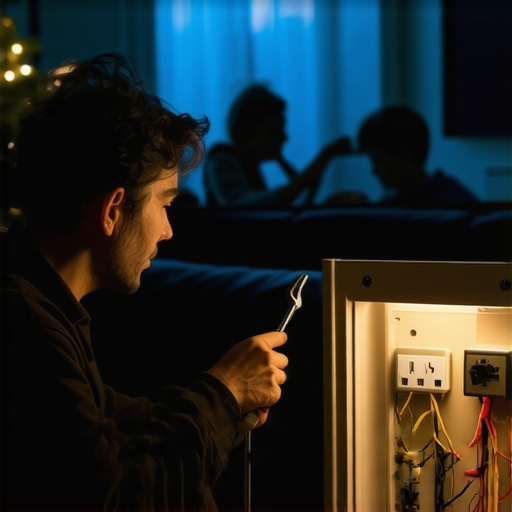
The Ghost of Holidays Future: Why Your 2026 Season Might Start with a Flash
The 2026 holiday season is fast approaching, and most homeowners are worried about gift lists and turkey prep. Me? I’m thinking about the physics of failure. After 35 years as a Master Electrician and forensic inspector, I don’t see a festive home; I see a complex system of copper and aluminum under extreme thermal stress. When the temperatures drop and the architectural lighting goes up, the hidden sins of mid-century wiring and ‘handyman’ shortcuts start to scream. If you’re pushing a 50-year-old service to its limit with modern smart lighting installation and heavy-duty office lighting upgrades, you aren’t just celebrating; you’re conducting a stress test on a ticking time bomb.
The Flipper’s Special: A Forensic Discovery
Last year, I got called to a ‘renovated’ 1974 ranch just three days before Christmas. The homeowner complained of a faint fishy smell in the kitchen—the classic calling card of polymer insulation beginning to liquefy. I pulled my Tick Tracer out, but the readings were erratic. Using my Wiggy, I confirmed a massive voltage drop. I started tracing the Home Run back to the panel and found the ‘flipper special.’ Behind a beautiful marble backsplash, they had buried three live junction boxes, joined with nothing but electrical tape and prayers. They had even used monkey shit (duct seal) to plug a hole where they’d bypassed the main disconnect services. One of those joints was charcoal. The only reason that house didn’t burn down was that the homeowner had the sense to call for same day service appointments before the Romex fully combusted. This is the reality of the 2026 holiday: old bones meeting new, high-amperage demands.
“Aluminum wire connections can overheat and cause a fire without tripping the circuit breaker.” – CPSC Safety Alert 516
1. The Humming Panel: A Symphony of Resistance
If you walk past your electrical panel and hear a low-frequency hum or a sharp ‘buzz,’ that isn’t the sound of holiday cheer. It’s the sound of arcing or mechanical vibration from a loose lug. In homes built between 1960 and 1980, the Cold Creep of aluminum wiring is your primary enemy. Aluminum has a much higher coefficient of thermal expansion than copper. Every time you turn on your holiday lights or your smart lighting installation, the wire heats up and expands. When it cools, it contracts. Over decades, this movement literally pushes the wire out from under the terminal screws. This creates a gap. Electricity doesn’t stop just because there’s a gap; it jumps it. This is arcing. The heat generated by an arc can exceed 3,000 degrees Fahrenheit in milliseconds, turning your panel into a forge. If you’re still running on a 100-amp service while trying to power an EV and a home office, you likely need a 400 amp service entrance upgrade to handle the load safely.
2. Flickering When the ‘Smart’ Kicks In
Modern homes in 2026 are saturated with electronics, but most are still grounded using 1970s logic. When you install high-end architectural lighting or complex office lighting upgrades, you’re introducing non-linear loads into your system. If your lights flicker when the furnace kicks on or the smart lighting installation activates, you’re looking at a neutral issue or an insufficient bonding jumper services setup. In forensic inspections, I often find that the bonding jumper—the critical link that ensures your metal pipes and electrical system stay at the same potential—has corroded or was never installed correctly. This doesn’t just cause flickering; it can energize your plumbing. For more on how we diagnose these issues, you can see how electricians tackle troubleshooting for lighting installations. Without a solid ground path, those surges have nowhere to go but through your expensive electronics.
“The grounded conductor shall be connected to the equipment grounding conductor and the service-disconnecting means enclosure via a bonding jumper.” – National Electrical Code (NEC) Article 250.24
3. The Smell of Ozone and Melting Plastics
If you smell something metallic or like ‘burnt hair,’ your code violation corrections are long overdue. This is often the result of galvanic reaction. In mid-century homes, people often mix copper and aluminum without the proper AlumiConn connectors. When two dissimilar metals touch, they react chemically, creating a layer of oxidation that acts as a resistor. Resistance generates heat ($I^2R$ losses, for the geeks out there). That heat melts the Romex jacket. By the time you smell it, the rough-in phase of the fire has already begun. During a holiday electrical inspections, we look for ‘carbon tracking’—tiny black lines on your outlets that indicate the plastic is carbonizing and becoming a conductor itself. If you notice this, you need same day service appointments immediately. Don’t wait for the trim-out to include a visit from the fire department.
4. Outdated Infrastructure Meeting Modern Demand
We’re seeing a massive trend in 2026 of people converting old garages into high-tech offices. They install phone line installation (usually Cat6 or fiber now) and massive server racks but forget the 400 amp service entrance. If your main disconnect services are constantly tripping, your house is telling you it’s hungry. You can’t run a 21st-century digital lifestyle on a 20th-century ‘stabs-and-bus-bars’ panel. We often recommend a ‘heavy-up’ to a 400-amp service to provide the overhead needed for smart lighting installation and EV chargers. Speaking of which, ensuring your home is ready for these loads is vital; check out ensuring safe and efficient EV charging station setup at home. If you’re still relying on a phone line installation from 1995 to carry your data while your wiring is arcing in the walls, your priorities are upside down. Safety isn’t a ‘nice-to-have’; it’s the foundation of the house.
Conclusion: Torque is Your Best Friend
At the end of the day, electricity is just a force of nature trying to get back to the earth. My job is to make sure it doesn’t take your house with it. Whether it’s bonding jumper services to ensure safety or code violation corrections to satisfy your insurance company, don’t play games with your holiday safety. When I finish a job, I don’t just ‘snug’ the screws; I use a torque wrench to meet the manufacturer’s specifications. That’s the difference between a ‘handyman’ and a Master Electrician. Sleep easy this holiday season knowing your connections are tight and your main disconnect actually works. If you’re seeing any of these signs, reach out for electrical inspections before the first frost hits. Stay safe, keep your dikes sharp, and don’t let your holiday lights be the last thing your house ever sees.