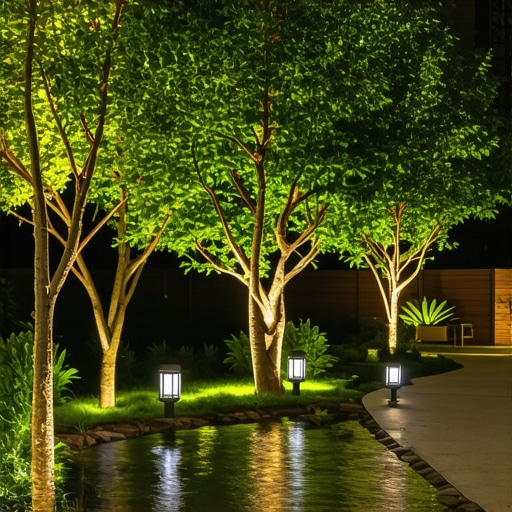
The Forensic Reality of Backyard Power
You see a Pinterest board full of glowing trees and architectural lighting; I see a potential house fire waiting for an oxygen source. After thirty-five years of pulling burnt Romex out of crawlspaces, I don’t look at up lighting services as a simple aesthetic choice. I look at them as a series of thermal calculations and resistive loads. Most homeowners think they can just tap into an existing circuit in the garage to power their 2026 backyard transformation. They’re wrong. If you’re living in a mid-century home, you’re likely sitting on a ticking time bomb of aluminum wiring or a Federal Pacific panel that wouldn’t trip if you hit it with a sledgehammer. Before you invest in lighting installation services, you need to understand the physics of what’s happening behind your drywall.
My journeyman used to smack my hand with a pair of dikes if I stripped a wire with a pocket knife. ‘You nick that copper, you create a hot spot,’ he’d scream. He was right. That microscopic notch reduces the cross-sectional area of the conductor. Under load, electrons crowd into that narrow neck, generating heat through friction at the molecular level. Multiply that by every fixture in a high-end architectural lighting layout, and you’ve turned your backyard wiring into a toaster element. This isn’t just theory; it’s forensic fact. When we perform drone light inspections today, we aren’t just looking for dead bulbs; we’re using thermal imaging to find those nicks and loose connections that are radiating heat before they ignite the mulch.
“Aluminum wire connections can overheat and cause a fire without tripping the circuit breaker.” – CPSC Safety Alert 516
The Anatomy of a Mid-Century Failure
If your home was built between 1960 and 1980, you probably have the ‘Widow Maker’—the Federal Pacific Electric (FPE) Stab-Lok panel. These panels are notorious in the forensic community. The breakers often jam on the bus bar. In a normal circuit, if a short occurs, the magnetic trip mechanism should engage in milliseconds. In an FPE panel, the breaker stays closed, and the wire keeps heating until the insulation melts, off-gasses, and ignites. This is why an electrical panel upgrade isn’t an ‘upsell’; it’s a survival requirement. When you add the load of a modern speaker system setup and high-intensity up-lighting, you are pushing that old bus bar to its breaking point. We often find ‘Cold Creep’ in these old systems. Aluminum expands more than copper when it gets hot. Over decades of turning your lights on and off, the wire literally crawls out from under the terminal screw. Once that connection is loose, you get arcing—a 3,000-degree plasma jump that creates its own fuel source.
[IMAGE_PLACEHOLDER]
Code Violation Corrections and the 2026 Standard
Most DIYers and handymen treat the National Electrical Code like a suggestion. It’s not. It’s a document written in blood. Every rule exists because someone’s house burned down or someone got electrocuted. When I do code violation corrections, the first thing I look for is ‘Monkey Shit’ (duct seal) used improperly or missing from conduit entries. Without it, moist air from the ground travels up the pipe into your panel, where it condenses and rots your breakers from the inside out. This is especially critical for flood water electrical safety. If your backyard lighting isn’t properly GFC-protected and sealed, a heavy rain transforms your lawn into a live conductor. I’ve seen dogs killed by ‘stray voltage’ because a homeowner didn’t want to pay for a proper lighting installation services professional to trench deep enough.
“Overcurrent protection for conductors and equipment is provided to open the circuit if the current reaches a value that will cause an excessive or dangerous temperature in conductors or conductor insulation.” – NEC Section 240.1
Load Calculations: Why 100 Amps Isn’t Enough
Let’s talk Ohm’s Law. If you’re adding a dozen 120V architectural fixtures, a subwoofer for your speaker system setup, and maybe a bathroom exhaust fan for a pool cabana, you’re adding significant amperage to your total demand. A 100-amp service from 1970 was designed for a toaster and a few incandescent bulbs. It wasn’t designed for EV chargers and massive outdoor entertainment zones. We use a Wiggy or a high-end multimeter to check the voltage drop at the furthest light in the run. If you see a drop of more than 3%, your wire is too thin for the distance. That lost voltage isn’t just disappearing; it’s converting into heat. That heat degrades the Romex jacket until it becomes brittle and cracks, leading to a ‘home run’ short that can burn through a joist before you even smell the ozone. For those planning a major overhaul, check out this lighting installations made easy guide to understand the complexity involved.
The Forensic Inspector’s Checklist for 2026
Before you sign a contract for those up lighting services, make sure your contractor isn’t just a ‘parts swapper.’ You need a forensic-level rough-in. This means using AlumiConn connectors if you have aluminum branch circuits and ensuring every junction box is accessible—not buried behind a new stone facade. I’ve spent days with a tracer finding live junctions hidden by flippers. It’s a violation that can void your insurance. If you’re experiencing flickering or the smell of burning plastic, don’t wait. You might need to look into how electricians tackle troubleshooting to see how we hunt down these gremlins. And if you’re upgrading for an EV in the future, your backyard project is the perfect time to pull that extra heavy-gauge copper. Make sure you’re aware of safe and efficient EV charging station setup requirements, as they will impact your total panel load. Even legacy items like an old phone line installation should be cleared out to reduce clutter and EMI in your communication lines. Electricity isn’t a hobby; it’s a force of nature that wants to return to the ground by the shortest path possible. Don’t let that path be through your home’s framing. If you have doubts about your current system’s capacity, it’s time to contact us for a real forensic evaluation before you flip the switch on that new backyard paradise.