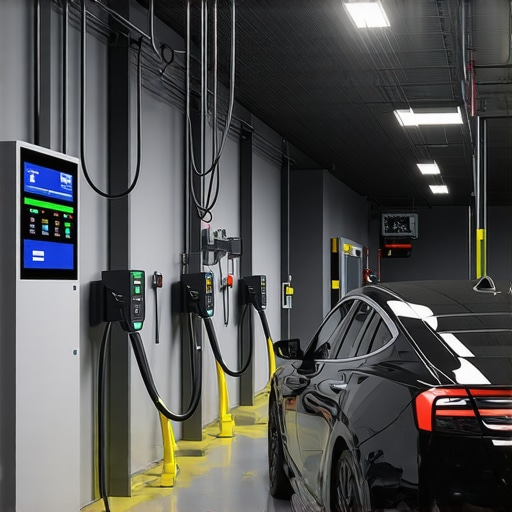
The 2026 Reality Check: Why Your Garage Is a Fire Hazard Waiting to Happen
Most modern homeowners think a garage is just a place to park a car and stash the lawnmower. If you are planning a 2026 build, you are likely looking at a structure that will pull more current than the entire neighborhood did in the 1950s. We aren’t just talking about a couple of light bulbs and an opener anymore. We are talking about Level 2 charging stations, subpanel installation requirements, and smart home hubs that generate heat 24/7. Most builders will try to get away with the bare minimum—the ‘builder grade’ special. That’s how you end up with charred insulation and a certified journeyman services call-out at 3 AM because your main breaker is screaming. I’ve seen it too many times. You think you’re ‘EV ready’ because there is a 240V outlet, but you haven’t considered the thermal load on the bus bars or the specific resistance of your bonding jumper services. When you’re pulling 48 amps continuously for eight hours, electricity isn’t just a convenience; it’s a high-pressure system looking for a weak point.
“Electric vehicle branch circuits shall have no other outlets and shall be sized for 125 percent of the continuous load.” – National Electrical Code (NEC) Article 625
My old journeyman used to smack my hand if I stripped a wire with a knife. ‘You nick the copper, you create a hot spot,’ he’d scream. He was right. That microscopic notch reduces the cross-sectional area of the conductor, increasing resistance. In a low-load scenario like a lamp, you might never notice. But when you’re charging an EV, that nick becomes a localized heater, reaching temperatures that can liquify PVC insulation. This is why certified journeyman services are non-negotiable for a 2026 build. We don’t just ‘hook up wires’; we manage the physics of heat and electron flow to ensure your home doesn’t become a statistic.
1. Dedicated Subpanel Installation: The Garage’s Power Hub
If your main panel is in the basement or on the far side of the house, you need a subpanel in the garage. Period. Why? Voltage drop and thermal expansion. When you run high-amperage lines over long distances, you lose voltage to heat. A subpanel installation allows us to run a high-gauge ‘home run’ from the main service, then distribute power locally. This is critical for 2026 builds because of the cumulative load. Between the EV charger, the standby generator install, and potential workshop tools, a single 20-amp circuit won’t cut it. We look at the ‘Cold Creep’—the phenomenon where conductors expand and contract during high-load cycles. Over time, this movement loosens the lugs on your breakers. If those lugs aren’t torqued to the exact inch-pounds specified by the manufacturer, you get arcing. Arcing leads to carbon tracking, and carbon tracking leads to a fire that your smoke detector won’t catch until it’s too late. Ensuring safe and efficient EV charging station setup at home starts with a robust subpanel that can handle the 125% continuous load mandate.
2. Standby Generator Install and Transfer Switches
In 2026, the grid isn’t getting any younger, but our reliance on it is growing. A standby generator install is no longer a luxury; it’s an insurance policy for your electronics and your vehicle’s mobility. But you can’t just slap a generator onto a circuit. You need a properly bonded transfer switch. I’ve walked into garages where some ‘handyman’ tried to backfeed a generator through a dryer outlet. That is a ‘Widow Maker’ setup. It can kill a lineman working on the poles three blocks away by energizing the transformer in reverse. A professional installation ensures that your bonding jumper services are correctly configured so the generator has a solid path to ground, preventing ‘floating neutrals’ that can fry your car’s sensitive onboard computers. If you’re already seeing issues with your current setup, EV charger troubleshooting often reveals that the root cause is actually poor power quality from the source.
3. CAT6 Cabling Services and Network Infrastructure
Why does a garage need CAT6 cabling services? Because your EV charger, your smart meter installation, and your inverter for solar arrays all need to talk to the cloud. Relying on Wi-Fi through three layers of drywall and a brick exterior is a recipe for dropped signals and failed firmware updates. Network cable installation in a garage environment requires specific attention to EMI (Electromagnetic Interference). High-voltage lines for your EV charger create a magnetic field that can induce ‘noise’ into unshielded data lines. We use shielded CAT6 cabling services to ensure your data packets aren’t corrupted by the 240V lines running parallel to them. If you’re building in 2026, you’re building a data center that just happens to hold cars. Don’t let your home theater wiring or smart home hub suffer because you skimped on the garage backbone.
4. Bonding Jumper Services and Smart Meter Integration
The smart meter installation is the gateway between you and the utility. It’s also where many grounding issues begin. Bonding jumper services ensure that all metal components of your electrical system—conduits, panel enclosures, and water pipes—are at the same electrical potential. If there’s a difference in potential, you get stray current. I’ve used my ‘Wiggy’ (solenoid tester) to find 40 volts sitting on a garage utility sink because the bonding jumper services were ignored during a renovation. In a garage with an EV, this is deadly. Salt tracked in from winter roads increases the conductivity of the floor, making you the perfect path to ground if you touch a poorly bonded charger casing. We also use ‘Monkey Shit’ (duct seal) to plug conduits leading from the smart meter installation to the interior panels, preventing moisture and corrosive gases from migrating into your clean copper connections.
“Aluminum wire connections can overheat and cause a fire without tripping the circuit breaker if the torque is not maintained.” – CPSC Safety Alert 516
5. Aesthetics and Comfort: Permanent Holiday Lighting and Fans
A 2026 build isn’t just about utility; it’s about integration. Permanent holiday lighting is becoming the standard. Instead of climbing ladders, these systems are hardwired into a dedicated circuit. This requires a clean rough-in during the construction phase. You don’t want these lights sharing a circuit with your refrigerator or your EV charger. Similarly, a ceiling fan installation in a garage isn’t just for comfort; it’s for heat dissipation. When an EV is fast-charging, the battery cooling system exhausts a significant amount of heat into the garage. A high-CFM fan helps prevent the ambient temperature from triggering the thermal de-rating of your electrical equipment. We integrate these into the rough-in phase so you don’t have ‘Romex’ stapled across your finished ceiling later. If you’re curious about how we integrate these aesthetic features safely, check out this electrician guide for lighting installations.
The Forensic Inspector’s Final Warning
I’ve spent 35 years looking at the aftermath of ‘good enough.’ I’ve seen home theater wiring melted into a lump because it was run through the same hole as a high-amperage kitchen circuit. I’ve seen smart meter installation lugs so loose they were glowing cherry red under a ‘Tick Tracer.’ Electricity is lazier than a teenager on a Saturday; it will always take the path of least resistance. If that path is through you or your drywall, it doesn’t care. When you’re planning your 2026 build, stop thinking about the cost of the wire and start thinking about the cost of the failure. Proper certified journeyman services ensure that every lug is torqued, every bonding jumper is secure, and every CAT6 cable is shielded. Don’t wait until you smell ozone to care about your garage wiring. Maintain your system and follow optimal EV charger maintenance tips to keep the electrons where they belong. Sleep at night knowing your garage isn’t a time bomb.