
The Scent of Impending Darkness
You probably don’t spend much time thinking about the gray box on the side of your house until the lights start a rhythmic, nauseating flicker that your dimmer switches can’t explain. I’ve spent 35 years in this trade, and I can tell you that the most dangerous problems aren’t usually in your living room. They’re inside the meter base, where the utility’s raw power meets your home’s distribution system. When that connection fails, it doesn’t just go out; it dies a slow, hot, and often violent death. In my career as a forensic inspector, I’ve seen meter sockets that have been cooking for years, hidden behind coats of paint and vines, just waiting for the right moment—like a heavy summer load or a massive holiday light installation—to finally melt down.
The Forensic Breakdown: The Flipper’s Hidden Hazard
I once walked into a split-level that had been ‘fully renovated’ by a flipper who clearly prioritized granite countertops over actual safety. The homeowners called for same day service appointments because they smelled something fishy—the classic scent of scorched phenol and melting insulation—near the garage. I pulled out my tick tracer and got a reading through the drywall before I even opened the enclosure. Behind a brand new layer of cedar siding, the flipper had buried a 1970s-era meter base that had never been serviced. The internal jaws were so badly carbonized that they had actually fused to the utility company’s lateral conductors. One of the lugs was vibrating with a low-frequency hum that you could feel in your teeth. This is why I tell people: if your renovation didn’t include a meter base replacement or at least a thorough inspection of the service entrance, you’re living on a countdown.
“Electrical connections and terminations shall be made by an approved means. The temperature rating associated with the amperage of the conductor shall be selected and coordinated so as not to exceed the lowest temperature rating of any connected termination, conductor, or device.” – National Electrical Code (NEC) 110.14
Component Zooming: The Physics of Resistance and Cold Creep
To understand why a meter socket replacement is necessary, you have to look at the physics of the connection. In many homes built between 1960 and 1980, the meter jaws—the spring-loaded clips that hold the glass meter in place—were made from alloys that eventually suffer from ‘annealing’ due to decades of thermal cycling. Every time you turn on an oven or an A/C unit, the metal heats up and expands. When it cools, it contracts. Over forty years, those jaws lose their spring tension. This creates a high-resistance connection. In electrical terms, resistance equals heat. As the tension drops, the surface area of the contact decreases, causing ‘Ohmic heating.’ This is further complicated by Cold Creep, a phenomenon where the copper or aluminum conductors actually move under the pressure of the lug screws, eventually loosening the connection further. Once air gets into that gap, oxidation layers form, creating even more resistance. It’s a feedback loop that ends in a fire. This is why we insist on AFCI breaker services for the interior of the home; they can sometimes detect the signature of an arc-fault before the meter base turns into a puddle of molten slag.
The Heavy Load Crisis: EV Chargers and Gate Openers
Modern life is brutal on old infrastructure. I see it all the time with electric gate opener installs or when someone wants an EV charger-troubleshooting session because their new Tesla is tripping the main. The 100-amp service of 1975 was designed for a toaster, a few light bulbs, and maybe a color TV. It wasn’t built for a 48-amp continuous draw from a car charger. Adding a high-draw device to an old meter socket is like trying to shove a fire hose’s worth of water through a straw. If you’re planning on ensuring safe and efficient EV charging station setup at home, you absolutely must verify that the meter base can handle the thermal load. I’ve seen transformer installation upgrades in neighborhoods where the utility side was fine, but the house-side meter socket was literally melting because the homeowner didn’t upgrade their service entrance cable while adding heavy-duty loads. We see similar issues with security camera wiring and network cable installation when they aren’t properly shielded or isolated from high-voltage runs, but the meter base remains the primary point of failure for the entire system.
“Aluminum wire connections can overheat and cause a fire without tripping the circuit breaker.” – CPSC Safety Alert 516
The Anatomy of a Professional Repair
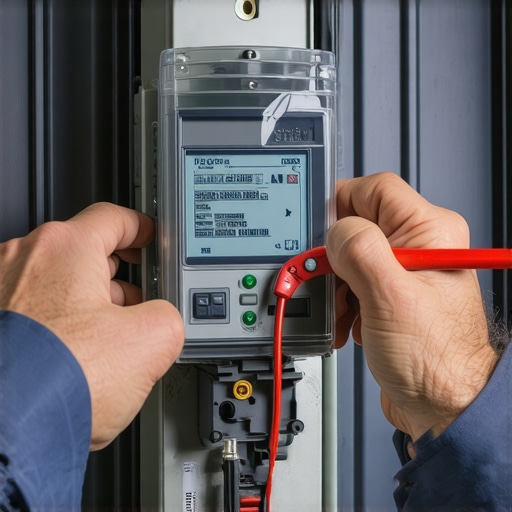
When we perform a meter socket replacement, we aren’t just swapping a box. We’re rebuilding the gateway to your home. This starts with the rough-in phase where we ensure the service mast is plumb and the weather head is positioned to prevent water from tracking down the conductors. We use monkey shit—that’s duct seal for the laypeople—to plug the hub and prevent moisture from entering the top of the enclosure. Moisture is the silent killer; it triggers galvanic reaction between dissimilar metals, especially if you have copper service wires hitting an aluminum lug. During the trim-out, every lug is torqued to specific inch-pound requirements using a calibrated torque wrench. Hand-tightening with dikes or a standard screwdriver isn’t enough; if it’s not torqued to spec, it’s a fire hazard. We also coordinate with the utility for a clean disconnect and reconnect, ensuring the home run to the main panel is sized correctly for the modern demand. Whether we are doing a fire alarm system install or a simple transformer installation, the grounding electrode system must be verified. If your meter base isn’t bonded correctly to the ground rods, a lightning strike or a utility surge has nowhere to go but through your expensive electronics.
Why You Can’t Ignore the Hum
If you hear a buzz, see flickering lights, or notice a burnt smell, don’t wait. Electricity is not a hobby, and it doesn’t forgive ‘good enough.’ Many homeowners try to DIY their way through a security camera wiring project, but the meter base is the ‘Widow Maker’ for amateurs. We offer same day service appointments because a failing meter socket is a true emergency. If the jaws fail completely, you don’t just lose power; you can experience a ‘floating neutral’ which sends 240 volts through your 120-volt outlets, frying everything from your microwave to your network cable installation equipment. You can learn more about managing these risks by checking our EV charging safety guide or reading about how we handle complex lighting installations. For any concerns, always contact us immediately before a flicker becomes a fire. We also suggest reviewing our privacy policy for how we handle your home data during inspections. Remember, a master electrician doesn’t just look for what’s working—we look for what’s about to fail. “