The Scent of a Short: Why Your Yard is a Waiting Disaster
I’ve spent thirty-five years dragging my knees through damp crawlspaces and huffing the acrid, metallic stench of vaporized copper. If there is one thing I’ve learned as a forensic inspector, it’s that electricity doesn’t care about your landscaping budget. Most homeowners look at their backyard and see a patio; I see a complex web of thermal expansion, soil acidity, and potential ground faults waiting to bite. My journeyman, Gus, used to smack my hand with a pair of dikes if he saw me stripping a wire with a pocketknife. ‘You nick that copper, kid, and you’ve just built a fuse that’ll blow in ten years,’ he’d growl. He was right. That microscopic nick creates a bottleneck—a point of high resistance where electrons pile up like a 50-car pileup on the interstate, generating heat until the Romex insulation turns into a brittle, charred husk.
As we march toward 2026, our outdoor spaces are no longer just grass and a grill. We are looking at high-draw architectural lighting, PA system installations for outdoor theaters, and sophisticated home automation setups. If you’re still relying on a mid-century electrical infrastructure—especially those 1970s-era Federal Pacific panels with their infamous ‘no-trip’ breakers—you aren’t just flirting with a power outage; you’re hosting a time bomb. These old bus bars corrode, and the breakers jam in the ‘on’ position even when the wire is glowing like a toaster element. It’s the ultimate betrayal of safety engineering.
1. The Forensic Trench: Proper Burial Depth and Conduit Integrity
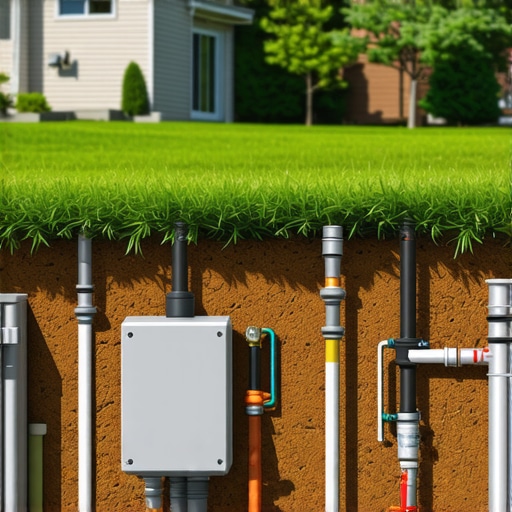
When I perform a forensic audit on a failed underground run, the culprit is almost always ‘Cold Creep’ or improper depth. The National Electrical Code isn’t a suggestion; it’s a survival manual. Most DIYers throw UF-B cable six inches under the dirt and call it a day. In two years, the freeze-thaw cycle of the soil heaves that wire upward, where a shovel or a lawn aerator eventually finds it.
“Direct buried conductors and cables emerging from grade shall be protected by enclosures or raceways extending to a minimum depth of 18 inches below finished grade.” – NEC Table 300.5
For 2026 yard power, we don’t just bury wire; we engineer a raceway system. I insist on Schedule 80 PVC for any area subject to physical damage. We use ‘Monkey Shit’—that’s duct seal for the laypeople—to plug the ends of the conduit. If you don’t, temperature differentials will pull moist air into your indoor panels through the pipe, leading to terminal oxidation. Once that green crust forms on your breakers, the resistance climbs, and your power quality analysis will start looking like a heart attack on a graph. This is why proper lighting installations made easy require more than just plugging in a transformer; they require a sealed, moisture-proof infrastructure.
2. Electrical Load Calculations: The Physics of 2026 Demands
Your 100-amp service was designed for a toaster and a few lightbulbs, not an outdoor kitchen, a PA system, and a hot tub. When we add these loads, we have to talk about the physics of the ‘Service Heavy-Up.’ If you overload a circuit, the wire doesn’t just get warm; the atoms in the copper literally vibrate more violently. In aluminum-wired homes from the late 60s, this is lethal. Aluminum has a much higher coefficient of thermal expansion than copper. It expands, pushes against the screw terminal, and when it cools, it doesn’t quite shrink back to the same spot. This is ‘Cold Creep.’ Eventually, the connection becomes loose, arcing begins, and you have a fire. [IMAGE_PLACEHOLDER]
Before we dig a single trench, an electrician must perform rigorous electrical load calculations. We look at the ‘Home Run’—the direct line from the panel to the first junction box—and ensure the voltage drop doesn’t exceed 3%. If your voltage drops, your motors (like those in your pool pumps) have to work harder, generating more internal heat and shortening their lifespan. This is why ensuring safe and efficient ev charging station setup at home is so critical; these high-draw devices expose every weakness in your grounding and bonding system.
3. Whole House Surge Protection: The Lightning Magnet
Underground wiring acts as a giant antenna for electromagnetic pulses. A nearby lightning strike doesn’t have to hit your house to fry your home automation setup; it just has to hit the ground nearby. The surge travels through the earth, finds your buried PA system cables, and hitches a ride straight into your sensitive data closet.
“Aluminum wire connections can overheat and cause a fire without tripping the circuit breaker.” – CPSC Safety Alert 516
While that quote focuses on the wire itself, the same principle applies to surge events—without a path to divert that energy, your devices become the fuse.
A whole house surge protection device (SPD) installed at the main panel is your first line of defense. It uses Metal Oxide Varistors (MOVs) to shunt excess voltage to the ground in nanoseconds. If you’re investing in architectural lighting or emergency exit lighting for a large property, skipping the SPD is like building a skyscraper without a lightning rod. We’ve seen entire data closets melted because a homeowner thought a $20 power strip was enough protection.
4. Augmented Reality Troubleshooting and Forensic Mapping
The days of guessing where a wire broke are over. I use a ‘Wiggy’ for solenoid testing and a high-end ‘Tick Tracer’ for non-contact voltage detection, but the real tech is in forensic mapping. We are now using augmented reality troubleshooting to overlay the ‘as-built’ wiring diagrams onto a technician’s field of vision. This prevents the ‘Handyman Special’ where someone nicks a buried line and tries to patch it with electrical tape and a prayer. If you have a fault in your yard power, we use TDR (Time Domain Reflectometry) to send a pulse down the line. It bounces back off the break, telling us exactly how many feet out the ‘widow maker’ is located.
This level of precision is vital for how electricians tackle troubleshooting for lighting installations. We don’t just dig up the whole yard; we perform a surgical strike. This protects the integrity of the remaining conduit and ensures that your power quality analysis remains stable across the entire branch circuit.
5. Data Closet Organization and PA System Isolation
In 2026, your yard power includes data. If you’re running ethernet or speaker wire next to high-voltage lines in the same trench without proper shielding or separation, you’re going to get ’60-cycle hum.’ This EMI (Electromagnetic Interference) ruins audio quality and drops data packets. Forensic inspection often reveals ‘bootleg grounds’—where a hack installer connects the neutral to the ground screw to trick a tester. This creates a parallel path for current, energizing the metal frames of your outdoor equipment. It’s a silent killer.
Proper data closet organization involves separating the ‘rough-in’ power from the low-voltage signals. We use shielded twisted pair (STP) for outdoor runs and ensure all underground enclosures are rated for NEMA 4X (corrosion resistance). This is especially important for ev charger troubleshooting where communication between the car and the grid is essential. Don’t let a sloppy ‘trim-out’ ruin a high-end installation. Torque your lugs to the manufacturer’s specs—usually in inch-pounds—and sleep at night knowing the thermal imaging won’t show any hot spots in your walls.