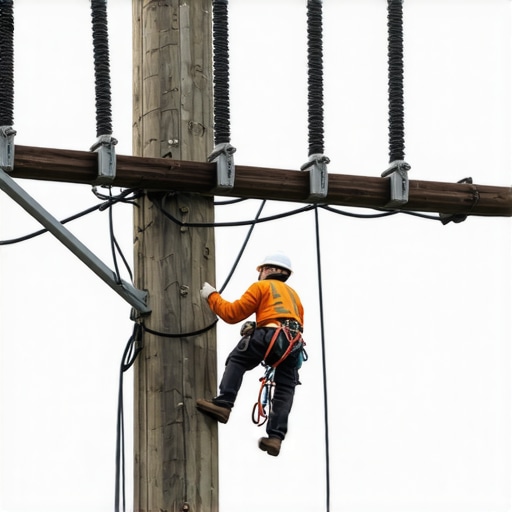
The Heavy Weight of Neglect: Why a Sagging Wire is a Structural Time Bomb
I remember my first week as an apprentice, standing in a rain-slicked driveway in 1989. My journeyman, a guy who had more scars than a roadmap, pointed up at a triplex service drop that was dipping dangerously low over a backyard pool. ‘Look at that wire,’ he growled, clutching his Wiggy like a holy relic. ‘That’s not just a cable; it’s a lever. Gravity and wind are using that line to pry the meter socket right off the side of this house. You nick the copper or stress that mast, and you’re creating a high-resistance hot spot that’ll burn this place down before the fire department can get their boots on.’ He was right. Decades later, I still see the same mechanical failures being ignored by homeowners who think electricity is just some invisible fluid that magically appears when they flip a switch.
When we talk about an overhead service drop, we are looking at the Home Run for your entire property. It is the umbilical cord between the utility transformer and your main service equipment. In 2026, as our climate produces more volatile weather patterns, the physical integrity of these wires is under more stress than ever. If your service drop looks like a wet noodle, you aren’t just looking at an aesthetic issue; you are looking at a forensic breakdown of your home’s electrical defense. Using a Tick Tracer to check for voltage is one thing, but understanding the physics of Strain Relief and Cold Creep in aging conductors is what keeps you alive.
“Service-drop conductors shall have a vertical clearance of not less than 8 feet from the highest point of roofs over which they pass.” – National Electrical Code (NEC) Section 230.24
1. The Mechanical Autopsy: Checking the Point of Attachment
The first thing I look for during a forensic inspection is the point of attachment. This is where the utility’s triplex—the two insulated lines wrapped around a bare neutral messenger wire—bolts to your structure. In older homes built between 1900 and 1950, this attachment is often into rotting fascia board or a brick chimney that wasn’t designed to handle 300 pounds of lateral tension. When the wire sags, the tension increases. It’s basic physics: the shallower the angle, the higher the horizontal force. I’ve seen 60 amp panel upgrade jobs where the old service mast was actually being pulled out of the roofline because the installer didn’t use a proper guy-wire or back-bracing.
If you see daylight between your meter can and the siding, or if the masthead (the ‘weatherhead’) is tilted away from the house, you are in the danger zone. This gap allows water to track down the inside of the service entrance cable. It’s called ‘wicking.’ Water enters the meter socket replacement area and begins to corrode the lugs. I’ve opened panels where the main breaker was literally sitting in a pool of rust-colored sludge because a sagging wire acted as a funnel for the last three Nor’easters. This is why we often recommend contacting a professional the moment you see a lean in your service mast.
2. The Clearance Crisis: Why Height Matters in 2026
Modern standards for clearance aren’t just arbitrary numbers; they are based on the height of emergency vehicles and the reach of a person on a ladder. If your wire is sagging over a driveway, it needs to be at least 12 feet up. Over a backyard? 10 feet. If it’s over a deck where you’ve recently done deck lighting services, that clearance is even more critical. I’ve seen ‘Handyman Specials’ where a new deck was built right under a sagging service line, putting the 240-volt conductors within arm’s reach of a child. That is a recipe for a coroner’s report.
We now use drone light inspections to get precise measurements of these heights without putting a man on a precarious roof. If the wire is dipping, it’s often because the wedge clamp—the device that grips the messenger wire—is sliding or the porcelain insulator has cracked. This causes the ‘triplex’ to unravel. When those wires start rubbing against each other or a tree limb, the insulation wears thin. Eventually, you get a phase-to-phase arc that sounds like a shotgun blast. If you are lucky, it trips a fuse at the pole. If you aren’t, it sends a surge into your house that fries every GFCI outlet installation you’ve ever paid for.
3. The 60-Amp Trap and the Need for a Heavy-Up
If your home still has a 60 amp panel upgrade on the ‘to-do’ list, your service drop is likely ancient. These old 2-wire or early 3-wire systems were never designed for the load of a modern 2026 household. We’re talking about kitchen range hood wiring, EV chargers, and high-efficiency HVAC systems. The gauge of the wire in a sagging 60-amp service is often too small (typically #6 or #4 copper/aluminum), leading to excessive heat. This heat causes the metal to expand and contract—a process called thermal cycling. Over decades, this expansion causes the wire to permanently stretch and sag.
Upgrading to a 200-amp service isn’t just about more power; it’s about structural safety. A modern electrical panel upgrade includes a new, rigid galvanized steel mast that can support the tension of modern triplex. During a virtual consultation wiring session, I often have homeowners send me photos of their meter. If I see Monkey Shit (duct seal) dried and cracked around the top of the meter hub, I know water is getting in. Replacing the meter socket and the service entrance conductors is the only way to ensure the circuit breaker replacement you just did actually protects the home.
“Aluminum wire connections can overheat and cause a fire without tripping the circuit breaker.” – CPSC Safety Alert 516
4. The Grounding and Bonding Forensic Check
A sagging wire often indicates that the entire service is shifting. This movement can snap your grounding electrode conductor—the wire that connects your electrical system to the earth. Without a solid ground, your phone line installation or cable TV lines can become the primary path to ground for a lightning strike or a utility fault. I’ve seen melted coax cables fused to living room carpets because the main service ground was severed by a shifting, sagging mast.
When we perform a meter socket replacement, we aren’t just swapping a box. We are re-establishing the bond to the water pipe and the ground rods. We ensure that if a tree limb hits that sagging wire, the surge has a clear path to the dirt, not through your flat-screen TV. This is why DIY is a myth in the electrical trade. You might know how to wire a light switch, but do you know the torque requirements for a 200-amp lug? Do you have the dikes to cut through 4/0 aluminum? Probably not. If you are worried about your infrastructure, looking into safe and efficient EV charging setups will show you just how much stress modern tech puts on these old wires.
The Verdict: Sleep Better with a Torqued System
Electricity is a lazy, opportunistic force. It is always looking for the easiest path to ground, and it doesn’t care if that path is through your attic insulation or your heartbeat. A sagging service drop is a visual warning that your home’s first line of defense is failing. Whether it’s a 60 amp panel upgrade or a simple circuit breaker replacement, the goal is to eliminate resistance. Resistance creates heat; heat creates fire. I’ve spent 35 years smelling the ozone of near-misses. Don’t wait for the ‘fishy smell’ of melting plastic to take action. Get the mast straightened, get the connections torqued, and keep the 240 volts where they belong: in the wire, not in your walls.