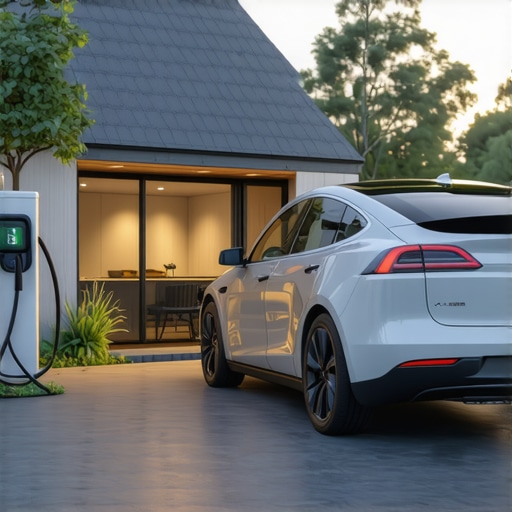
The Ghost in the Copper: Why Your Old Panel Can’t Handle the Future
My journeyman used to smack my hand with a pair of dikes if I stripped a wire with a pocket knife. ‘You nick the copper, you create a hot spot,’ he’d scream over the sound of a reciprocating saw. He was right. That tiny notch in the metal reduces the cross-sectional area, forcing electrons through a bottleneck. In the world of high-voltage V2H (Vehicle-to-Home) charging, that nick isn’t just a mistake; it is an ignition source. We are moving into 2026, where your car is no longer just a commuter tool—it is a 100-kilowatt-hour rolling generator. But if you try to backfeed that much juice into a mid-century load center with aluminum branch circuits, you aren’t ‘powering your home’; you are pre-heating a furnace you can’t turn off.
1. The Load Center Upgrade: Beyond the 100-Amp Myth
Most 1970s-era homes are sitting on a 100-amp service that is already gasping for air. You add an electric range, a dryer, and a heat pump, and you are at the limit. Now, imagine a V2H system trying to pull 48 amps continuous to charge, or worse, pushing that same current back through the bus bars during an outage. This is where we talk about ‘Cold Creep.’ Aluminum wiring, common in mid-century builds, expands and contracts at a different rate than the steel lugs in your panel. Over time, the connection loosens. A loose connection creates resistance. Resistance creates heat. Heat creates fire.
“Aluminum wire connections can overheat and cause a fire without tripping the circuit breaker.” – CPSC Safety Alert 516
For a V2H setup to be safe, we perform load center upgrades that replace those tired, oxidized bus bars with tin-plated copper. This ensures that when your EV starts dumping power into the house, the metal doesn’t migrate out from under the screws.
2. Meter Socket Replacement and the ‘Island Mode’ Transfer
When the grid goes dark in 2026, your home must disconnect from the utility lines to prevent ‘backfeeding.’ If you don’t, your car could send 240 volts back up the transformer, potentially killing a line worker blocks away. This requires a sophisticated meter socket replacement involving an automatic transfer switch or a ‘mid-meter’ bypass. We often find the existing meter cans are rotted out or full of ‘monkey shit’—that gray duct seal used to keep moisture out that eventually just traps it in. A forensic look at a 40-year-old meter socket usually reveals heavy pitting on the jaws. If those jaws don’t have a death grip on the meter’s stabs, the resulting arc will melt the entire enclosure. Ensuring safe and efficient EV charging station setup means starting at the point of entry. We check the service mast and the bonding jumper services to ensure the path to ground is clear and low-resistance.
3. Infrared Thermography: Seeing the Invisible Heat
I don’t trust my eyes; I trust my infrared thermography scans. During a preventative electrical maintenance visit, we put the V2H system under full load and look through a thermal lens. A healthy breaker should be warm, but a failing one glows like a cigarette cherry. This is critical for 2026 homes because V2H systems operate as ‘continuous loads.’ Under the NEC, a continuous load is anything running for three hours or more. This triggers the 125% rule—meaning if your car is pulling 40 amps, your circuit must be rated for 50 amps. If you’ve got a knob and tube removal project that was half-baked, or old Romex with brittle insulation, that heat will bake the wire until the jacket turns to dust. Using a Wiggy or a Tick Tracer won’t tell you the temperature of a lug, but an IR scan will. This is how we catch the ‘Widow Maker’ before it catches you. Following top EV charger maintenance tips involves regular thermal checks to ensure no lugs have vibrated loose from the 60Hz hum.
4. Network Cable Installation and Fire Alarm System Integration
V2H isn’t just ‘dumb’ electricity; it’s data. Your car needs to talk to your home’s energy management system via network cable installation (Cat6 or fiber) to negotiate how much power to discharge. If this communication fails, the system shuts down. Furthermore, when you are drawing massive current from a lithium-ion battery into a garage, a fire alarm system install is non-negotiable. We integrate heat detectors (not just smoke detectors) into the garage ceiling. Smoke detectors are great for smoldering couches, but for an electrical fire in a load center, you want a rate-of-rise heat detector that triggers the moment the temperature spikes. We see too many homeowners spend $60k on an EV and $5k on a charger, then try to save $200 by skipping the bonding jumper services.
“Electrical equipment shall be installed in a neat and workmanlike manner.” – NEC 110.12
This isn’t just about aesthetics; it’s about making sure your up lighting services and network cable installation don’t become a tangled mess of interference and heat. If you’re experiencing issues, checking ev charger troubleshooting guides can help, but for V2H, you need a master’s touch.
The Final Torque: Why Professionalism Prevents Catastrophe
In 35 years, I’ve never seen a ‘handyman special’ that actually met the torque requirements stamped on the side of a breaker. Most guys just tighten it until it feels ‘snug.’ I use a calibrated torque screwdriver because 5 inch-pounds can be the difference between a cool connection and a house fire. Whether you are doing a rough-in for a new 2026 build or a trim-out on a renovation, the physics of electricity don’t care about your budget. If you want to use your EV to keep the lights on during the next blizzard, you need to ensure the infrastructure can handle the stress. This means looking at everything from the meter socket replacement to the priority service membership that keeps your system under a watchful forensic eye. Electricity isn’t a hobby—it’s a force of nature that is constantly trying to return to the ground. Your job is to make sure it doesn’t go through your floorboards to get there.