The Ghost of Electricity Past
Walk into any home built between 1920 and 1950, and you’ll smell it before you see it. It’s a faint, metallic tang—ozone mixed with seventy years of attic dust. That’s the smell of a 60-amp service gasping for air. If you’re still running your life on a 60-amp fuse box or an early circuit breaker panel, you aren’t just living in the past; you’re living inside a kiln. I remember my first week as an apprentice, my journeyman, a guy who had more scars than teeth, watched me prep a Home Run for a new kitchen circuit. He saw me use my pocket knife to strip the cloth-jacketed wire. Before I could finish the cut, he smacked my hand so hard my Dikes flew across the room. ‘You nick that copper, kid, and you’ve just built a heater,’ he barked. ‘A nick creates a bottleneck. A bottleneck creates resistance. Resistance creates a fire.’ He was right. Every time you ask a 60-amp panel to handle a modern load, you are nicking the safety of your entire structure. By the time 2026 rolls around, these ancient systems won’t just be obsolete—they’ll be uninsurable and potentially lethal bottlenecks. We need to talk about why that Licensed Master Electrician you called is looking at your panel like it’s a ticking bomb.
1. The Physics of Thermal Fatigue and the ‘Widow Maker’
When I pull my Wiggy out to test a dead circuit in a 60-amp home, I’m often looking for more than just a blown fuse. I’m looking for signs of Cold Creep and thermal fatigue. Electricity is the movement of electrons, and when you shove too many electrons through a pipe that’s too small, they generate heat. In these old 60-amp setups, the bus bars—the main conductive tracks—weren’t designed for the 24/7 draw of a high-end Home Theater Wiring system or a Ceiling Fan Installation in every room. Over decades, the copper or (heaven forbid) early aluminum expands and contracts as it heats and cools. This is thermal cycling. Eventually, the screws holding the wires to the lugs lose their tension. A loose connection is a high-resistance connection. This creates a feedback loop: heat causes looseness, looseness causes more heat.
“Aluminum wire connections can overheat and cause a fire without tripping the circuit breaker.” – CPSC Safety Alert 516
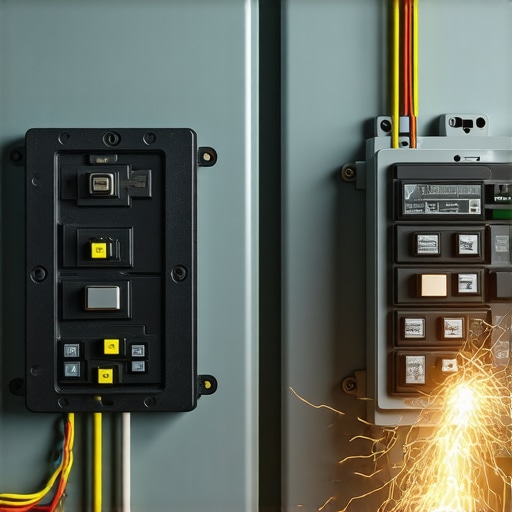
This is why your lights flicker when the fridge kicks on. It’s not a ‘quirk’ of an old house; it’s the sound of an arc starting to form behind the dead front. If you are planning an EV Charger Installation, trying to bridge it onto a 60-amp service is a recipe for a Widow Maker scenario where the main lugs weld themselves shut, or worse, ignite the Romex insulation before the main fuse even realizes there is a problem. [image_placeholder_1]
2. The Invisible Load: From Garage Wiring to the Curb
Modern living has moved outdoors, but your 1940s electrical panel hasn’t. Today, homeowners want Patio Cover Outlets, Tree Mounted Lights, and an Electric Gate Opener. Each of these adds to the ‘base load’ of the house. When we perform Garage Wiring Services, we often find that the original 60-amp service was intended for four circuits: lights, a few outlets, and maybe a single dedicated line for a primitive washing machine. Now, you’re trying to plug in a Tesla. You can’t just ‘tap into’ an existing circuit.
“Overloaded electrical systems are a leading cause of residential fires. Updating service panels to meet current demand is a primary safety recommendation.” – NFPA 70E Standard for Electrical Safety
When you look at an ensuring safe and efficient EV charging station setup at home, you’re looking at a 40-amp or 50-amp draw just for the car. On a 60-amp main, that leaves you 10 amps to run your entire house, your RV Hookup Installation, and your HVAC. It’s mathematically impossible. The 2026 standards are pushing for Smart Meter Installation integration that will monitor this load in real-time. If your panel is ancient, it won’t be able to communicate with the grid, and you’ll find your utility company sending you ‘non-compliance’ notices faster than you can flip a breaker.
3. The ‘Monkey Shit’ and the Meter Cans: Why 2026 is the Hard Deadline
As we approach 2026, the industry is seeing a massive shift in how insurance companies view risk. If your service entrance is still using a round meter socket or a 60-amp disconnect, you are a ‘High Risk’ entity. I’ve seen meter cans where the Monkey Shit (duct seal) has dried out and cracked, allowing moisture to seep into the service mast. In a 60-amp system, there is very little ‘margin for error.’ Corrosion on the main lugs can lead to a phase-to-ground arc that can vaporize the interior of the panel. During a Rough-in for a renovation, I often find that these old panels lack a proper grounding electrode system. They rely on a single wire to a water pipe that might have been replaced with PEX years ago, leaving the house completely ungrounded. This is why ev charger troubleshooting expert tips to fix common issues often start with ‘check your ground.’ Without a 200-amp upgrade, you can’t install the necessary AFCI (Arc-Fault Circuit Interrupter) protection that modern code requires for bedrooms and living areas. When we do a Trim-out on a panel upgrade, we aren’t just giving you more breakers; we are giving you a system that can actually detect a fire before it happens. If you’re unsure about your current capacity, you should contact us for a forensic inspection before the 2026 insurance mandates kick in. Don’t wait until the smell of ozone becomes the smell of smoke. Protecting your home starts at the service entrance, not the fire extinguisher.