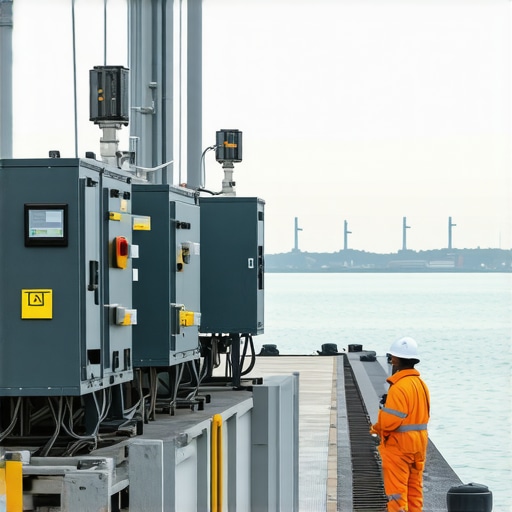
The Invisible Killer in the Mist: A Master’s Forewarning
The first thing you notice isn’t the sight of a frayed wire; it’s the smell. It’s that sharp, metallic tang of ozone mixed with the rotting seaweed of a low tide. To a Master Electrician with thirty-five years of salt-crusted boots, that smell means one thing: something is cooking, and it isn’t the catch of the day. Most boaters treat their dock power like an extension cord in a dry garage. That’s a lethal mistake. When you’re dealing with the corrosive cocktail of humidity and salt, the physics of electricity changes from a utility to a predator.
My journeyman used to smack my hand if I stripped a wire with a knife. ‘You nick the copper, you create a hot spot,’ he’d scream over the sound of the surf. He was right. In a coastal environment, that tiny nick becomes a gateway for salt air. Within months, the copper undergoes a galvanic reaction, turning into a brittle green powder that chokes current and generates enough heat to melt a PVC conduit before the breaker even thinks about tripping. This isn’t just about losing power to your boat; it’s about ‘Stray Current Drowning,’ where a fault in your wiring turns the water around your dock into a high-voltage kill zone.
“Aluminum wire connections can overheat and cause a fire without tripping the circuit breaker.” — CPSC Safety Alert 516
1. The Equipotential Grid: Bonding the Death Trap
If you don’t have an equipotential grid, your dock is a liability. In 2026, the standard for shore power isn’t just about having a ground wire; it’s about ensuring there is no voltage gradient across the surfaces you touch. Imagine standing on a wet dock and grabbing a metal railing. If there’s a leak in the system, you become the bridge. An equipotential grid involves bonding all metallic parts—ladders, cleats, and frames—into a single massive loop. We use heavy-gauge solid copper, often buried or embedded in the structure, to ensure that everything sits at the same electrical potential.
When I do a rough-in for a new dock, I’m looking for ‘Voltage Gradients.’ If my Wiggy (solenoid voltmeter) shows even a 2-volt difference between the water and the shore power pedestal, we have a crisis. This is where the physics of ‘Cold Creep’ comes into play. As the temperature swings from the midday sun to the midnight chill, metal expands and contracts. If those bonding lugs aren’t torqued to spec, they loosen, resistance climbs, and your safety grid becomes a heating element. This is why a professional inspection is non-negotiable for any waterfront property.
2. The GFCI and ELCI Defense: Beyond the Standard Outlet
Most homeowners think a GFCI outlet installation is the end-all-be-all. On a dock, it’s barely the beginning. For 2026, we are pushing for Equipment Leakage Circuit Interrupters (ELCI). While a standard GFCI trips at 5mA to protect a human from a shock, an ELCI sits at the shore power pedestal and monitors the entire boat-to-shore connection for leakage in the 30mA range. This prevents the boat itself from leaking current into the marina water.
I’ve walked docks with a Tick Tracer (non-contact voltage tester) and seen the tip glow red just by pointing it at the water’s surface. That’s usually the result of a ‘Handyman Special’ where someone bypassed the ground or used indoor-rated Romex inside a piling. Saltwater bridges the gap between the hot leg and the ground faster than you can blink. You need a home run of marine-grade, tin-coated copper wire from the main panel to the pedestal. If your system is still running on an old fuse box, you are living on borrowed time. A fuse box to breaker conversion is the minimum requirement to handle the sensitive trip-curves needed for modern ELCI protection.
“Ground-fault protection shall be provided for all 15- and 20-ampere, single-phase, 125-volt receptacles installed outdoors…” — National Electrical Code (NEC) 210.8
3. The Heavy-Up: Accommodating the 2026 Load
The docks of yesterday powered a few lights and a radio. Today’s docks are high-tech hubs. I’m seeing more requests for EV charger installation right at the slip for electric tenders and jet skis. You cannot simply tap into your existing dock circuit for this. It requires a dedicated sub-panel and a recalculated load analysis. If you try to pull 40 amps through a line designed for 20, you’re going to experience massive voltage drop, which kills the electronics in your boat and fries your EV charger components.
During a trim-out, I always check the terminal lugs. If they aren’t coated in Monkey Shit (duct seal) and dielectric grease, the salt air will find its way into the strands. Once that happens, the wire acts like a wick, drawing moisture deep into the insulation. For those setting up high-performance environments, like a workshop electrical setup in a boathouse or a high-end speaker system setup for the pier, the grounding must be flawless. Any interference from the shore power’s AC ripple will manifest as a hum in your audio or, worse, phantom glitches in your EV charging station.
4. Preventing the ‘Widow Maker’ with Proper Grounding
The most dangerous thing I find in coastal inspections is the ‘bootleg ground.’ This is when a hack electrician connects the neutral to the ground at the pedestal because they didn’t want to pull a fourth wire. In a house, it’s a code violation. On a dock, it’s a ‘Widow Maker.’ Because the ground and the water are in constant contact, a bootleg ground can cause the entire metal frame of your boat to become energized if the neutral wire ever breaks. You won’t know it until you jump into the water and your muscles seize up.
If you’re unsure about your wiring, don’t guess. We now offer virtual consultation wiring reviews, but for dock work, you really need a pair of eyes on-site with a Wiggy. We check for ‘Salt Bridges’—layers of dried salt that have built up inside your recessed lighting installation on the dock roof, creating a path for current to track across the housing. We replace those corroded fixtures with stainless steel or composite enclosures and pack the wire nuts with silicone grease. It’s the difference between a system that lasts thirty years and one that fails in three. Don’t wait for the smell of burning plastic to call me. If your lights flicker when the boat lift kicks on, your resistance is too high and your safety is too low. Keep it torqued, keep it dry, and for God’s sake, keep it grounded.