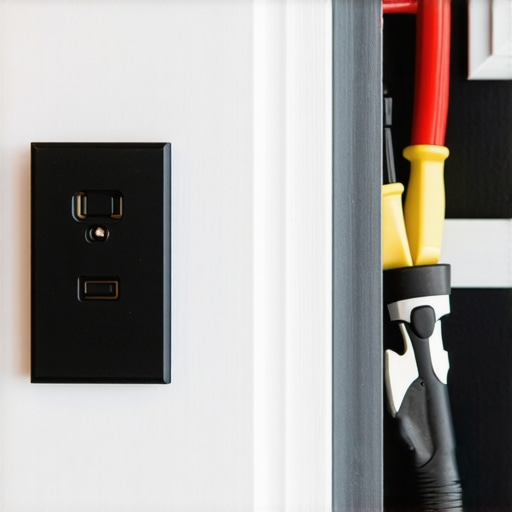
The Sizzle of Disaster: Why Your Walls are Talking
You hear it before you see it. It’s a faint, predatory hiss—the sound of electrons jumping a gap they were never meant to cross. As a forensic inspector who has spent 35 years pulling charred remains of ‘handyman specials’ out of wall cavities, I can tell you that a sparking outlet isn’t an inconvenience; it’s a thermal event in progress. When you smell that metallic, ozone-heavy stench, you aren’t just looking at a bad switch. You are witnessing the beginning of a high-impedance arc that can reach temperatures exceeding 10,000 degrees Fahrenheit in milliseconds.
The Forensic Breakdown: The Physics of the Failure
Why does it spark? It usually comes down to interfacial resistance. In older homes, especially those requiring cloth insulated wiring replacement, the insulation has become brittle, resembling a dry snake skin that flakes off when touched. When that copper is exposed and the terminal screw isn’t torqued to spec, the connection becomes a tiny heater. This is called ‘Cold Creep’ in aluminum systems, but in copper, it’s often about oxidation layers. A microscopic layer of copper oxide builds up, creating resistance. Resistance creates heat. Heat causes the metal to expand and contract, further loosening the screw. It’s a death spiral for your infrastructure.
“Arc-faults are a leading cause of residential fires, often occurring in damaged or aged wiring where traditional breakers fail to trip.” – CPSC Safety Alert 516
The Journeyman’s Lesson: The Nick that Burnt the House
I remember my first week as an apprentice. My journeyman, a guy we called ‘Iron Mike,’ saw me using a standard utility knife to strip the jacket off a Romex cable. He didn’t just correct me; he threw his Wiggy tester at the wall. ‘You nick that copper, kid, and you’ve just created a localized bottleneck,’ he roared. ‘The electricity doesn’t just flow over it; it piles up like a traffic jam, creates a hot spot, and eventually, that wire snaps under the thermal stress.’ He was right. Every time I perform troubleshooting on a ‘sparking’ wall today, I find a nicked conductor or a 14-gauge wire forced onto a 20-amp circuit. It’s physics, and physics doesn’t take days off.
4 Urgent Tactics for 2026 Home Safety
1. Implementing AI Fault Detection Systems
By 2026, we’ve moved past the ‘dumb’ breaker. Modern AI fault detection units now integrate with your main panel to distinguish between the harmless arc of a vacuum cleaner motor and the dangerous signature of a loose neutral. If your wall is sparking, the first tactic isn’t just replacing the outlet; it’s upgrading the branch circuit protection to an AI-driven AFCI (Arc Fault Circuit Interrupter) that monitors waveform distortion in real-time. This is essential for home theater wiring where sensitive electronics can be fried by a single surge.
2. The Forensic Inspection of Cloth Insulation
If your home predates the 1960s, that spark is likely the result of carbonization. Cloth insulation absorbs moisture over decades. Eventually, the cloth becomes conductive. When you see a spark behind the plate, you need to stop. We call this the ‘Widow Maker’ scenario. The repair tactic here isn’t a new switch; it’s a surgical rough-in where we pull new THHN conductors through the existing conduits or perform a full cloth insulated wiring replacement. You can’t put a Band-Aid on gangrene.
3. Bonding and Grounding: The Spa and Hot Tub Defense
Sparking isn’t limited to interior walls. I’ve seen swimming pool bonding failures where the ‘spark’ was actually a voltage gradient across the wet concrete. For 2026 homes with high-end outdoor living, hot tub wiring services and spa grounding services must involve equipotential bonding. If your outdoor garage wiring services aren’t properly bonded to the house ground, you’re creating a path for stray current to find a home in your pool’s handrail. This is why how electricians tackle troubleshooting for lighting installations is so critical—it’s about the entire grounding ecosystem.
4. Heavy-Duty Commercial-Grade Trim-Out
Stop buying 99-cent residential outlets. If you’re running a restaurant kitchen electrical setup or even a high-demand home office, you need ‘Spec-Grade’ or ‘Hospital-Grade’ devices. These have back-wire clamps rather than side-wire loops. When we do a trim-out, we use a torque screwdriver. Most people think ‘hand-tight’ is enough. It’s not. The NEC now mandates specific torque settings for terminal screws because a loose connection is a fire waiting to happen.
“All terminal connection screws shall be tightened to the torque values specified by the manufacturer to prevent thermal runaway.” – National Electrical Code (NEC) Section 110.14(D)
The Component Zoom: The Anatomy of a Spark
Let’s look at the switch itself. Inside that plastic housing is a spring-loaded contact arm. Over time, the spring loses its tension—a process called ‘stress relaxation.’ When the contact pressure drops, the ‘effective contact area’ shrinks to the molecular level. Now, you’ve got 15 amps trying to squeeze through a space the size of a pinhead. The result? Arcing. This arc vaporizes a tiny amount of metal, which settles as a black soot (carbon) inside the switch. Carbon is conductive. Now the spark has a permanent bridge to follow. This is why a ‘flicker’ eventually becomes a ‘fire.’
Beyond the Outlet: Integrated Home Infrastructure
Whether it’s access control wiring for your smart locks or a complex home theater wiring project, every wire is a potential failure point if the home run (the direct line to the panel) is compromised. In 2026, we also have to consider the massive load of EV chargers. If your garage hasn’t been audited, that sparking outlet in the kitchen might actually be a symptom of a main bus bar overheating due to the 80-amp draw in the driveway. It’s all connected. If you’re seeing issues, it’s time to contact us for a forensic evaluation before the smoke starts. Electricity is a lazy beast; it will always take the easiest path, even if that path is through your 2×4 studs. Don’t give it the chance. Ensure your garage wiring services and access control wiring are up to the standards of tomorrow, not the shortcuts of yesterday. Use monkey shit (duct seal) to block air drafts in conduits and always use your tick tracer to verify dead circuits. Stay safe, stay grounded, and for heaven’s sake, torque your terminals.